
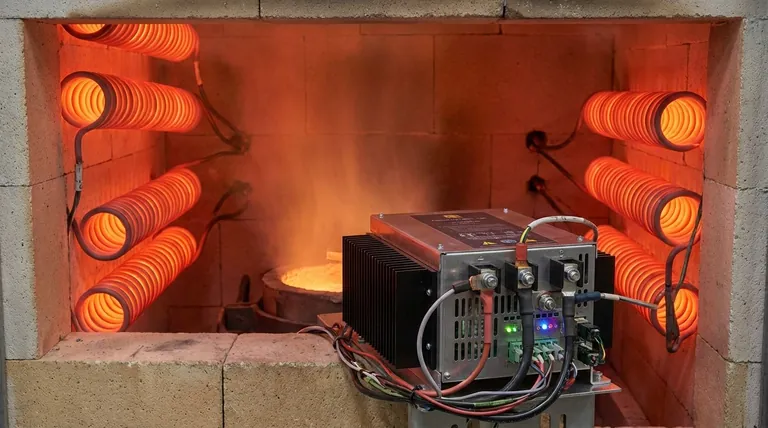
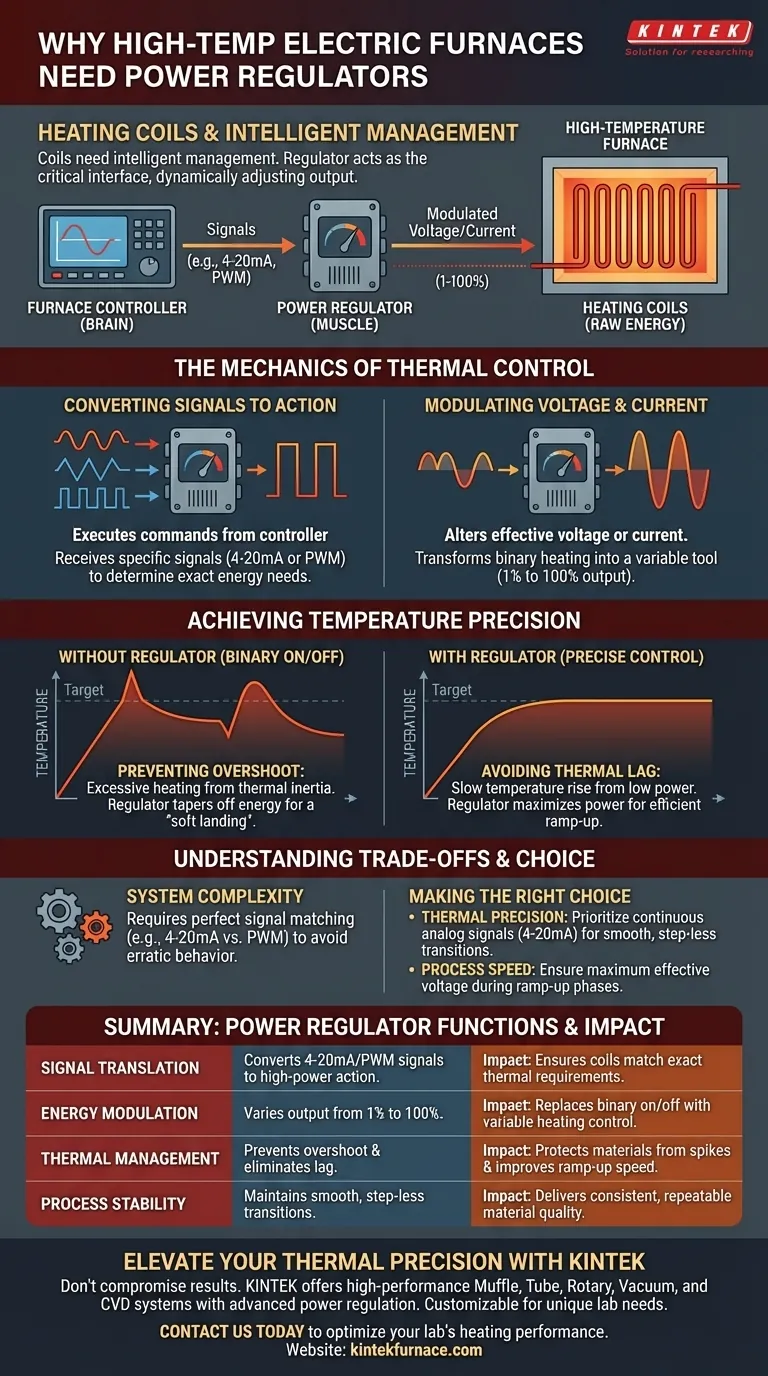
Heating coils in high-temperature furnaces are raw energy sources that require intelligent management to function correctly. Power regulators serve as the critical interface, dynamically adjusting the electrical output to the coils to match the specific thermal requirements of your metal processing application.
While the furnace controller acts as the brain, the power regulator acts as the muscle, translating low-voltage control signals into high-power adjustments. This modulation is the only way to transform raw electricity into precise, stable heat profiles without damaging temperature fluctuations.
The Mechanics of Thermal Control
Converting Signals to Action
Power regulators do not make decisions; they execute commands based on input from the furnace controller. They receive specific control signals, typically 4-20mA or Pulse Width Modulation (PWM).
These signals tell the regulator exactly how much energy the system requires at any specific moment to maintain the desired process state.
Modulating Voltage and Current
Upon receiving the control signal, the regulator alters the effective voltage or current delivered to the heating coils.
This capability transforms the heating element from a binary device (simply on or off) into a variable tool. It allows the furnace to supply anywhere from 1% to 100% of its potential output based on immediate needs.
Achieving Temperature Precision
Preventing Temperature Overshoot
A major risk in metal processing is excessive heating, often caused by thermal inertia when coils run at full power for too long.
Power regulators mitigate this by tapering off the energy input as the furnace approaches its setpoint. This "soft landing" prevents the temperature from spiking beyond the target range.
Avoiding Thermal Lag
Conversely, if the power delivery is too low or static, the system suffers from a slow temperature rise.
Regulators dynamically maximize power delivery during the initial ramp-up phases. This ensures the furnace reaches operating temperature efficiently without the delays associated with insufficient power.
Understanding the Trade-offs
System Complexity and Compatibility
While power regulators are essential for precision, they introduce a layer of complexity to the furnace design.
The regulator must be perfectly matched to the controller's signal type (e.g., 4-20mA vs. PWM) to function correctly. A mismatch in signal interpretation can lead to erratic heating behavior, defeating the purpose of the device.
Making the Right Choice for Your Goal
To optimize your furnace's performance, select a regulation strategy that aligns with your specific processing needs:
- If your primary focus is Thermal Precision: Prioritize regulators that support continuous analog signals (like 4-20mA) to ensure smooth, step-less power transitions.
- If your primary focus is Process Speed: Ensure your regulator is calibrated to deliver maximum effective voltage during ramp-up phases to eliminate slow temperature rise.
The correct power regulator turns a simple heating element into a precision instrument capable of complex thermal profiles.
Summary Table:
| Feature | Function of Power Regulator | Impact on Metal Processing |
|---|---|---|
| Signal Translation | Converts 4-20mA/PWM signals to high-power action | Ensures coils match exact thermal requirements |
| Energy Modulation | Varies output from 1% to 100% | Replaces binary on/off with variable heating control |
| Thermal Management | Prevents overshoot and eliminates thermal lag | Protects materials from spikes and improves ramp-up speed |
| Process Stability | Maintains smooth, step-less power transitions | Delivers consistent, repeatable material quality |
Elevate Your Thermal Precision with KINTEK
Don't let inefficient energy management compromise your metal processing results. Backed by expert R&D and manufacturing, KINTEK offers high-performance Muffle, Tube, Rotary, Vacuum, and CVD systems—all customizable with advanced power regulation to meet your unique laboratory needs.
Our precision-engineered high-temp furnaces ensure stable heat profiles, preventing temperature overshoot and reducing thermal lag for superior efficiency. Contact us today to discover how KINTEK can optimize your lab's heating performance.
Visual Guide
References
- Serdar Ekinci, Євген Зайцев. Efficient control strategy for electric furnace temperature regulation using quadratic interpolation optimization. DOI: 10.1038/s41598-024-84085-w
This article is also based on technical information from Kintek Furnace Knowledge Base .
Related Products
- High Temperature Muffle Oven Furnace for Laboratory Debinding and Pre Sintering
- 1400℃ High Temperature Laboratory Tube Furnace with Alumina Tube
- 1200℃ Muffle Oven Furnace for Laboratory
- 1700℃ High Temperature Laboratory Tube Furnace with Alumina Tube
- 1800℃ High Temperature Muffle Oven Furnace for Laboratory
People Also Ask
- Why is controlled heat treatment in a muffle furnace necessary for calcined clay? Achieve Optimal Pozzolanic Activity
- What role does a high-temperature muffle furnace play in STFO synthesis? Achieve Pure Perovskite Results
- What role does a high-temperature muffle furnace play in the formation of biochar catalysts? Master Catalyst Synthesis
- What role does a high-temperature muffle furnace play in the multi-stage synthesis of Li0.5MnFe1.5O4? Key to Pure Spinel
- What is the function of a laboratory high-temperature muffle furnace in niobate phosphor synthesis?



















