
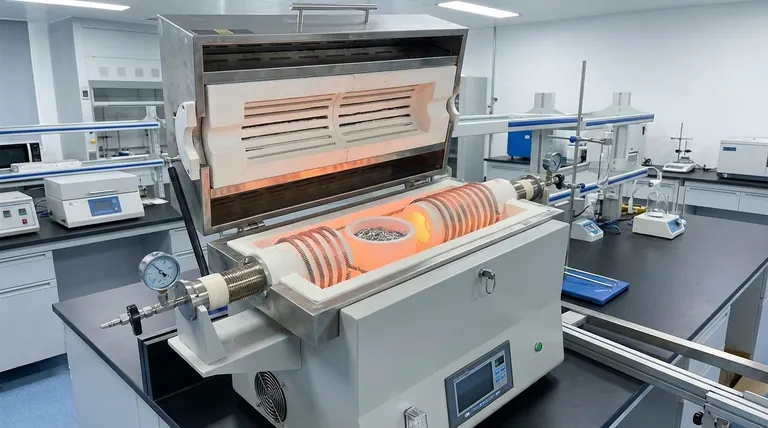
For resistive heating evaporation, the standard and most effective crucible material is high-purity alumina (aluminum oxide). This ceramic container is designed to hold the source material, such as magnesium, while resistance wires coiled around its exterior provide the necessary heat through radiation and conduction.
The choice of alumina is a critical engineering decision driven by a single, non-negotiable requirement: chemical inertness at extreme temperatures. This ensures the crucible does not react with the molten source material, preventing contamination and guaranteeing the purity of the final evaporated product.
Why Alumina is the Material of Choice
To understand why alumina is the industry standard, we must look at the demanding conditions of the evaporation process. The goal is to heat a source material until it evaporates, and the container holding it must not interfere.
Chemical Inertness at High Temperatures
At the high temperatures required for evaporation, many materials become highly reactive. Molten metals, such as magnesium, will aggressively react with and corrode unsuitable containers.
High-purity alumina (Al₂O₃) is a chemically stable ceramic. It acts as a completely inert vessel, meaning it will not react with or dissolve into the molten source material. This is the single most important property for this application.
Preventing Product Contamination
The primary consequence of a chemical reaction between the crucible and the source material is contamination. If the crucible material leaches into the melt, the purity of the resulting evaporated film or powder is compromised.
Using an inert alumina crucible ensures that the only material being evaporated is the source material itself, leading to a high-purity final product.
Excellent Thermal and Structural Stability
A crucible must maintain its structural integrity under intense thermal stress. Alumina possesses a very high melting point and excellent corrosion resistance, allowing it to withstand repeated heating and cooling cycles without degrading.
The system also uses alumina in other forms. Alumina fiber cotton is typically packed around the crucible to serve as thermal insulation, minimizing heat loss and directing the energy efficiently toward the source material.
Understanding the Core Principles
The selection of a crucible material is not an isolated choice. It is fundamentally tied to the principles of the heating method and the primary goal of the process.
The Goal: Material Purity
In processes like magnesium powder production, purity is the ultimate objective. The entire system—from the crucible to the insulation—is designed to prevent the introduction of foreign elements. The crucible is the first line of defense against contamination.
The Method: External Heating
In resistive heating, the crucible itself is not the heat source. Instead, resistance wires (like tungsten or molybdenum) are wrapped around the crucible's exterior.
This means the crucible material must be a good thermal conductor to efficiently transfer heat from the external coils to the internal source material, but it does not need to be electrically conductive. This distinguishes it from other methods where the crucible might be directly involved in heating.
Resistive vs. Inductive Heating
It's useful to contrast this with inductive heating. In that process, an electromagnetic coil generates eddy currents directly within the molten material, heating it from the inside out. While inductive systems may also use ceramic crucibles, the heating principle is fundamentally different and often more efficient, as it bypasses the need to heat the crucible first.
Making the Right Choice for Your Goal
Your choice of materials and system design should always reflect your primary objective.
- If your primary focus is achieving the highest material purity: You must use a high-purity alumina crucible to eliminate any risk of reaction and contamination.
- If your primary focus is process efficiency and stability: Ensure the alumina crucible is supported by proper thermal insulation, like alumina fiber cotton, to minimize energy waste and maintain stable temperatures.
- If you are designing a thermal evaporation system: Remember that in resistive heating, the crucible is a passive but critical component—it must contain the material without reacting while effectively transferring externally-applied heat.
Ultimately, selecting the correct crucible material is the foundation for achieving reliable and high-purity results in any thermal evaporation process.
Summary Table:
| Property | Benefit in Resistive Heating Evaporation |
|---|---|
| Chemical Inertness | Prevents reaction with molten source materials (e.g., magnesium), ensuring product purity. |
| High-Temperature Stability | Maintains structural integrity at extreme temperatures required for evaporation. |
| Excellent Thermal Conductivity | Efficiently transfers heat from external resistance wires to the source material. |
Achieve Unmatched Purity in Your Evaporation Process
Your research and production depend on the integrity of your materials. The right crucible is not just a container—it's the foundation of a contamination-free process.
KINTEK's high-purity alumina crucibles are engineered for excellence, providing:
- Guaranteed Chemical Inertness: Ensure your source material evaporates without contamination.
- Superior Thermal and Mechanical Stability: Withstand repeated high-temperature cycles for reliable, long-lasting performance.
- Optimized for Your System: Perfectly suited for use with resistive heating elements and alumina insulation.
Backed by expert R&D and manufacturing, KINTEK offers Muffle, Tube, Rotary, Vacuum, and CVD systems, along with crucibles and lab high-temp furnaces, all customizable for your unique needs.
Ready to eliminate contamination and enhance your results? Contact KINTEK today to discuss the ideal crucible solution for your application.
Visual Guide

Related Products
- 1400℃ High Temperature Laboratory Tube Furnace with Alumina Tube
- 1700℃ High Temperature Laboratory Tube Furnace with Alumina Tube
- Magnesium Extraction and Purification Condensing Tube Furnace
- Vacuum Induction Melting Furnace
People Also Ask
- How are high-temperature laboratory tube furnaces applied in long-term vacuum homogenization heat treatments for intermetallic samples?
- How do high-temperature laboratory tube furnaces ensure environmental stability? Precision Thermal Reduction Tips
- How are high-temperature tube furnaces applied in testing ceramic-supported alloy membranes? Insights
- What is the function of a furnace in CuAlMn alloy treatment? Achieve Perfect Microstructural Homogenization
- How does a laboratory high-temperature tube furnace contribute to the conversion of electrospun fibers? Expert Insights



