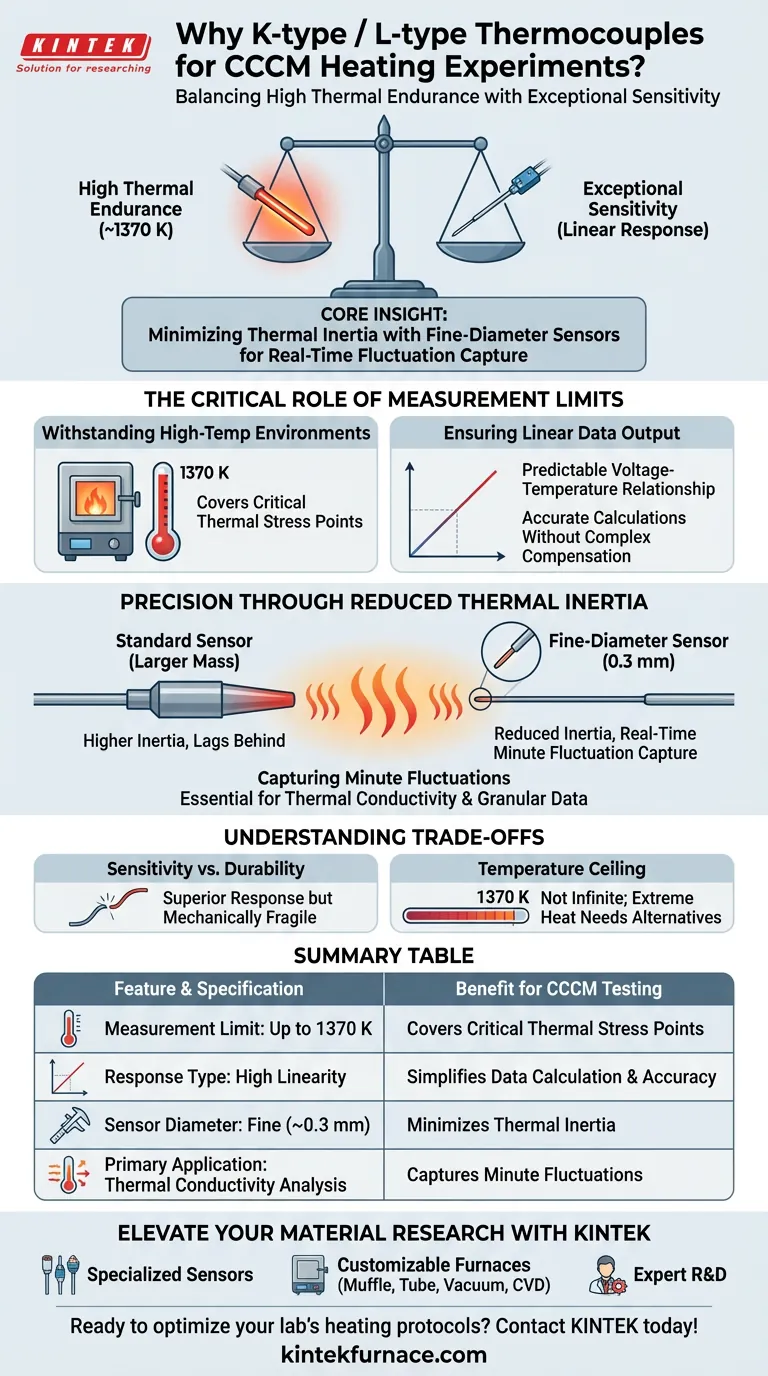
K-type (chromel-alumel) and L-type thermocouples are selected for Carbon-Carbon Composite Material (CCCM) experiments because they uniquely balance high thermal endurance with exceptional sensitivity. They provide a high measurement ceiling of approximately 1370 K while delivering the linear response required to accurately calculate thermal conductivity.
Core Insight: The selection of these thermocouples is not just about withstanding heat; it is about minimizing thermal inertia. By using fine-diameter sensors within this specific temperature range, researchers can capture the minute, real-time fluctuations necessary to characterize the material's internal thermal properties.
The Critical Role of Measurement Limits
Withstanding High-Temperature Environments
CCCM experiments often involve extreme heating conditions to test material resilience.
K-type and L-type thermocouples are utilized because they offer a high measurement limit of approximately 1370 K.
This range covers the critical thermal stress points required for most standard carbon composite testing protocols.
Ensuring Linear Data Output
Reliable data interpretation depends on a predictable relationship between voltage and temperature.
These thermocouples provide excellent linear response characteristics across their operating range.
This linearity ensures that the data remains accurate as temperatures rise, allowing researchers to track predefined thermal curves without complex compensation algorithms.
Precision Through Reduced Thermal Inertia
The Advantage of Fine Diameters
To maximize precision, these experiments often utilize thermocouples with a very fine diameter, typically around 0.3 mm.
The physical mass of the sensor significantly impacts its reaction speed.
A smaller diameter drastically reduces the thermal inertia of the sensor, meaning the sensor itself does not absorb significant heat or lag behind the actual environment temperature.
Capturing Minute Fluctuations
In CCCM analysis, calculating thermal conductivity requires detecting very subtle changes in heat transfer.
Reduced thermal inertia allows for the real-time capture of minute temperature fluctuations.
This level of sensitivity is essential for monitoring both the specimen surface and the interior core, providing the granular data needed for accurate thermal property calculations.
Understanding the Trade-offs
Sensitivity vs. Durability
While fine-diameter (0.3 mm) thermocouples provide superior response times, they are mechanically more fragile than standard industrial probes.
In rigorous testing environments, care must be taken to ensure the wire integrity is not compromised by physical stress or debris.
Temperature Ceilings
While 1370 K is sufficient for many CCCM experiments, it is not an infinite limit.
If an experiment pushes beyond this specific threshold into ultra-high temperature regimes, K-type sensors may degrade, requiring alternative non-contact measurement methods or tungsten-rhenium thermocouples.
Making the Right Choice for Your Goal
When configuring your CCCM experiment, select your sensor geometry based on your specific analytical needs:
- If your primary focus is Thermal Conductivity Calculations: Prioritize fine-diameter (0.3 mm) thermocouples to minimize thermal inertia and capture rapid, minute internal fluctuations.
- If your primary focus is General Furnace Monitoring: Ensure your thermocouples are integrated with high-temperature sealants to maintain airtightness and pressure balance, ensuring the accuracy of heat loss data.
Select the sensor that offers the highest fidelity for your specific data requirements, not just the highest temperature rating.
Summary Table:
| Feature | K-Type / L-Type Specification | Benefit for CCCM Testing |
|---|---|---|
| Measurement Limit | Up to 1370 K | Covers critical thermal stress points |
| Response Type | High Linearity | Simplifies data calculation and accuracy |
| Sensor Diameter | Fine (approx. 0.3 mm) | Minimizes thermal inertia for real-time tracking |
| Primary Application | Thermal Conductivity Analysis | Captures minute fluctuations in heat transfer |
Elevate Your Material Research with KINTEK
Precision in CCCM testing requires more than just high temperatures—it demands expert control and reliable data. KINTEK provides high-performance laboratory solutions, from specialized sensors to fully customizable Muffle, Tube, Vacuum, and CVD systems. Our expert R&D and manufacturing teams ensure every furnace is optimized for your unique thermal property calculations.
Ready to optimize your lab’s heating protocols? Contact KINTEK today to discuss your custom furnace requirements!
Visual Guide
References
- Dmytro Borovyk, D.I. Skliarenko. DETERMINATION OF THERMOPHYSICAL CHARACTERISTICS OF CARBON-CARBON MATERIALS BY A COMPUTATIONAL-EXPERIMENTAL METHOD. DOI: 10.31472/ttpe.4.2024.4
This article is also based on technical information from Kintek Furnace Knowledge Base .
Related Products
- Multi Heating Zones CVD Tube Furnace Machine for Chemical Vapor Deposition Equipment
- High Temperature Muffle Oven Furnace for Laboratory Debinding and Pre Sintering
- Multi Zone Laboratory Quartz Tube Furnace Tubular Furnace
- Vertical Laboratory Quartz Tube Furnace Tubular Furnace
- 1200℃ Muffle Oven Furnace for Laboratory
People Also Ask
- What is the function of a multi-zone tube furnace in CVD synthesis? Master 2D In2Se3 Nanosheet Precision
- What environmental protection applications utilize multi zone tube furnaces? Unlock Precision in Waste Treatment and Green Tech
- What role do multi zone tube furnaces play in new energy research? Unlock Precise Thermal Control for Innovation
- What temperature-related capabilities make multi zone tube furnaces valuable for research? Unlock Precision Thermal Control
- Why are multi zone tube furnaces particularly useful for nanomaterial research? Unlock Precise Thermal Control for Advanced Synthesis