
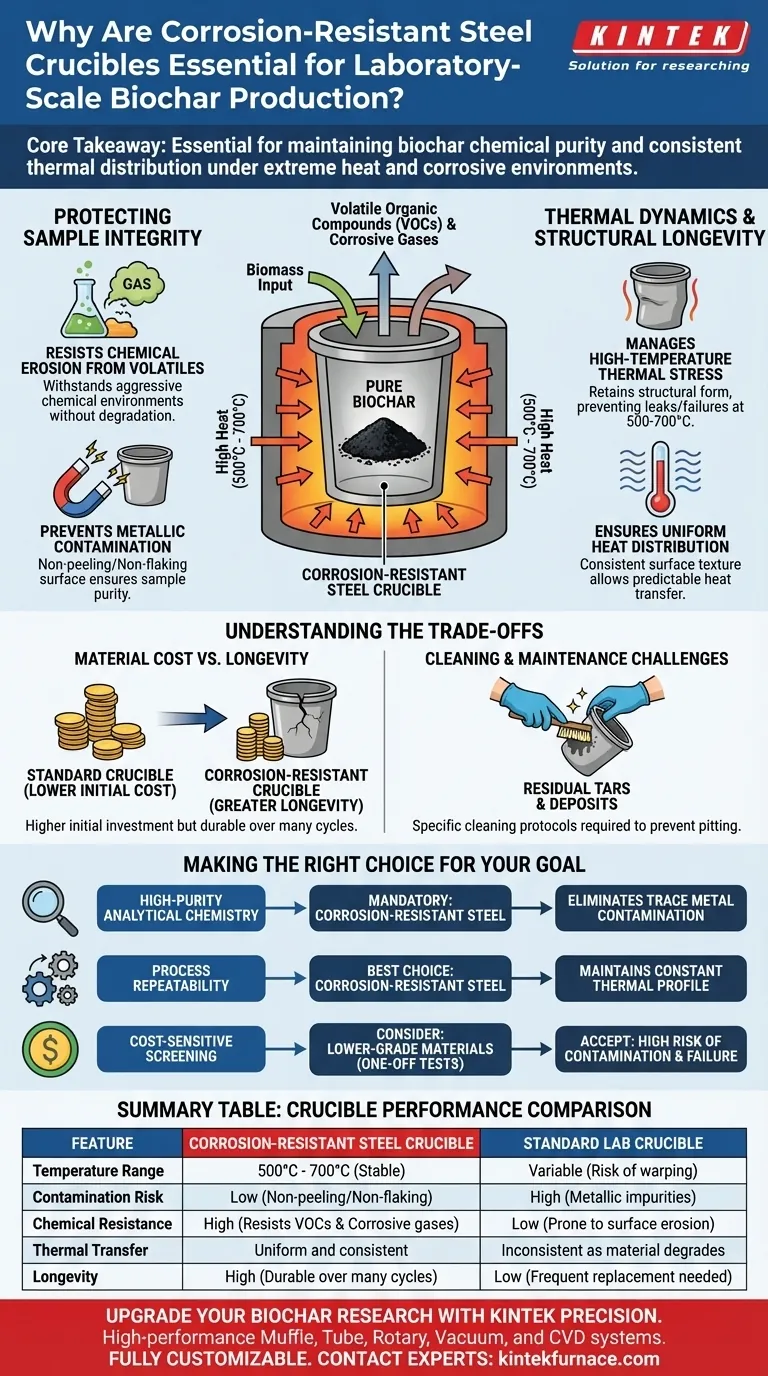
Corrosion-resistant steel crucibles are essential because laboratory-scale pyrolysis involves a combination of extreme heat and aggressive chemical environments. These specialized vessels prevent material degradation—such as peeling or flaking—that would otherwise contaminate the resulting biochar with metallic impurities. By maintaining their structural integrity at temperatures between 500°C and 700°C, they ensure both sample purity and consistent thermal distribution during the conversion process.
Core Takeaway: Choosing corrosion-resistant steel is a critical measure to protect the chemical purity of biochar from the corrosive gases and thermal stress inherent in high-temperature biomass processing.
Protecting Sample Integrity under Extreme Conditions
Resisting Chemical Erosion from Volatiles
During the pyrolysis of biomass digestate, the material releases a complex mixture of volatile organic compounds (VOCs) and corrosive gases.
Standard containers often react with these byproducts, leading to surface degradation. Corrosion-resistant steel is specifically engineered to withstand this chemical erosion without breaking down.
Preventing Metallic Contamination
If a crucible begins to peel or flake under stress, microscopic metal particles can integrate into the biochar.
Maintaining a closed pyrolysis environment free from these impurities is vital for accurate laboratory analysis. Corrosion-resistant materials ensure that the final biochar profile reflects the biomass source rather than the container.
Thermal Dynamics and Structural Longevity
Managing High-Temperature Thermal Stress
Pyrolysis typically occurs at temperatures ranging from 500°C to 700°C, which subjects the crucible to significant thermal stress.
Lower-grade materials may warp or become brittle after repeated heating cycles. Specialized steel retains its structural form, preventing leaks or mechanical failures during sensitive experiments.
Ensuring Uniform Heat Distribution
The efficiency of biochar production depends on uniform heating throughout the sample.
Corrosion-resistant crucibles maintain a consistent surface texture and thickness over time. This consistency allows for predictable heat transfer, ensuring the biomass reaches the required temperatures evenly.
Understanding the Trade-offs
Material Cost vs. Longevity
While corrosion-resistant steel crucibles require a higher initial investment than standard carbon steel or ceramic alternatives, they offer greater longevity.
Frequent replacement of degraded crucibles can lead to higher long-term costs and potential downtime in the lab.
Cleaning and Maintenance Challenges
Despite their resistance, these crucibles still require specific cleaning protocols to remove residual tars and carbon deposits.
Failure to clean them properly can lead to localized pitting over time, which may eventually compromise the "non-peeling" benefits of the steel.
Making the Right Choice for Your Goal
When selecting equipment for laboratory-scale biochar production, your material choice should align with your specific research parameters:
- If your primary focus is high-purity analytical chemistry: Corrosion-resistant steel is mandatory to eliminate the risk of trace metal contamination in your biochar samples.
- If your primary focus is process repeatability: These crucibles are the best choice because they maintain a constant thermal profile across dozens of heating cycles.
- If your primary focus is cost-sensitive screening: You may consider lower-grade materials for one-off tests, but you must accept the high risk of sample contamination and crucible failure.
Proper crucible selection is the foundation of reliable, uncontaminated biochar research in any high-temperature environment.
Summary Table:
| Feature | Corrosion-Resistant Steel Crucible | Standard Lab Crucible |
|---|---|---|
| Temperature Range | 500°C - 700°C (Stable) | Variable (Risk of warping) |
| Contamination Risk | Low (Non-peeling/Non-flaking) | High (Metallic impurities) |
| Chemical Resistance | High (Resists VOCs & corrosive gases) | Low (Prone to surface erosion) |
| Thermal Transfer | Uniform and consistent | Inconsistent as material degrades |
| Longevity | High (Durable over many cycles) | Low (Frequent replacement needed) |
Upgrade Your Biochar Research with KINTEK Precision
Don't let crucible degradation compromise your laboratory results. Backed by expert R&D and manufacturing, KINTEK offers a comprehensive range of high-performance Muffle, Tube, Rotary, Vacuum, and CVD systems, along with specialized lab high-temp furnace accessories. Whether you are processing biomass or engineering advanced materials, our systems are fully customizable to meet your unique temperature and purity requirements.
Ready to ensure consistent, contamination-free results? Contact our technical experts today to find the perfect thermal solution for your laboratory.
Visual Guide
References
- Van Ngoc Duong, Hynek Roubík. A novel treatment of biogas digestate waste for biochar production and its adsorption of methylene blue and malachite green in a binary system. DOI: 10.1002/bbb.2772
This article is also based on technical information from Kintek Furnace Knowledge Base .
Related Products
- Electric Rotary Kiln Pyrolysis Furnace Plant Machine Small Rotary Kiln Calciner
- Electric Rotary Kiln Continuous Working Small Rotary Furnace Kiln for Pyrolysis Plant Heating
People Also Ask
- What are the advantages of electric rotary kilns compared to fuel-fired ones? Boost Precision and Efficiency in Your Process
- What advantages do electric rotary kilns offer over fuel-based kilns? Boost Efficiency and Purity in Your Process
- What materials can be processed in an electric rotary kiln? Versatile Solutions for Advanced Materials
- What are the key components of a rotary kiln electric furnace? Unlock Efficient Thermal Processing
- What is the significance of the refractory lining in a rotary kiln electric furnace? Unlock Efficiency and Longevity

