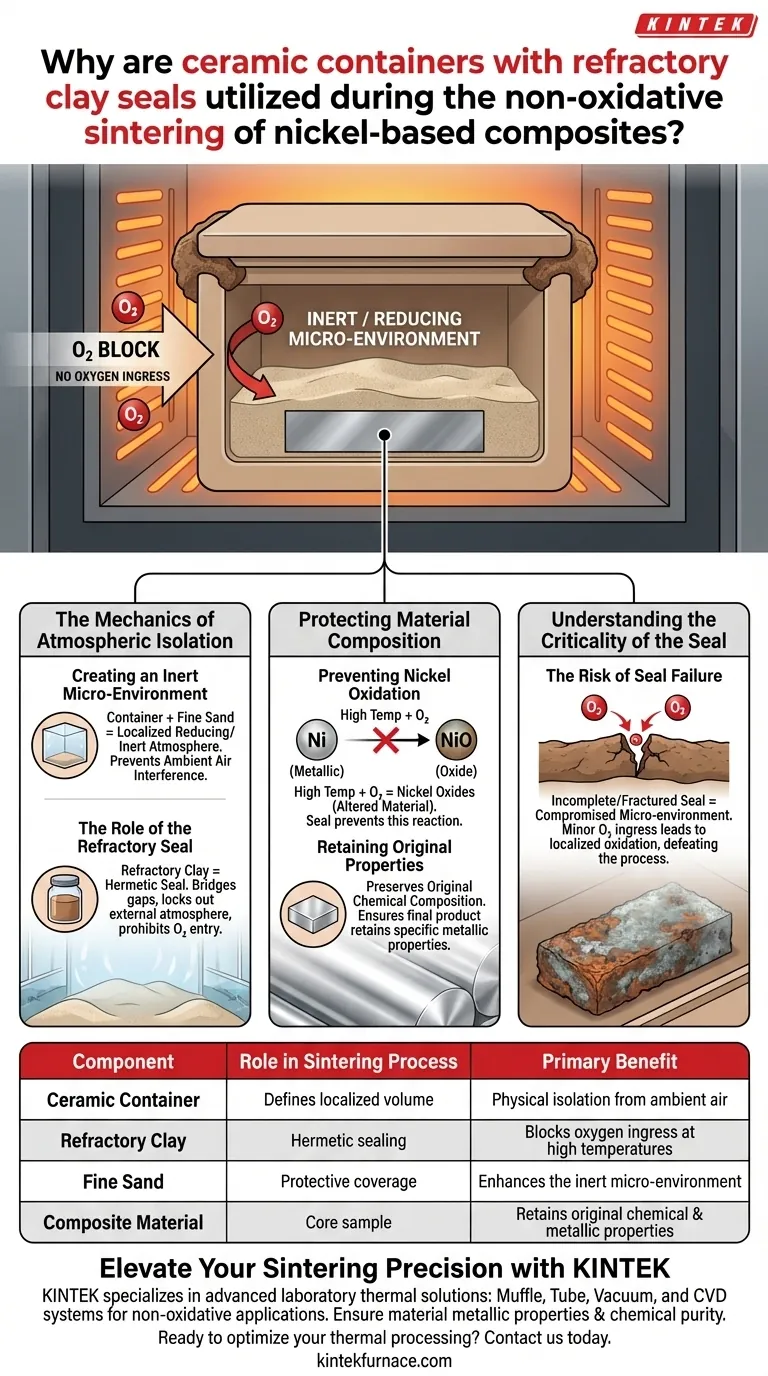
Ceramic containers sealed with refractory clay are critical tools for creating a protective micro-environment. This assembly, often used in conjunction with fine sand coverage, physically isolates the nickel-based composite from the surrounding air. By establishing this barrier, the setup prevents atmospheric oxygen from reaching the material during the high-temperature sintering process.
By excluding oxygen, this configuration maintains a localized reducing or inert atmosphere. This ensures the nickel remains in its metallic state and the composite retains its original chemical composition.

The Mechanics of Atmospheric Isolation
Creating an Inert Micro-Environment
The primary function of the ceramic container is to define a specific volume around the composite materials.
When combined with coverage materials like fine sand, the container fosters a localized atmosphere that is reducing or inert. This separation is essential for processes that must occur without the interference of ambient air.
The Role of the Refractory Seal
Refractory clay serves as the hermetic seal for this isolation system.
It bridges any gaps in the container assembly, effectively locking out the external atmosphere. This seal ensures that atmospheric oxygen is strictly prohibited from entering the sintering zone.
Protecting Material Composition
Preventing Nickel Oxidation
Metallic nickel is highly susceptible to oxidation when exposed to the high temperatures required for sintering.
If oxygen were allowed to contact the heated material, it would react with the nickel to form oxides. This reaction would fundamentally alter the material, stripping it of its metallic characteristics.
Retaining Original Properties
The ultimate goal of using this sealed configuration is to preserve the original chemical composition of the composite.
By successfully blocking oxidation, the process ensures that the final product retains the specific metallic properties intended by the design.
Understanding the Criticality of the Seal
The Risk of Seal Failure
The effectiveness of this entire process relies on the integrity of the refractory clay application.
If the seal is incomplete or fractures, the inert micro-environment will be compromised. Even minor oxygen ingress can lead to localized oxidation, defeating the purpose of the non-oxidative sintering process.
Making the Right Choice for Your Goal
To ensure the success of your sintering process, consider the following specific objectives:
- If your primary focus is Chemical Purity: Ensure the refractory clay seal is continuous and robust to prevent any interaction with atmospheric oxygen.
- If your primary focus is Material Performance: Rely on this sealed container method to maintain the metallic nickel phase, which is essential for the composite's mechanical properties.
Effective isolation is the single most important factor in preserving the integrity of nickel-based composites at high temperatures.
Summary Table:
| Component | Role in Sintering Process | Primary Benefit |
|---|---|---|
| Ceramic Container | Defines localized volume | Physical isolation from ambient air |
| Refractory Clay | Hermetic sealing | Blocks oxygen ingress at high temperatures |
| Fine Sand | Protective coverage | Enhances the inert micro-environment |
| Composite Material | Core sample | Retains original chemical & metallic properties |
Elevate Your Sintering Precision with KINTEK
Preserving the integrity of nickel-based composites requires more than just high temperatures—it demands total atmospheric control. KINTEK specializes in advanced laboratory thermal solutions, offering expert-engineered Muffle, Tube, Vacuum, and CVD systems designed for non-oxidative applications.
Whether you need customizable high-temp furnaces or R&D-backed manufacturing support, our team ensures your materials retain their metallic properties and chemical purity.
Ready to optimize your thermal processing? Contact us today to discover how KINTEK’s precision equipment can support your unique lab requirements.
Visual Guide
References
- Hermansyah Aziz, Ibrahim k. salman. Effect of Adding Nano Carbon on Density, Porosity, and Water Absorption of Nickel by Powder Metallurgy. DOI: 10.55810/2313-0083.1102
This article is also based on technical information from Kintek Furnace Knowledge Base .
Related Products
- High Temperature Muffle Oven Furnace for Laboratory Debinding and Pre Sintering
- Dental Porcelain Zirconia Sintering Ceramic Vacuum Press Furnace
- Vacuum Dental Porcelain Sintering Furnace for Dental Laboratories
- Chairside Dental Porcelain Zirconia Sintering Furnace with Transformer for Ceramic Restorations
- Ultra-High Vacuum Flange Aviation Plug Glass Sintered Airtight Circular Connector for KF ISO CF
People Also Ask
- What thermal phenomena occur during polymer binder burnout in ceramic green bodies? Lab Furnace Guide
- What role does a high-temperature muffle furnace play in STFO synthesis? Achieve Pure Perovskite Results
- Why is controlled heat treatment in a muffle furnace necessary for calcined clay? Achieve Optimal Pozzolanic Activity
- How does a high-temperature muffle furnace facilitate the formation of LaNbxAl1−xO3+δ perovskite structures? Key Roles
- What role does a high-temperature muffle furnace play in the multi-stage synthesis of Li0.5MnFe1.5O4? Key to Pure Spinel