
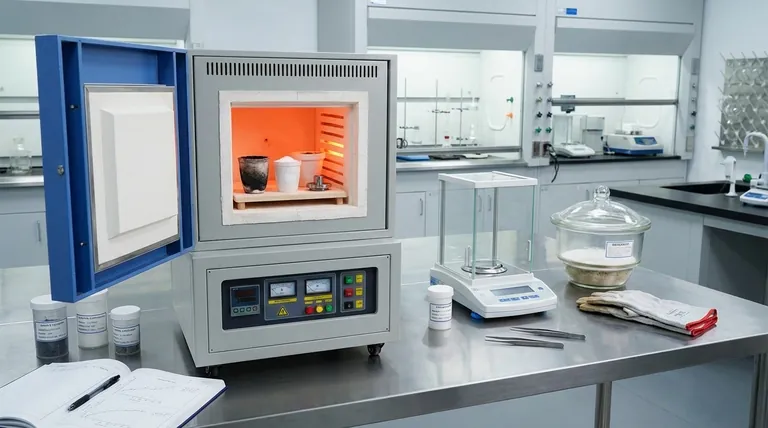
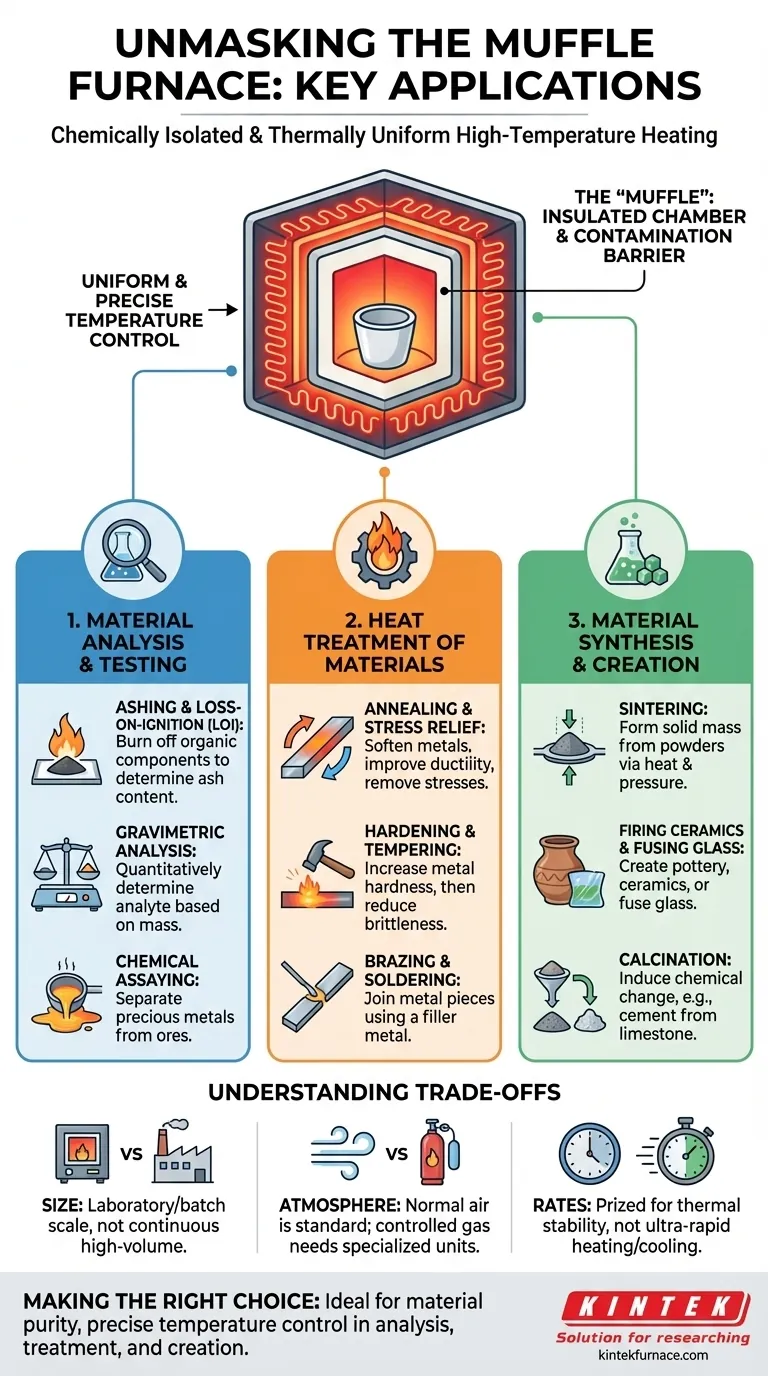
In essence, a muffle furnace is a high-temperature oven used for a wide range of applications where a sample must be heated without being contaminated by the heating source. Its most common uses fall into three primary categories: analyzing the composition of materials, heat-treating metals to alter their properties, and synthesizing new materials like ceramics or fused glass.
A muffle furnace's core value is not just its high heat, but its ability to provide a chemically isolated and thermally uniform environment. This makes it an indispensable tool for any process where material purity and precise temperature control are non-negotiable.
The Core Principle: Why a "Muffle"?
Before listing applications, it is critical to understand what makes this furnace unique. The name itself reveals its function.
The Insulated Chamber (The "Muffle")
A muffle furnace contains a primary chamber, or "muffle," made of a high-temperature, non-corrosive material like ceramic fiber. This chamber holds the sample.
Preventing Contamination
The heating elements are located outside this muffle. This design completely separates the material being heated from any byproducts of combustion or direct radiation from the electric elements, ensuring the sample's chemical purity is maintained.
Uniform and Precise Temperature Control
This separation, combined with heavy insulation, allows for an exceptionally uniform and stable temperature throughout the chamber. This is crucial for processes that are sensitive to thermal gradients.
Application Category 1: Material Analysis and Testing
A primary use for muffle furnaces is to determine the composition of a substance by seeing what remains after intense heating.
Ashing and Loss-on-Ignition (LOI)
This is perhaps the most common analytical use. A sample is weighed, heated in the furnace to burn off all organic and volatile components, and then weighed again.
The remaining material is the ash content, which is critical for quality control in industries like food, plastics, coal, and pharmaceuticals. The weight difference represents the loss-on-ignition.
Gravimetric Analysis
This is a broader category that includes ashing. It involves quantitatively determining an analyte based on its mass. The furnace is used to convert a substance into a form that can be accurately weighed.
Chemical Assaying
In mining and metallurgy, muffle furnaces are used in assaying to separate precious metals like gold and silver from their ores for measurement. The high, controlled heat is essential for the chemical reactions involved in this separation.
Application Category 2: Heat Treatment of Materials
Muffle furnaces are fundamental tools for altering the physical and mechanical properties of metals and other materials.
Annealing and Stress Relief
Annealing involves heating a metal to a specific temperature and then cooling it slowly. This process softens the metal, makes it easier to work with, and improves its ductility. A similar process, stress relief, removes internal stresses caused by manufacturing.
Hardening and Tempering
Hardening requires heating steel to a high temperature and then cooling it rapidly (quenching). This makes the metal harder but also more brittle. Tempering is a subsequent, lower-temperature heating process that reduces that brittleness while retaining most of the hardness.
Brazing and Soldering
These processes join metal pieces together using a filler metal that has a lower melting point than the base metals. The uniform heat of a muffle furnace is ideal for ensuring the filler metal flows evenly into the joint.
Application Category 3: Material Synthesis and Creation
The furnace is also a creative tool, used to form solid materials from powders or other precursors.
Sintering
Sintering is the process of compacting and forming a solid mass of material by heat and pressure without melting it to the point of liquefaction. It is widely used to create ceramic parts, metal components, and other powder metallurgy products.
Firing Ceramics and Fusing Glass
The controlled, predictable heating cycles of a muffle furnace are perfect for firing pottery and ceramics, where temperature must be increased and decreased at a precise rate to prevent cracking. Similarly, it's used for fusing pieces of glass together in art and manufacturing.
Calcination
Calcination involves heating a solid material to a high temperature to induce a chemical change, often by driving off a volatile component like carbon dioxide or water. A common example is the production of cement clinker from limestone.
Understanding the Trade-offs
While incredibly versatile, muffle furnaces are not the right tool for every high-temperature job.
Size and Batch Processing
Most muffle furnaces are designed for laboratory or small-scale batch work. They are generally not suited for continuous, high-volume industrial production lines, where a tunnel or conveyor furnace would be more appropriate.
Atmosphere Control
A standard muffle furnace operates with a normal air atmosphere. While this is fine for many applications like ashing, some processes (like heat-treating certain reactive metals) require an inert or controlled gas atmosphere. Furnaces with this capability are specialized and more costly.
Heating and Cooling Rates
Muffle furnaces are prized for their thermal stability. While they can reach high temperatures, they are not typically designed for extremely rapid heating or cooling cycles, which can stress the ceramic muffle.
Making the Right Choice for Your Goal
To determine if a muffle furnace fits your need, consider your end goal.
- If your primary focus is determining the inorganic content of a sample: A muffle furnace is the standard tool for ashing and loss-on-ignition analysis.
- If your primary focus is altering the properties of a metal part: A muffle furnace provides the precise temperature control needed for annealing, hardening, and tempering.
- If your primary focus is creating a solid object from powder or clay: A muffle furnace is ideal for sintering materials or firing ceramics due to its uniform heat.
Ultimately, the muffle furnace is a cornerstone of materials science, providing a clean, stable, and precise high-temperature environment for analysis, treatment, and creation.
Summary Table:
| Application Category | Key Processes | Common Industries |
|---|---|---|
| Material Analysis | Ashing, Gravimetric Analysis, Chemical Assaying | Food, Pharmaceuticals, Mining, Metallurgy |
| Heat Treatment | Annealing, Hardening, Tempering, Brazing | Metalworking, Manufacturing |
| Material Synthesis | Sintering, Firing Ceramics, Calcination | Ceramics, Glass, Powder Metallurgy |
Unlock the full potential of your laboratory with KINTEK's advanced high-temperature furnace solutions! Leveraging exceptional R&D and in-house manufacturing, we provide diverse labs with reliable muffle, tube, rotary, vacuum & atmosphere furnaces, and CVD/PECVD systems. Our strong deep customization capability ensures we can precisely meet your unique experimental needs for material analysis, heat treatment, or synthesis. Contact us today to discuss how our tailored solutions can enhance your processes and deliver superior results!
Visual Guide
Related Products
- 1400℃ Muffle Oven Furnace for Laboratory
- 1700℃ High Temperature Muffle Oven Furnace for Laboratory
- 1800℃ High Temperature Muffle Oven Furnace for Laboratory
- 1200℃ Muffle Oven Furnace for Laboratory
- High Temperature Muffle Oven Furnace for Laboratory Debinding and Pre Sintering
People Also Ask
- How does a high-temperature laboratory muffle furnace affect material properties? Transform Anodic Oxide Films Fast
- What is the primary function of a high-temperature laboratory muffle furnace in chemical synthesis? Achieve Precision.
- How is a laboratory high-temperature muffle furnace utilized to achieve the specific crystalline structure of LaFeO3 catalysts?
- What is the muffle furnace function in ilmenite oxidative roasting? Enhance Phase Change & Magnetic Separation
- What function does a muffle furnace perform in perovskite formation? Optimize Your Thermal Synthesis



















