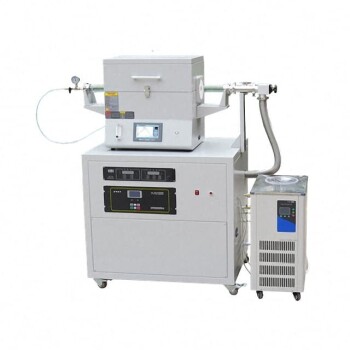
The technical advantages of tube furnaces center on their ability to provide a hermetically sealed, highly controlled microenvironment. Unlike standard laboratory ovens, tube furnaces allow for precise atmosphere manipulation—including vacuum, inert, and reducing conditions—while offering multi-zone temperature control essential for chemical vapor deposition (CVD) and complex material synthesis.
Core Takeaway: The fundamental advantage of a tube furnace lies in its sealed architecture, which isolates the reaction environment to enable nanometer-scale precision in chemical composition and material microstructure that is impossible to achieve in a vented laboratory oven.
Advanced Atmosphere and Vacuum Control
Superior Sealing for High-Purity Environments
A tube furnace utilizes a specialized, sealed tube structure (typically quartz or ceramic) to completely isolate the sample from the external environment. This design allows researchers to eliminate interference from atmospheric nitrogen or moisture, which is a common failure point in standard muffle furnaces.
Integration with Gas Delivery Systems
These systems are designed for seamless integration with mass flow controllers and multi-channel gas paths. This enables the exact introduction of specific reactive or protective gases, such as Argon or Hydrogen, to facilitate strictly anaerobic or reducing atmospheres.
High-Vacuum Compatibility
Because of their cylindrical geometry and specialized flanges, tube furnaces can easily maintain high-vacuum conditions. This is a prerequisite for specialized processes like the high-temperature sintering of oxygen-sensitive materials or the removal of volatile impurities.
Precision Thermal Management
Multi-Zone Gradient Control
Advanced tube furnaces often feature independent heating zones along the length of the tube. This allows for the creation of precise temperature gradients, where precursors can be vaporized in one zone and deposited on a substrate in another at a different, lower temperature.
Rapid Heating and Cooling Rates
The compact heating volume of a tube furnace allows for significantly higher thermal ramp rates compared to bulky laboratory ovens. This agility is critical for studying phase transformation kinetics and for the synthesis of specialized nanomaterials that require rapid thermal processing.
Enhanced Uniformity in Rotary Designs
In applications involving powders or granular materials, rotary tube furnaces provide continuous agitation. This ensures that gaseous precursors in a CVD process are distributed evenly across all particle surfaces, leading to superior coating uniformity.
Understanding the Trade-offs
Geometry and Volume Limitations
The primary limitation of a tube furnace is its physical form factor. The narrow diameter of the work tube restricts the size and shape of samples, making it unsuitable for large, bulky components that would easily fit in a standard box oven.
Material Stress and Maintenance
The furnace tube itself is a consumable component subject to thermal shock and chemical etching. High-temperature operations or rapid cycling can lead to tube failure, requiring more frequent maintenance and monitoring than the fixed refractory linings of standard ovens.
Pressure Constraints
While excellent for vacuum, standard furnace tubes are not designed to handle high internal pressures. Attempting to conduct high-pressure atmospheric treatments without specialized, heavy-walled vessels can lead to catastrophic tube rupture.
How to Apply This to Your Project
When deciding between a tube furnace and a standard laboratory oven, your choice should be dictated by the specific requirements of your material's chemistry and the scale of your process.
- If your primary focus is High-Purity Thin Films or CVD: Utilize a multi-zone tube furnace to achieve the necessary atmospheric isolation and precise precursor transport.
- If your primary focus is Large Batch Heat Treatment: A standard laboratory oven or muffle furnace is preferable due to its larger internal volume and ease of loading.
- If your primary focus is Uniform Powder Coating: Select a rotary tube furnace to ensure that all surfaces of the particulate matter are equally exposed to the reaction gas.
- If your primary focus is Oxygen-Sensitive Sintering: Opt for a tube furnace equipped with high-vacuum flanges and a hydrogen-compatible safety system to prevent oxidation.
By aligning the specific atmospheric and thermal capabilities of a tube furnace with your experimental goals, you can achieve a level of material precision that standard heating equipment simply cannot provide.
Summary Table:
| Feature | Tube Furnace Advantage | Standard Laboratory Oven |
|---|---|---|
| Atmosphere Control | Hermetically sealed; supports vacuum, inert, & reducing gases | Vented design; primarily for ambient atmosphere |
| Thermal Precision | Multi-zone heating for precise temperature gradients | Uniform single-zone heating for bulk batches |
| Processing Speed | Rapid heating and cooling rates due to compact volume | Slower thermal ramp rates in larger chambers |
| Applications | Ideal for CVD, thin films, and powder coating | Best for bulk heat treatment and drying |
| Material Purity | High isolation prevents atmospheric contamination | Higher risk of interference from ambient air |
Unlock Precision with KINTEK High-Temperature Solutions
Are you looking to achieve nanometer-scale precision in your chemical vapor deposition or atmospheric treatments? KINTEK specializes in high-performance laboratory equipment designed for the most demanding research environments.
We offer a comprehensive range of customizable furnaces to fit your exact needs:
- Advanced Tube Furnaces: Multi-zone and rotary designs optimized for CVD and thin-film synthesis.
- High-Temp Systems: Muffle, vacuum, atmosphere, dental, and induction melting furnaces.
- Custom Engineering: Every furnace can be tailored for unique thermal profiles and material requirements.
Don't let equipment limitations hinder your material innovation. Contact KINTEK today to consult with our experts and secure the reliability and purity your lab deserves!
References
- Xiang Zhong, Jianfeng Yao. Photochemical Synthesis of Porous Triazine‐/Heptazine‐Based Carbon Nitride Homojunction for Efficient Overall Water Splitting. DOI: 10.1002/cssc.202202059
This article is also based on technical information from Kintek Furnace Knowledge Base .
Related Products
- Vacuum Sealed Continuous Working Rotary Tube Furnace Rotating Tube Furnace
- 1400℃ High Temperature Laboratory Tube Furnace with Alumina Tube
- 1700℃ High Temperature Laboratory Tube Furnace with Alumina Tube
- 1200℃ Split Tube Furnace Laboratory Quartz Tube Furnace with Quartz Tube
- Vertical Laboratory Quartz Tube Furnace Tubular Furnace
People Also Ask
- What is the purpose of rotary tube furnaces? Achieve Uniform Heat Treatment for Powders and Granules
- What are the key advantages of using a rotary tube furnace? Achieve Dynamic, Uniform Heating for Powders
- How does the amount of material processed vary between batch and continuous rotary tube furnaces? Scale Your Production Efficiently
- What are the advantages of rotary tube furnaces in fuel compatibility? Boost Efficiency and Cut Costs
- What is the temperature range of some rotary tube furnaces? Achieve Uniform Heating Up to 1200°C