
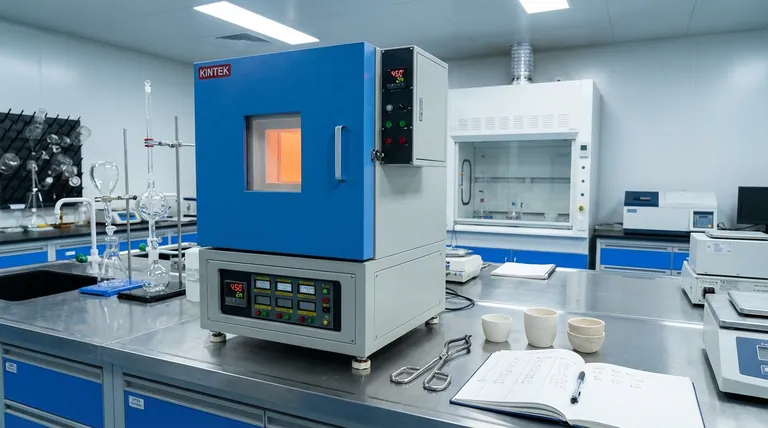
To successfully convert Bismuth Oxyiodide (BiOI) into Bismuth Vanadate (BiVO4), a high-temperature muffle furnace must provide a strictly controlled heating rate of 2°C per minute up to a target temperature of 450°C. Upon reaching this peak, the system must maintain a constant temperature for a duration of exactly 2 hours to facilitate the necessary solid-phase reaction.
The conversion of BiOI to BiVO4 is not simply about reaching a high temperature; it requires a slow, precise thermal ramp and a sustained dwell time to ensure the formation of a stable, uniform, and structurally sound monoclinic scheelite-type thin film.
The Critical Thermal Parameters
Achieving the correct crystal structure requires adherence to specific thermal mechanics. The high-temperature muffle furnace acts as a precision instrument to drive the solid-phase reaction.
The Necessity of a Slow Ramp Rate
The furnace must be programmed to increase temperature at a rate of 2°C per minute.
This controlled ascent is slower than standard rapid heating protocols. It prevents thermal shock and allows the material to adjust gradually, ensuring the precursor materials react uniformly rather than chaotically.
The Target Dwell Temperature
The reaction requires a sustained hold at 450°C.
At this specific temperature, the thermodynamic conditions are ideal for transforming the Bismuth Oxyiodide structure. Deviating significantly from this temperature could result in incomplete conversion or the formation of unwanted secondary phases.
The Duration of Phase Transformation
The furnace must maintain the 450°C environment for a continuous 2-hour period.
This duration provides sufficient time for the diffusion processes required in a solid-phase reaction to complete. It ensures the entire film, not just the surface, undergoes the transformation.
The Role of the Muffle Furnace Environment
Beyond the raw numbers, the muffle furnace provides the stability required for high-quality material synthesis.
Achieving the Monoclinic Structure
The ultimate goal of this thermal treatment is to create monoclinic scheelite-type BiVO4.
This specific crystal structure is essential for the material's performance. The precise thermal history provided by the furnace dictates whether the atoms arrange themselves into this highly active configuration.
Ensuring Uniformity and Stability
A muffle furnace isolates the sample from direct fuel combustion and external fluctuations.
This isolation ensures that the heat distribution is uniform across the sample. The result is a photocatalytic thin film that is structurally stable and possesses consistent properties across its entire surface.
Understanding the Trade-offs
While the specified parameters are optimal for the BiOI to BiVO4 conversion, understanding the limitations of thermal processing is vital for troubleshooting.
The Risk of Rapid Heating
It is often tempting to increase the ramp rate to save time.
However, exceeding the 2°C per minute rate risks creating defects in the thin film. Rapid heating can induce stress that leads to cracking or poor adhesion to the substrate, compromising the film's structural soundness.
Sensitivity to Temperature Fluctuations
The process relies on a solid-phase reaction, which is diffusion-limited and temperature-sensitive.
If the furnace cannot maintain a stable 450°C—fluctuating significantly above or below—the phase transformation may be partial. This results in a material with lower photocatalytic efficiency due to mixed crystal phases.
Making the Right Choice for Your Goal
To maximize the quality of your Bismuth Vanadate thin films, apply these thermal principles to your specific objectives:
- If your primary focus is structural integrity: Prioritize the 2°C/min heating rate to minimize thermal stress and prevent film cracking during the ramp-up phase.
- If your primary focus is phase purity: Ensure the furnace holds strictly at 450°C for the full 2 hours, allowing the solid-phase reaction to convert all BiOI precursor into the desired BiVO4 crystal structure.
Precision in your thermal protocol is the defining factor in synthesizing high-performance photocatalytic materials.
Summary Table:
| Parameter | Target Specification | Purpose |
|---|---|---|
| Heating Ramp Rate | 2°C per minute | Prevents thermal shock and ensures uniform reaction |
| Target Temperature | 450°C | Optimal thermodynamic point for BiOI transformation |
| Dwell Time | 2 Hours | Completes diffusion processes for solid-phase reaction |
| Final Crystal Phase | Monoclinic Scheelite-type | Maximizes photocatalytic activity and material stability |
Elevate Your Material Synthesis Precision with KINTEK
Achieving the perfect monoclinic scheelite-type BiVO4 structure requires more than just heat; it requires absolute thermal control. KINTEK provides the advanced high-temperature solutions necessary for your most sensitive laboratory transformations.
Backed by expert R&D and world-class manufacturing, we offer a full range of Muffle, Tube, Rotary, Vacuum, and CVD systems. Whether you are developing thin films or complex catalysts, our furnaces are fully customizable to meet your specific ramp rates and dwell requirements.
Ready to optimize your thermal protocols? Contact KINTEK today to find the perfect furnace for your lab!
Visual Guide

References
- Zhimin Niu, Desong Wang. Ultralow charge–discharge voltage gap of 0.05 V in sunlight‐responsive neutral aqueous Zn–air battery. DOI: 10.1002/cey2.535
This article is also based on technical information from Kintek Furnace Knowledge Base .
Related Products
- 1700℃ High Temperature Muffle Oven Furnace for Laboratory
- 1800℃ High Temperature Muffle Oven Furnace for Laboratory
- 1200℃ Muffle Oven Furnace for Laboratory
- 1400℃ Muffle Oven Furnace for Laboratory
- Laboratory Muffle Oven Furnace with Bottom Lifting
People Also Ask
- What is the primary function of a high-temperature laboratory muffle furnace in chemical synthesis? Achieve Precision.
- How does a high-temperature laboratory muffle furnace affect material properties? Transform Anodic Oxide Films Fast
- What role does a muffle furnace play in BCZY712 electrolyte powder production? Achieve Perfect Phase Purity
- What role does a muffle furnace play in sintering photocathodes? Enhance Electrode Conductivity & Catalytic Activity
- What is the role of a high-temperature muffle furnace in guava leaf carbonization? Master Precise Pyrolysis Control



















