
Thermal processing coupled with constant tensile stress serves as the fundamental stabilization mechanism for Polyvinylidene Fluoride (PVDF) fiber membranes. This precise annealing treatment eliminates manufacturing defects and locks the fiber structure into a state ready for advanced electrical applications.
The core objective of this thermal treatment is to resolve the mechanical history of the fiber. By eliminating residual stresses and stabilizing the crystal structure, the process creates the necessary physical environment for efficient dipole flipping during subsequent polarization.
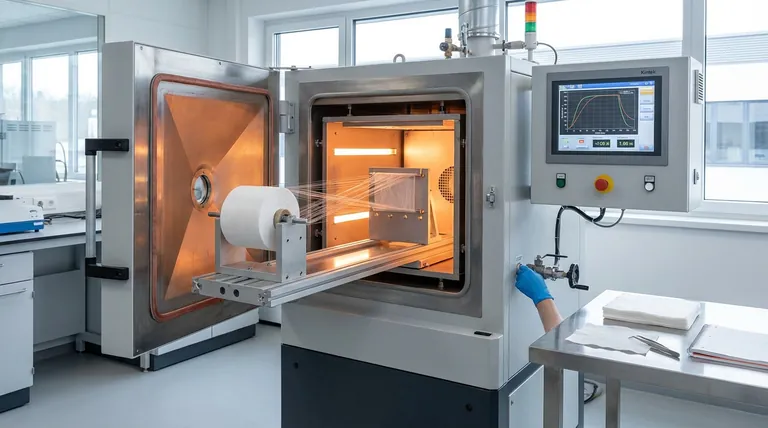
The Mechanics of Stabilization
The Role of Controlled Annealing
Thermal processing in this context functions as an annealing stage. By subjecting the fibers to precise temperature control, you allow the material to relax at a molecular level without losing its form.
Managing Stretch Ratios
This process is not static; it occurs while the fibers are held at preset stretch ratios. Maintaining specific dimensions during heating ensures that the alignment achieved during earlier processing is preserved rather than lost to thermal retraction.
Eliminating Manufacturing Stress
The primary mechanical benefit is the removal of residual stresses. These stresses are inevitably generated during the initial spinning process. If left untreated, they can cause dimensional instability or mechanical failure; thermal processing effectively neutralizes them.
Preparing for Electrical Performance
Stabilizing the Crystal Structure
Beyond simple stress relief, heat and tension work together to stabilize the crystal structure of the PVDF. This structural organization is critical for ensuring the material's properties remain consistent over time.
Enabling Dipole Movement
The ultimate goal of this stabilization is to prepare the material for electrical functionality. The treatment creates favorable conditions for dipole flipping.
The Link to Polarization
This step is a prerequisite for the subsequent electrical polarization stage. Without this thermal and mechanical preparation, the dipoles within the material would not be sufficiently free or aligned to respond effectively to the polarization process.
Understanding the Critical Variables
The Necessity of Precision
The reference emphasizes "precise" temperature control for a reason. Deviating from the optimal thermal window can either fail to relieve stress (if too cool) or degrade the crystal structure (if too hot).
The Requirement of Constant Tension
Tensile stress must remain constant throughout the process. Fluctuating tension allows the fibers to relax unpredictably, which undermines the alignment necessary for the crystal structure to stabilize correctly.
Making the Right Choice for Your Goal
To optimize your PVDF membrane processing, consider your primary objective:
- If your primary focus is mechanical longevity: Prioritize the elimination of residual stresses to prevent warping or failure after the spinning process.
- If your primary focus is piezoelectric performance: Focus on maintaining constant tensile stress to ensure the crystal structure is perfectly primed for dipole flipping during polarization.
Effective stabilization is the bridge between a raw spun fiber and a functional, high-performance membrane.
Summary Table:
| Stabilization Factor | Mechanism | Primary Outcome |
|---|---|---|
| Precise Temperature | Controlled Annealing | Eliminates residual stresses & molecular defects |
| Constant Tensile Stress | Stretch Ratio Management | Prevents thermal retraction & maintains alignment |
| Structural Alignment | Crystal Stabilization | Primes material for electrical polarization |
| Dipole Management | Molecular Conditioning | Facilitates dipole flipping for piezoelectricity |
Maximize Your PVDF Membrane Performance with KINTEK
Precise stabilization requires industrial-grade accuracy. KINTEK provides high-performance thermal solutions designed to bridge the gap between raw spun fiber and functional membranes. Backed by expert R&D and manufacturing, KINTEK offers Muffle, Tube, Rotary, Vacuum, and CVD systems, all customizable for your unique stabilization needs.
Whether you are prioritizing mechanical longevity or piezoelectric efficiency, our lab high-temp furnaces deliver the uniform heating and stability your research demands.
Upgrade your thermal processing—Contact KINTEK today
Visual Guide

References
- Asra Tariq, Ghaus Rizvi. Amplifying the Sensitivity of Electrospun Polyvinylidene Fluoride Piezoelectric Sensors Through Electrical Polarization Process for Low-Frequency Applications. DOI: 10.3390/fib13010005
This article is also based on technical information from Kintek Furnace Knowledge Base .
Related Products
- Vacuum Heat Treat Furnace with Ceramic Fiber Liner
- Laboratory Quartz Tube Furnace RTP Heating Tubular Furnace
- Vacuum Heat Treat Sintering Furnace Molybdenum Wire Vacuum Sintering Furnace
- 2200 ℃ Graphite Vacuum Heat Treat Furnace
- Vertical Laboratory Quartz Tube Furnace Tubular Furnace
People Also Ask
- How does vacuum heat treating affect the grain structure of metal alloys? Achieve Precise Microstructure Control
- What are the benefits of using vacuum heat treating furnaces for metal alloys? Achieve Superior Metal Properties and Performance
- What is one of the most important uses of vacuum heat treating furnaces in aerospace? Achieve Superior Strength in Aircraft Alloys
- How does a vacuum heat treat furnace work? Achieve Pristine, High-Performance Results
- What is the difference between heat treat and vacuum heat treat? Achieve Superior Metal Properties with Pristine Finishes




