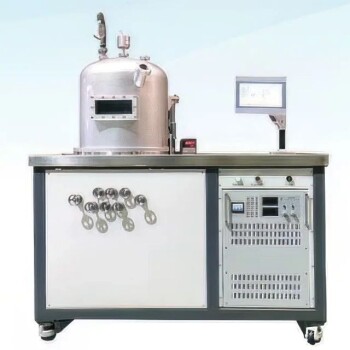
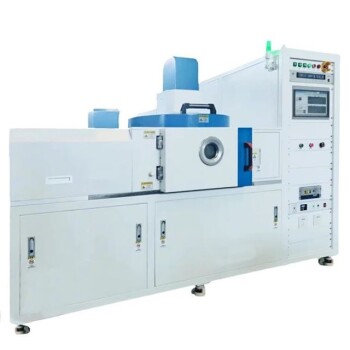
Chemical Vapor Deposition (CVD) equipment functions as a precision reactor used to synthesize and process composite nanomaterials. It creates a controlled multi-component gas environment—typically using an argon-hydrogen mixture—that is essential for reducing metal oxides loaded within carbon pores into active metal nanoparticles.
Core Takeaway CVD equipment enables the transformation of precursor materials into high-performance composites by strictly governing the reduction temperature and gas atmosphere. This precise control prevents particle aggregation, ensuring the material retains the high specific surface area necessary for optimal catalytic activity.
The Mechanism of Nanoparticle Synthesis
Creating the Reduction Environment
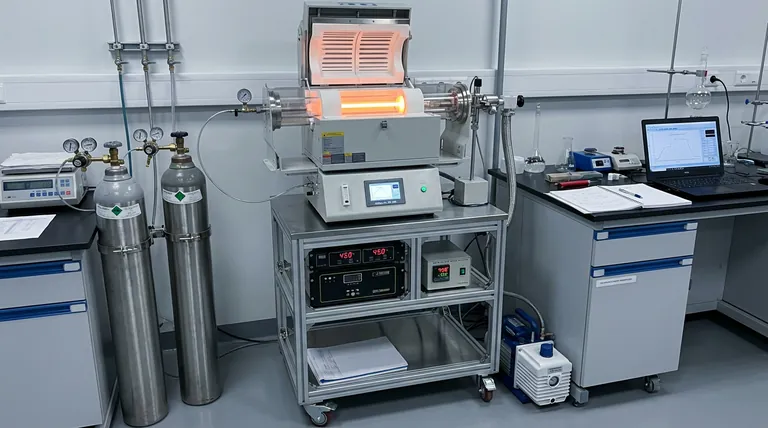
The primary role of CVD equipment in this context is to provide a stable, manageable atmosphere for chemical reduction.
By introducing a specific argon-hydrogen gas mixture, the equipment facilitates the reduction of metal oxides that have been loaded into the pores of a carbon substrate.
This gas phase interaction allows for deep penetration into the material's structure, ensuring internal surfaces are treated effectively.
From Precursor to Composite
CVD systems are designed to transport volatile precursors into a reaction chamber where they decompose or react.
In the processing of composite nanomaterials, this often involves converting solid or gas precursors into a desired coating or particle form.
The equipment ensures that these chemical by-products react specifically on the heated substrate, adhering to the surface to form a cohesive composite structure.
Critical Control Parameters
Temperature Regulation
The most vital function of the CVD equipment is maintaining the reduction temperature within a specific window, typically between 300 °C and 500 °C.
Operating within this range is critical for controlling the growth rate of metal particles.
If the temperature is too high, particles may grow too rapidly or merge; precise thermal control prevents this aggregation.
Preserving Surface Area
By preventing particle aggregation, the equipment protects the high specific surface area of the nanomaterial.
This is directly linked to the material's performance: smaller, well-distributed particles offer more active sites for chemical reactions.
Consequently, the equipment’s ability to stabilize these conditions is what guarantees the final catalytic activity of the composite.
Understanding the Trade-offs
Complexity vs. Uniformity
CVD allows for the coating of complex, contoured surfaces and porous structures with exceptional uniformity.
However, achieving this requires sophisticated "vacuum" and "pyrolysis" chambers to manage the interactions of radical monomers and gases.
While the output is a high-purity, uniform coating, the process demands rigorous maintenance of vacuum seals and thermal controllers to avoid defects.
Scalability vs. Cost
The CVD process is scalable and can produce large-area depositions, making it suitable for industrial applications like semiconductor or solar cell manufacturing.
Yet, the requirement for high-temperature resistance and specialized precursor handling can increase operational complexity compared to simpler, less precise coating methods.
Making the Right Choice for Your Goal
To maximize the efficacy of Chemical Vapor Deposition in your processing pipeline, consider your specific material requirements:
- If your primary focus is Catalytic Performance: Prioritize precise temperature control (300–500 °C) to prevent aggregation and maximize active surface area.
- If your primary focus is Material Purity: Ensure your equipment can maintain a rigorous vacuum and gas flow balance to expel unreacted precursors and by-products.
CVD equipment is ultimately a tool for imposing order on chaos, allowing you to engineer nanostructures with exact specifications by mastering the reaction environment.
Summary Table:
| Feature | Role in Nanomaterial Processing | Benefit for Composites |
|---|---|---|
| Gas Environment | Provides Argon-Hydrogen mixtures | Efficiently reduces metal oxides into active nanoparticles |
| Thermal Control | Regulates temperature (300°C - 500°C) | Prevents particle aggregation and maintains high surface area |
| Precursor Delivery | Transports volatile chemical precursors | Ensures uniform coating of complex, porous carbon structures |
| Atmosphere Stability | Maintains vacuum and pyrolysis conditions | Guarantees high-purity deposition and material consistency |
Elevate Your Nanomaterial Research with KINTEK
Precision is the difference between aggregation and high-performance catalytic activity. KINTEK provides industry-leading CVD systems, Tube furnaces, and Vacuum solutions specifically designed to meet the rigorous demands of nanomaterial synthesis.
Backed by expert R&D and manufacturing, our systems are fully customizable to your unique temperature and gas-flow requirements, ensuring your lab achieves maximum specific surface area and material purity.
Ready to engineer order from chaos? Contact us today to discuss your custom CVD furnace needs.
Visual Guide

References
- Bakhytzhan Lesbayev, Ayazhan Zhamash. Preparation of Nanoporous Carbon from Rice Husk with Improved Textural Characteristics for Hydrogen Sorption. DOI: 10.3390/jcs8020074
This article is also based on technical information from Kintek Furnace Knowledge Base .
Related Products
- HFCVD Machine System Equipment for Drawing Die Nano Diamond Coating
- Custom Made Versatile CVD Tube Furnace Chemical Vapor Deposition CVD Equipment Machine
- MPCVD Machine System Reactor Bell-jar Resonator for Lab and Diamond Growth
- 915MHz MPCVD Diamond Machine Microwave Plasma Chemical Vapor Deposition System Reactor
- Multi Heating Zones CVD Tube Furnace Machine for Chemical Vapor Deposition Equipment
People Also Ask
- What is Hot-filament Chemical Vapor Deposition (HFCVD)? Achieve High-Quality Thin Films with Precision Control
- What are the equipment for chemical vapor deposition? A Guide to the 5 Essential Components
- What is the significance of the vacuum pressure control system in the CVD coating process for powders?
- What is the function of high-purity Argon (Ar) gas during CVD? Optimize Your Thin Film Uniformity and Purity
- What are the advantages of using Chemical Vapor Deposition (CVD) for coating turbine blades? Enhance Life & Performance