
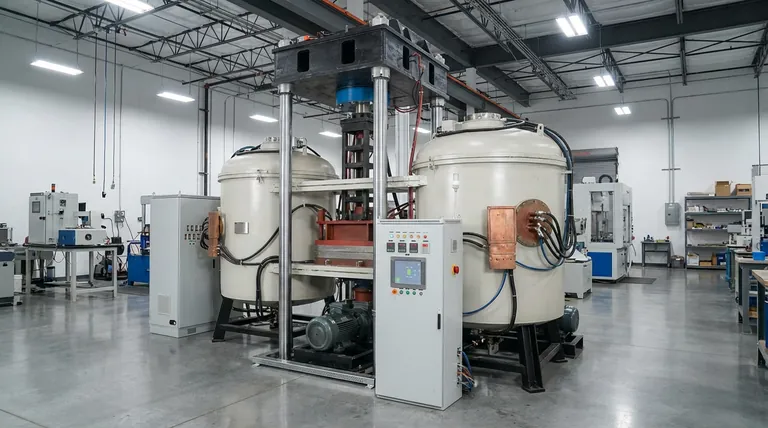
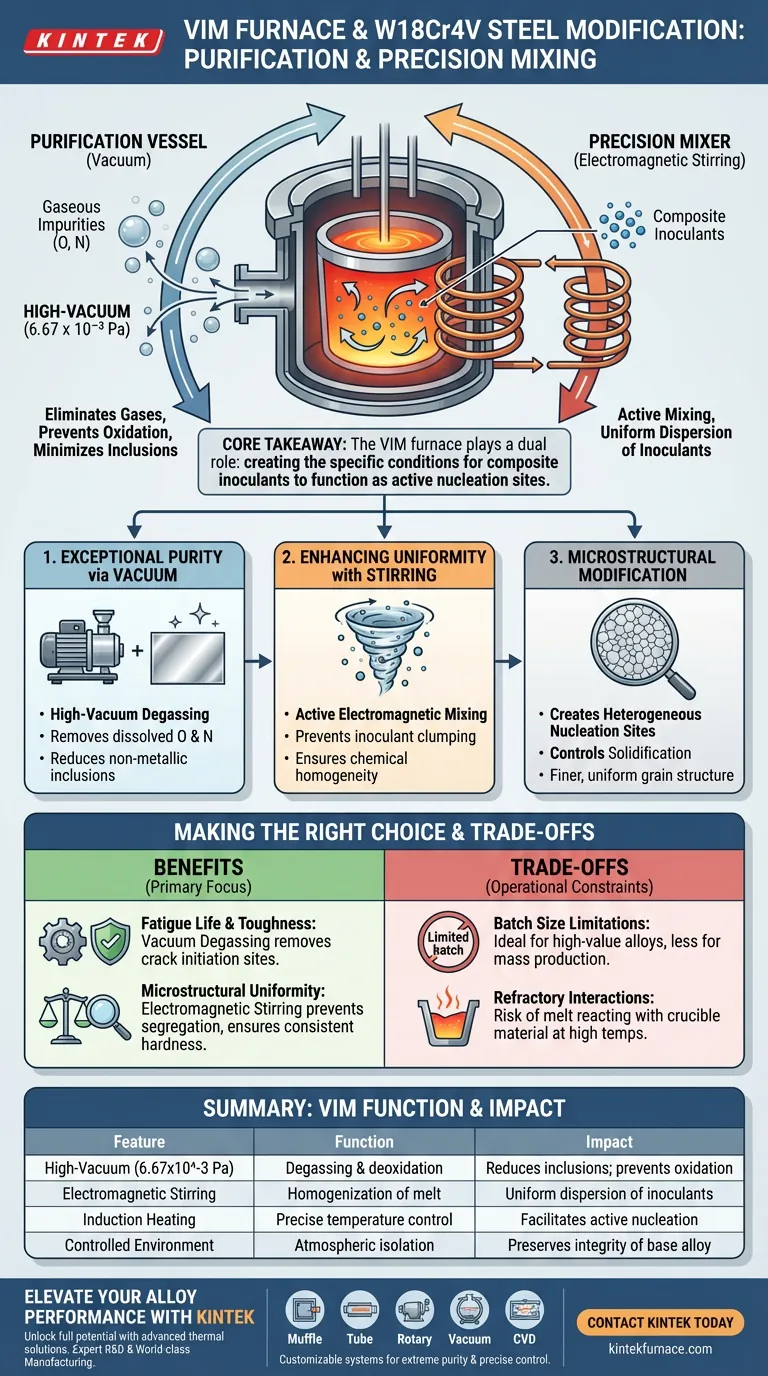
A vacuum induction melting (VIM) furnace functions as both a purification vessel and a precision mixer for W18Cr4V high-speed steel. It primarily serves to eliminate gaseous impurities through high-vacuum processing while utilizing electromagnetic forces to uniformly disperse composite inoculants, which is critical for modifying the steel's internal structure.
Core Takeaway The VIM furnace plays a dual role in steel modification: purification and homogenization. By combining a high-vacuum environment with electromagnetic stirring, it creates the specific conditions required for composite inoculants to function effectively, ensuring they become active nucleation sites rather than inactive inclusions.
Achieving Exceptional Purity via Vacuum
To modify W18Cr4V steel effectively, one must first eliminate variables that cause structural inconsistency. The VIM furnace establishes a baseline of extreme purity.
High-Vacuum Degassing
The furnace operates under a high vacuum, specifically around 6.67 x 10^-3 Pa. This low-pressure environment significantly lowers the partial pressure of gases in the chamber.
Elimination of Inclusions
By operating in this vacuum, the process actively draws out dissolved gases like oxygen and nitrogen from the liquid steel. This reduction is critical because it minimizes the formation of non-metallic inclusions (oxides and nitrides) that would otherwise weaken the steel.
Prevention of Oxidation
While melting, the vacuum prevents the molten steel from reacting with the atmosphere. This preserves the integrity of the base alloy and ensures the subsequent modification agents react with the steel, not the air.
Enhancing Uniformity with Induction Stirring
The physical mechanism of induction heating provides a secondary benefit that is arguably more important for modification than the heat itself: electromagnetic stirring.
Active Mixing of the Melt
The induction coils generate electromagnetic forces that cause the molten metal to circulate continuously. This is not passive melting; it is an active, dynamic process that ensures chemical homogeneity.
Dispersion of Composite Inoculants
For W18Cr4V steel, modification often involves adding "composite inoculants." Without stirring, these additives might float, sink, or clump together. The furnace's electromagnetic stirring forces these inoculants to diffuse rapidly and uniformly throughout the entire volume of liquid steel.
Facilitating Microstructural Modification
The ultimate goal of using a VIM furnace for this alloy is to control how the steel solidifies.
Creating Nucleation Sites
The uniform diffusion of inoculants mentioned above is not an end in itself; it is a means to control solidification. By spreading the inoculants evenly, the furnace ensures the distribution of heterogeneous nucleation sites.
Controlling Grain Structure
These nucleation sites are where crystals begin to form as the steel cools. An even distribution of sites leads to a finer, more uniform grain structure, which directly translates to the high performance expected of high-speed tool steels.
Understanding the Trade-offs
While VIM furnaces offer superior control for modification, it is important to recognize operational constraints to ensure realistic project planning.
Batch Size Limitations
VIM is inherently a batch process. Unlike continuous casting methods used for lower-grade steels, the output is limited to the crucible size. This makes it ideal for high-value alloys like W18Cr4V but less suitable for mass-production of structural steel.
Refractory Interactions
Despite the vacuum preventing atmospheric contamination, the molten steel is still in contact with the crucible (refractory lining). At high temperatures and low pressures, there is a risk of the melt reacting with the refractory material, potentially re-introducing trace impurities if the lining material is not carefully selected.
Making the Right Choice for Your Goal
When deciding if VIM is the correct processing route for your W18Cr4V modification, consider your specific performance targets.
- If your primary focus is Fatigue Life and Toughness: The VIM furnace is essential because its vacuum degassing capability removes the non-metallic inclusions that typically act as crack initiation sites.
- If your primary focus is Microstructural Uniformity: The VIM furnace is critical because its electromagnetic stirring ensures the modification agents (inoculants) are evenly dispersed, preventing segregation and ensuring consistent hardness.
The VIM furnace transforms W18Cr4V from a simple alloy mix into a high-performance material by creating the strictly controlled environment required for precise chemical modification.
Summary Table:
| Feature | Function in W18Cr4V Modification | Impact on Steel Quality |
|---|---|---|
| High-Vacuum (6.67 x 10^-3 Pa) | Degassing and deoxidation | Reduces inclusions; prevents oxidation of alloys |
| Electromagnetic Stirring | Homogenization of melt | Ensures uniform dispersion of composite inoculants |
| Induction Heating | Precise temperature control | Facilitates active nucleation and grain refinement |
| Controlled Environment | Atmospheric isolation | Preserves integrity of base alloy and modifiers |
Elevate Your Alloy Performance with KINTEK
Unlock the full potential of your high-speed steel with KINTEK’s advanced thermal solutions. Backed by expert R&D and world-class manufacturing, KINTEK provides high-performance Muffle, Tube, Rotary, Vacuum, and CVD systems, including specialized high-temperature lab furnaces customizable to your exact metallurgy needs. Whether you require extreme purity or precise microstructural control, our team is ready to design a system that fits your unique application.
Ready to optimize your modification process? Contact us today to speak with a specialist!
Visual Guide
References
- Lina Bai, Jie Liu. Effect of In Situ NbC-Cr7C3@graphene/Fe Nanocomposite Inoculant Modification and Refinement on the Microstructure and Properties of W18Cr4V High-Speed Steel. DOI: 10.3390/ma17050976
This article is also based on technical information from Kintek Furnace Knowledge Base .
Related Products
- Vacuum Induction Melting Furnace
- 600T Vacuum Induction Hot Press Vacuum Heat Treat and Sintering Furnace
- Small Vacuum Heat Treat and Tungsten Wire Sintering Furnace
- Vacuum Heat Treat Sintering and Brazing Furnace
- Vacuum Heat Treat Sintering Furnace Molybdenum Wire Vacuum Sintering Furnace
People Also Ask
- What are the core functions of the High Vacuum Induction Melting (VIM) furnace? Optimize DD5 Superalloy Purification
- What are the technical advantages of using a Vacuum Induction Melting furnace in the development of advanced packaging steel?
- What is the role of VIM and directional solidification in aero-engine blade substrates? Engineering Extreme Durability
- What role does a Vacuum Induction Melting furnace play in the production of high-aluminum nickel-based superalloys?
- Why is a Vacuum Induction Melting furnace (VIM) used for Cu-Zn-Al-Sn alloys? Achieve Precision Composition Control



















