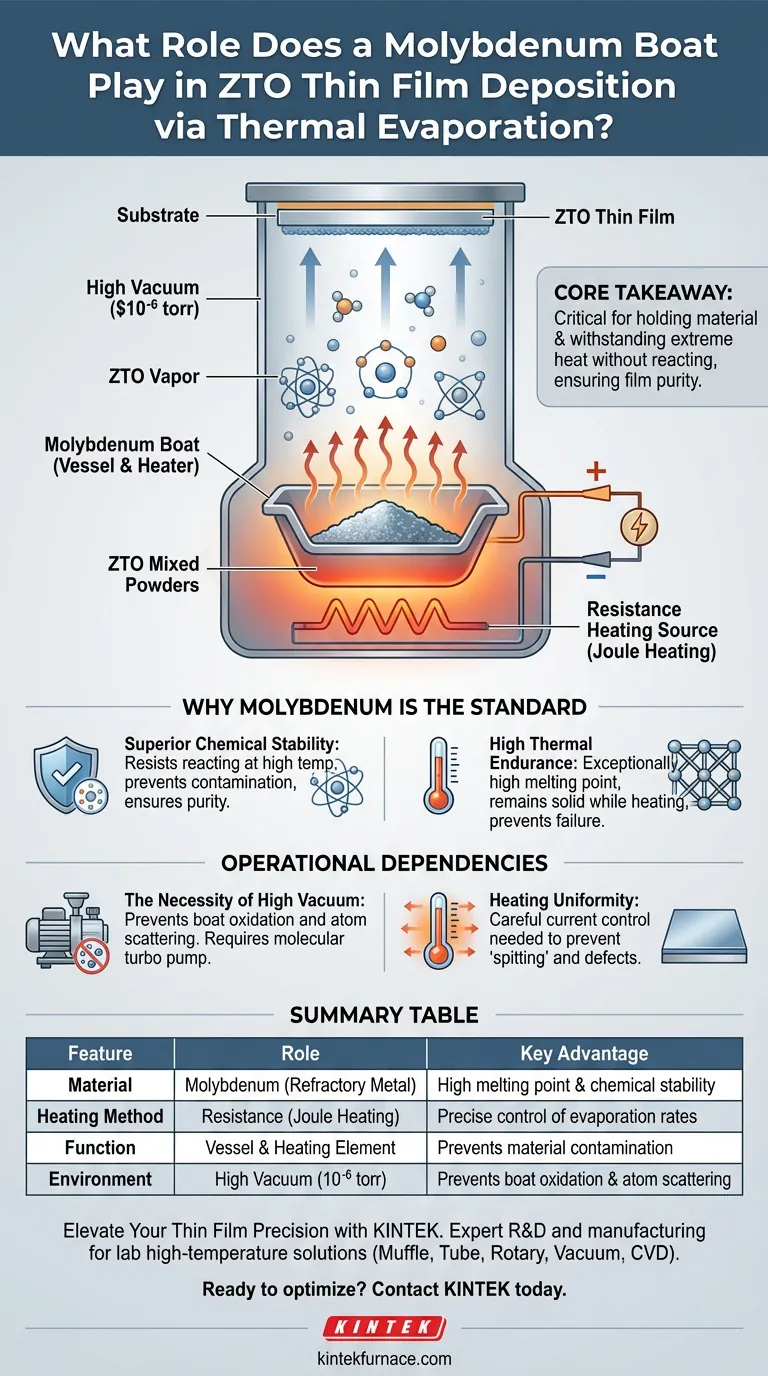
The Molybdenum Boat functions as both the physical vessel and the active heating element required to deposit Zinc Tin Oxide (ZTO) thin films via thermal evaporation. By passing a high electrical current through the boat, it serves as a resistance heater that raises the temperature of the ZTO mixed powders until they sublime or evaporate, transitioning into a gas phase that coats the target substrate.
Core Takeaway The Molybdenum Boat is critical not just for holding the source material, but for its ability to withstand extreme heat without chemically reacting with the ZTO powder. This ensures the deposited film remains pure and is not contaminated by the boat material itself.
The Mechanics of Thermal Deposition
Resistance Heating Source
The fundamental role of the Molybdenum Boat is to convert electrical energy into thermal energy.
When a high electrical current is passed through the boat, its inherent electrical resistance generates intense heat. This process, known as Joule heating, allows the boat to reach the specific evaporation temperature required by the ZTO powder.
Phase Transition Control
The heat generated by the boat is transferred directly to the ZTO mixed powders it holds.
As the temperature rises, the powder undergoes a phase change, sublimating or evaporating into a vapor. This vapor travels through the vacuum chamber to settle on the substrate, forming the thin film.
Why Molybdenum is the Standard
Superior Chemical Stability
In thin film deposition, maintaining material purity is paramount.
Molybdenum possesses excellent chemical stability, meaning it is highly resistant to reacting with other elements even at high temperatures. This prevents the boat from contaminating the ZTO vapor, ensuring the stoichiometry of the deposited layer matches the source material.
High Thermal Endurance
The evaporation process requires temperatures that would melt or deform lesser metals.
Molybdenum has an exceptionally high melting point. This allows it to remain structurally sound and solid while heating the ZTO powder to its evaporation point, preventing catastrophic failure of the heating element during the process.
Operational Dependencies and Trade-offs
The Necessity of High Vacuum
While the Molybdenum Boat is robust, its performance is strictly tied to the vacuum environment.
As noted in standard vacuum practices, a molecular turbo pump is required to achieve a high vacuum (around $10^{-6}$ torr). Without this ultra-high vacuum, oxygen in the air would not only scatter the evaporated ZTO atoms but could also cause the hot Molybdenum boat to oxidize and degrade rapidly.
Heating Uniformity
The geometry of the boat dictates how evenly the ZTO powder is heated.
If the boat is packed unevenly or if the current is ramped up too quickly, "spitting" of the powder can occur. This results in defects on the film surface, necessitating careful control of the input current.
Making the Right Choice for Your Goal
To ensure successful ZTO deposition, consider these operational priorities:
- If your primary focus is Film Purity: Ensure the Molybdenum Boat is thoroughly cleaned before loading to leverage its chemical stability and prevent cross-contamination.
- If your primary focus is Deposition Rate: Regulate the electrical current precisely; higher current increases the evaporation rate, but risking the boat's structural integrity if pushed beyond its thermal limits.
Mastering the thermal characteristics of the Molybdenum Boat is the first step toward achieving consistent, high-quality ZTO thin films.
Summary Table:
| Feature | Role in ZTO Deposition | Key Advantage |
|---|---|---|
| Material | Molybdenum (Refractory Metal) | High melting point & chemical stability |
| Heating Method | Resistance (Joule Heating) | Precise control of evaporation rates |
| Function | Vessel & Heating Element | Prevents material contamination |
| Environment | High Vacuum ($10^{-6}$ torr) | Prevents boat oxidation & atom scattering |
Elevate Your Thin Film Precision with KINTEK
Achieving high-purity ZTO thin films requires more than just high-quality materials—it requires the right heating environment. Backed by expert R&D and manufacturing, KINTEK offers a comprehensive range of laboratory high-temperature solutions, including Muffle, Tube, Rotary, Vacuum, and CVD systems.
Whether you need standard equipment or a customizable system tailored to your unique deposition needs, our expert team is here to support your research and production goals.
Ready to optimize your thermal processes? Contact KINTEK today to consult with our engineering experts.
Visual Guide
References
- Ashish Khandelwal, K. S. Sharma. Effect of Different Compositions of Mixed Metal Oxides (Zinc Oxide and Tin Oxide) on Structural and Optical Properties for the Application of Window Layers in Solar Cells. DOI: 10.3329/jsr.v16i1.64157
This article is also based on technical information from Kintek Furnace Knowledge Base .
Related Products
- Molybdenum Vacuum Heat Treat Furnace
- Vacuum Heat Treat Sintering Furnace Molybdenum Wire Vacuum Sintering Furnace
- Molybdenum Disilicide MoSi2 Thermal Heating Elements for Electric Furnace
People Also Ask
- How does vacuum heat treating work in terms of temperature and time control? Master Precise Material Transformations
- What is the primary application of vacuum heat treating furnaces in aerospace? Enhance Component Performance with Precision
- What is the process of vacuum heat treating? Achieve Superior Metallurgical Properties
- Why are vacuum heat treating furnaces essential for aerospace? Ensure Superior Material Integrity for High-Stakes Applications
- How does a vacuum heat treating furnace improve the condition of metal alloys? Achieve Superior Metal Performance