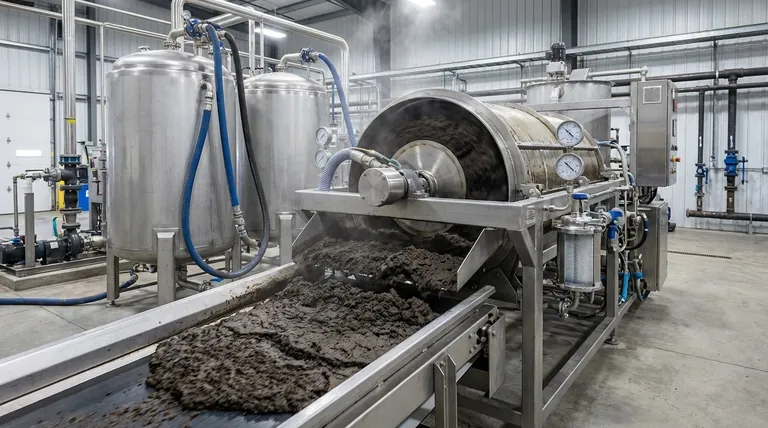
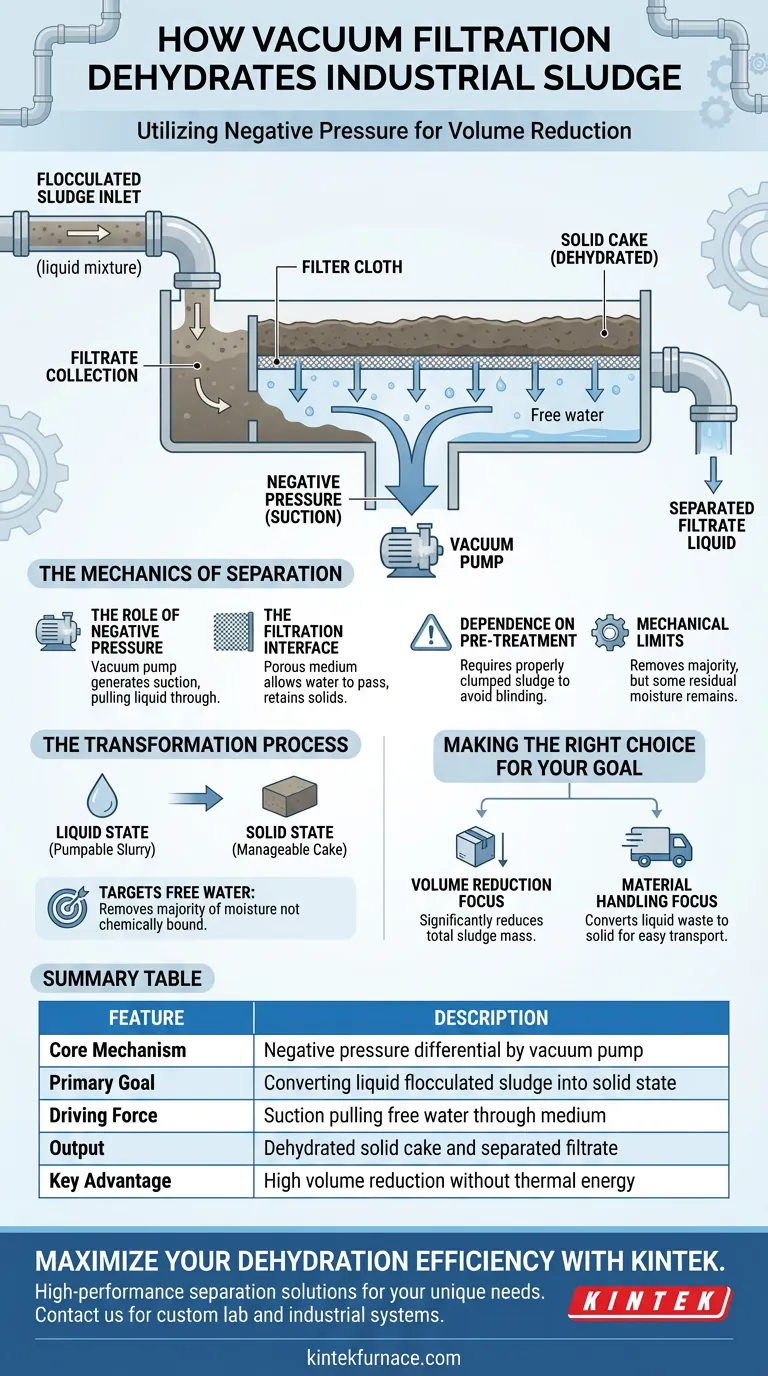
Vacuum filtration systems operate by generating a negative pressure differential. A vacuum pump creates suction that acts as the driving force to pull free water out of industrial sludge and through a porous filtering medium. This mechanical separation is the primary method used to transition sludge from a liquid mixture into a solid form.
By utilizing negative pressure to guide free water through a filter cloth, vacuum filtration effectively removes the majority of moisture from flocculated sludge, converting it into a manageable solid state.
The Mechanics of Separation
The Role of Negative Pressure
The core mechanism of this system is the vacuum pump.
Instead of applying positive pressure to squeeze water out, the pump creates a vacuum (negative pressure) beneath the filtration surface. This suction force actively pulls liquids through the system while leaving solids behind.
The Filtration Interface
The separation physically occurs at the filtering medium, typically a specialized filter cloth.
This medium creates a barrier that allows water to pass through under the influence of the vacuum but retains the solid particles. The efficiency of the system depends heavily on this interface.
Processing Flocculated Sludge
These systems are specifically designed to handle flocculated sludge.
This implies that the sludge has likely been pre-treated to clump particles together. The vacuum system then acts upon this material to separate the free water from the solid aggregates.
The Transformation Process
Transitioning States
The ultimate goal of the operation is a phase change from a liquid state to a solid state.
By removing the liquid carrier, the system converts pumpable slurry into a solid cake that can be handled, transported, or disposed of more easily.
Targeting Free Water
It is important to note that this process specifically targets free water.
The mechanical suction draws out the water that is not chemically bound to the solids. This allows for the removal of the majority of water volume without requiring thermal energy.
Understanding the Limitations
Dependence on Pre-treatment
The system relies on the input being flocculated sludge.
If the sludge is not properly flocculated (clumped), the solids may blind the filter cloth or pass through with the water, compromising the negative pressure efficiency.
Mechanical Limits
While effective, this is a mechanical separation method.
It removes the "majority" of water, but not all of it. It is designed to create a solid state, not a completely dry powder; some residual moisture will always remain after mechanical filtration.
Making the Right Choice for Your Goal
How to Apply This to Your Project
- If your primary focus is volume reduction: Vacuum filtration is highly effective for removing the majority of free water, significantly reducing the total mass of the sludge.
- If your primary focus is material handling: This method is the ideal choice for converting liquid waste into a solid state suitable for transport or landfill.
Effective dehydration relies on maintaining a consistent negative pressure differential to maximize the removal of free water.
Summary Table:
| Feature | Description |
|---|---|
| Core Mechanism | Negative pressure differential generated by a vacuum pump |
| Primary Goal | Converting liquid flocculated sludge into a solid state |
| Driving Force | Suction pulling free water through a filtering medium |
| Output | Dehydrated solid cake and separated filtrate liquid |
| Key Advantage | High volume reduction without the need for thermal energy |
Maximize Your Dehydration Efficiency with KINTEK
Is your lab or industrial process struggling with sludge volume management? At KINTEK, we specialize in high-performance separation solutions. Backed by expert R&D and manufacturing, we offer a comprehensive range of lab equipment including Muffle, Tube, Rotary, Vacuum, and CVD systems, all customizable to meet your unique dehydration and thermal processing needs.
Our advanced systems ensure consistent pressure differentials for superior moisture removal, helping you transition liquid waste into manageable solids with ease.
Ready to optimize your workflow? Contact us today to consult with our technical team and find the perfect filtration or high-temp furnace solution for your requirements!
Visual Guide
References
- Jing Ye, Shu-Xu Yi. Laboratory Test of Industrial Waste Mud Treated by the Flocculation-Vacuum-Curing Integrated Method: Deep Dehydration and Preparation of Geopolymer Fluid Solidified Soil. DOI: 10.3390/ma18132961
This article is also based on technical information from Kintek Furnace Knowledge Base .
Related Products
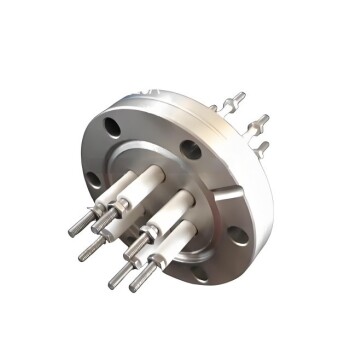
- CF KF Flange Vacuum Electrode Feedthrough Lead Sealing Assembly for Vacuum Systems
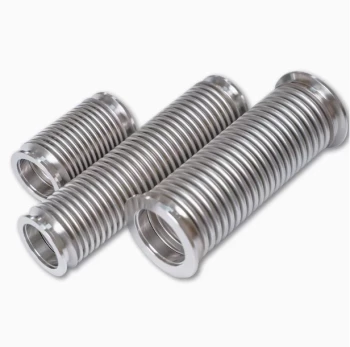
- High Performance Vacuum Bellows for Efficient Connection and Stable Vacuum in Systems
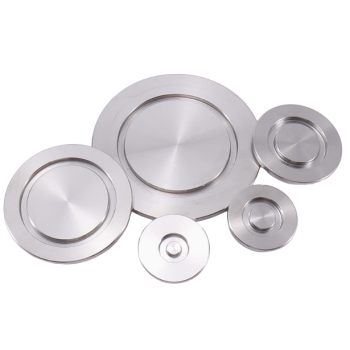
- Stainless Steel KF ISO Vacuum Flange Blind Plate for High Vacuum Systems
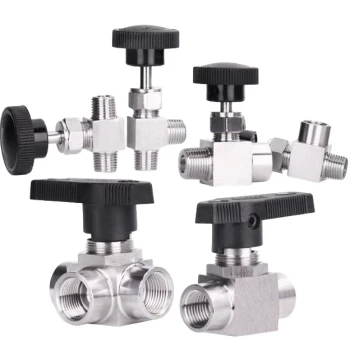
- 304 316 Stainless Steel High Vacuum Ball Stop Valve for Vacuum Systems
- Vacuum Induction Melting Furnace
People Also Ask
- Why is a vacuum sealing process necessary for the synthesis of TaAs2 single crystals? Ensuring Purity in CVT Method
- Why is a PTFE-lined stainless steel autoclave used for Ni12P5 synthesis? Key Benefits for Nanomaterial Production
- What is the function of PTFE sealing rings in plastic pyrolysis? Ensure Safe, Anaerobic Material Decomposition
- What is the function of a Teflon-lined stainless steel autoclave in the hydrothermal synthesis of Bi2O3 precursors?
- Why is a stainless steel autoclave with a Teflon liner necessary for BiVO4? Ensure Purity & High Performance