
A laboratory high-temperature muffle furnace serves as the critical validation tool connecting raw material formulation to industrial viability. It plays a dual role: it acts as a production unit for sintering green bodies to induce necessary phase changes, and as a testing ground to rigorously simulate extreme operating environments—such as cement kilns—to validate physical limits like refractoriness and thermal shock resistance.
The core value of a high-temperature muffle furnace lies in its ability to replicate the thermal intensity of industrial kilns (up to 1800°C) within a controlled setting, allowing researchers to precisely correlate heating curves with material durability and structural integrity.
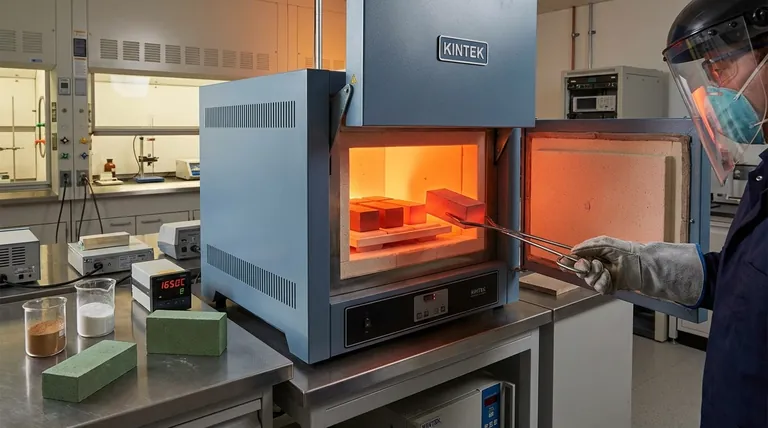
The Role in Production and Sintering
The production of high-quality refractory bricks requires precise thermal treatment to transform raw compacted powder into a durable ceramic material.
Pre-Sintering for Structural Integrity
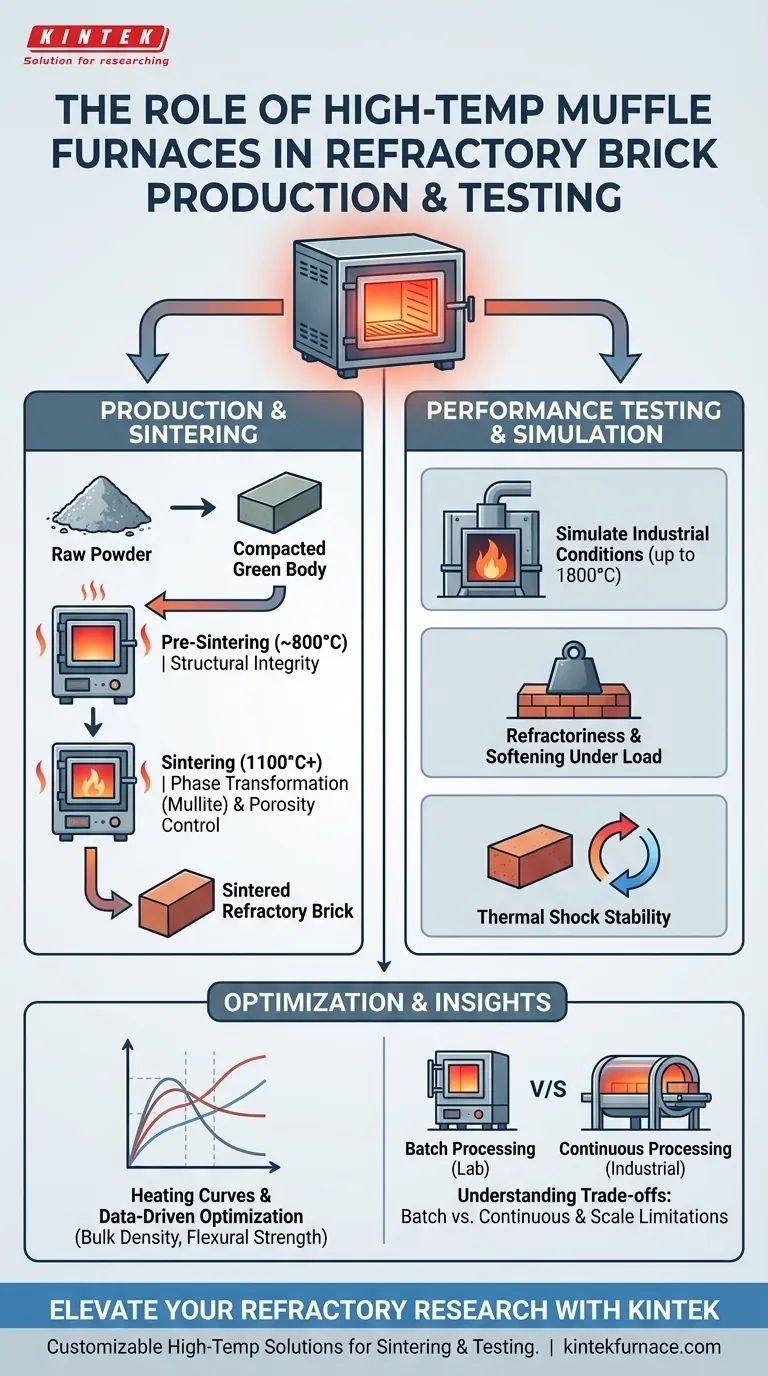
Before full firing, the furnace is often used for a pre-sintering stage, typically heating cold-pressed green compacts to temperatures around 800°C. This step initiates the bonding of powder particles under atmospheric pressure. It improves the structural integrity of the compact, ensuring it is robust enough for subsequent densification processes like high-pressure hot re-pressing.
Driving Mineral Phase Transformations
During the primary sintering phase, the furnace provides a stable thermal field, often held between 1000°C and 1100°C or higher depending on the material. This sustained heat promotes critical mineralogical changes, such as transforming kaolinite into metakaolinite and eventually into mullite crystalline phases. This phase transformation is what gives refractory bricks their thermal resistance and mechanical strength.
Microstructure and Porosity Control
The furnace's precise temperature control directly dictates the evolution of the brick's internal microstructure. By manipulating the heat, engineers can control the growth of mullite crystals and adjust the material's porosity. These factors are the primary determinants of the final brick's density and insulating properties.
The Role in Performance Testing and Simulation
Once a prototype is created, the muffle furnace shifts roles from production to rigorous stress testing to ensure the brick can survive actual service conditions.
Simulating Industrial Kiln Conditions
A high-temperature muffle furnace capable of reaching 1800°C is essential for simulating the working conditions of heavy industrial equipment, such as cement kilns. This allows researchers to verify how the material will behave in the field before mass production begins.
Testing Refractoriness and Softening
The furnace is used to determine the softening temperature under load. This test identifies the exact temperature at which a brick begins to deform while supporting weight, a vital safety metric for structural refractories. It also validates the material's overall refractoriness—its ability to withstand heat without melting.
Thermal Shock Stability
The furnace enables thermal shock stability cycle experiments. By subjecting the bricks to rapid heating and cooling cycles, researchers can assess the material's resistance to cracking or spalling. This mimics the fluctuating temperatures found in operational industrial furnaces.
Optimizing Material Metrics
Beyond basic firing, the muffle furnace is a tool for data-driven optimization.
Establishing Heating Curves
Researchers use the furnace to set and execute precise heating curves. This allows for the systematic study of how different heating rates and dwell times affect the final product.
Correlating Temperature to Performance
By varying the sintering temperatures, engineers can map out the relationship between heat input and core performance indicators. Specifically, this process helps optimize the bulk density and flexural strength of the refractory bricks, ensuring they meet specific mechanical standards.
Understanding the Trade-offs
While the muffle furnace is indispensable, it is important to recognize the limitations inherent in laboratory-scale testing.
Batch vs. Continuous Processing
Muffle furnaces operate as batch processors, whereas most industrial brick production occurs in continuous tunnel kilns. While the muffle furnace accurately tests the material chemistry, it may not perfectly replicate the thermal gradients or flowing atmosphere of a continuous production line.
Scale Limitations
The "large storage capacity" of a lab furnace is relative; it allows for simultaneous testing of multiple samples, but it cannot produce full-scale production volumes. Data derived from these furnaces must be carefully scaled up, as mass effects in larger loads can alter heat distribution.
Making the Right Choice for Your Goal
To maximize the utility of a high-temperature muffle furnace, align your usage with your specific technical objectives.
- If your primary focus is Material Formulation: Focus on the dwell time accuracy in the 1000°C–1100°C range to ensure complete phase transformation and optimal mullite crystal growth.
- If your primary focus is Quality Assurance: Prioritize the maximum temperature capability (1800°C) and thermal cycling features to stress-test the refractoriness and shock stability of the finished product.
Ultimate success in refractory production relies on using the muffle furnace not just to "bake" samples, but to systematically stress and analyze the material's limits before it ever reaches the industrial kiln.
Summary Table:
| Stage | Role of Muffle Furnace | Key Outcomes |
|---|---|---|
| Sintering | Controlled heating up to 1100°C+ | Promotes mullite phase transformation and structural integrity. |
| Phase Control | Sustained thermal field | Optimizes microstructure, porosity, and mineralogical development. |
| Performance Testing | High-temp simulation (up to 1800°C) | Validates refractoriness, softening under load, and thermal shock stability. |
| Optimization | Heating curve precision | Maximizes bulk density and flexural strength through data-driven testing. |
Elevate Your Refractory Research with KINTEK
Precision thermal processing is the foundation of high-performance refractory materials. Backed by expert R&D and manufacturing, KINTEK offers a comprehensive range of Muffle, Tube, Rotary, Vacuum, and CVD systems, as well as other lab high-temperature furnaces—all fully customizable to meet your unique sintering and testing needs.
Whether you are refining material formulations or conducting rigorous thermal shock simulations, our equipment ensures the accuracy and reliability your lab demands. Contact us today to find the perfect high-temperature solution for your application.
Visual Guide
References
- Samuel Audu Seth, Jacob Jatau. Production and Characterisation of Refractory Bricks for Cement Kiln Burning Zone Application. DOI: 10.11648/j.ie.20250901.13
This article is also based on technical information from Kintek Furnace Knowledge Base .
Related Products
- 1800℃ High Temperature Muffle Oven Furnace for Laboratory
- 1700℃ High Temperature Muffle Oven Furnace for Laboratory
- 1400℃ Muffle Oven Furnace for Laboratory
- 1200℃ Muffle Oven Furnace for Laboratory
- Laboratory Muffle Oven Furnace with Bottom Lifting
People Also Ask
- What is the primary function of a high-temperature laboratory muffle furnace in chemical synthesis? Achieve Precision.
- How does a high-temperature laboratory muffle furnace affect material properties? Transform Anodic Oxide Films Fast
- Why is a laboratory high-temperature muffle furnace required for LaNixFe1-xO3 catalysts? Optimize Two-Stage Synthesis
- Why is a laboratory high-temperature muffle furnace used for BaTiO3? Achieve Optimal Tetragonal Crystalline Phases
- How is a laboratory high-temperature muffle furnace used to evaluate porous Co-Al materials? Precision Thermal Analysis



















