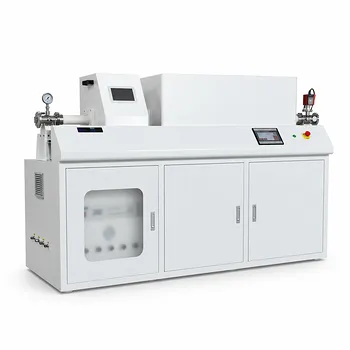
The argon atmosphere tube furnace is the critical vessel that enables the thermal transformation of organic precursors into carbon microfibers (CMF) without the material burning away. By maintaining a continuous flow of high-purity argon at temperatures typically reaching 1000 °C, the furnace removes non-carbon elements and facilitates the reorganization of the internal molecular structure into a conductive carbon framework.
An argon atmosphere tube furnace provides a strictly controlled, oxygen-free environment that prevents oxidative ablation, ensuring that organic fibers are successfully converted into high-strength, electrically conductive carbon microfibers through precise thermal processing.
The Essential Role of Atmospheric Control
The primary function of the furnace is to replace reactive air with a chemically inert shield.
Preventing Oxidative Ablation
At temperatures exceeding 400 °C, carbon materials will react with oxygen and literally turn into gas (CO2). The argon atmosphere acts as a protective barrier, preventing oxidative burnout and ensuring the carbon skeleton remains intact throughout the heating cycle.
Preserving Microscopic Integrity
By excluding oxygen, the furnace protects the delicate pore structures and nanostructures of the fibers. This preservation is vital for applications requiring specific surface areas or morphological features, such as energy storage or filtration.
Engineering the Carbon Structure
Beyond simple protection, the furnace environment actively facilitates the chemical evolution of the fiber.
Removal of Non-Carbon Elements
As the furnace heats the stabilized fibers, it drives off volatile components and non-carbon elements. This purification process is what increases the carbon yield and transforms an organic polymer into a nearly pure carbon material.
Reorganization and Graphitization
The high-temperature environment triggers dehydrogenation and cyclization reactions. These molecular changes reorganize the carbon atoms into a more ordered, crystalline structure, which is the foundation of the material's mechanical strength.
Enhancing Electrical Conductivity
The precise thermal energy provided by the tube furnace allows for localized crystallization. This transition from an amorphous state to a more structured framework is what grants carbon microfibers their electrical conductivity.
The Importance of Thermal Precision
A tube furnace is more than a heater; it is a precision instrument for material synthesis.
Managing Heating Rates
Precise regulation of the heating rate (such as 5 °C/min) is necessary to prevent structural defects. Controlled heating ensures that volatile gasses escape slowly, preventing the fibers from rupturing or developing internal stresses.
Temperature Uniformity
The design of the tube furnace ensures that heat is distributed evenly across the material. Temperature uniformity is a critical factor in determining the final consistency, structural integrity, and mechanical performance of the entire batch of CMF.
Understanding the Trade-offs and Pitfalls
While argon tube furnaces are highly effective, they require careful management to avoid process failure.
Gas Purity and Flow Rate
Using low-purity argon or an insufficient flow rate can allow trace oxygen to enter the system. This leads to surface pitting or reduced carbon yield, significantly weakening the mechanical properties of the microfibers.
Thermal Gradients
In larger tubes, the temperature at the center may differ from the temperature near the heating elements. These thermal gradients can cause non-uniform carbonization, resulting in a batch of microfibers with inconsistent conductivity.
Making the Right Choice for Your Goal
To achieve the best results in carbonization, your approach should align with your specific material requirements.
- If your primary focus is Maximum Conductivity: Prioritize higher temperatures (1000 °C and above) and longer soak times to promote advanced graphitization of the carbon structure.
- If your primary focus is Structural Integrity: Focus on a slow, precise heating rate to allow volatile components to escape without damaging the microscopic pore network.
- If your primary focus is High Yield: Ensure a strictly oxygen-free environment by utilizing high-purity argon and verifying the furnace seal integrity before the run.
By masterfully controlling the intersection of inert atmosphere and thermal energy, the tube furnace serves as the definitive tool for creating high-performance carbon microfibers.
Summary Table:
| Key Role | Primary Benefit | Critical Process Parameter |
|---|---|---|
| Atmospheric Control | Prevents oxidative ablation (burning) of fibers | Gas purity & flow rate |
| Chemical Purification | Removes non-carbon elements for higher yield | Target temperature (up to 1000°C) |
| Structural Reorganization | Enhances mechanical strength & conductivity | Soak time at peak temperature |
| Precision Heating | Prevents structural defects and ruptures | Controlled heating rate (e.g., 5°C/min) |
| Thermal Uniformity | Ensures consistent quality across the batch | Furnace zone control & tube design |
Elevate Your Material Synthesis with KINTEK Precision
Achieving the perfect carbonization of carbon microfibers requires uncompromising control over atmosphere and temperature. KINTEK specializes in high-performance laboratory equipment and consumables, offering a comprehensive range of customizable high-temperature furnaces, including tube, muffle, rotary, vacuum, CVD, and atmosphere furnaces.
Whether you need to enhance electrical conductivity or preserve microscopic integrity, our team provides the technical expertise and reliable hardware to support your unique research needs.
Ready to optimize your carbonization process? Contact KINTEK today to find the ideal furnace solution for your laboratory!
References
- Amin Karamati, Xinwei Wang. Function Graded Carbon Micro‐Structures for Powerless Photon Sensing with Intriguing µm‐Scale Position Sensitivity. DOI: 10.1002/adom.202301377
This article is also based on technical information from Kintek Furnace Knowledge Base .
Related Products
- 1200℃ Controlled Inert Nitrogen Atmosphere Furnace
- Mesh Belt Controlled Atmosphere Furnace Inert Nitrogen Atmosphere Furnace
- 1700℃ Controlled Inert Nitrogen Atmosphere Furnace
- 1400℃ Controlled Inert Nitrogen Atmosphere Furnace
- Controlled Inert Nitrogen Hydrogen Atmosphere Furnace
People Also Ask
- What controlled-atmosphere furnace conditions are required for sintering powder metallurgy copper alloy compacts? Ideal Setup
- How does introducing reactive gases into a controlled atmosphere furnace affect ceramic densification and coarsening?
- What are the advantages of a controlled atmosphere furnace over tube furnaces? Superior Process Control for Sensitive Materials
- What are the operational advantages of using a controlled atmosphere furnace? Boost Quality and Efficiency in Heat Treatment
- What are the key benefits of precise temperature control in a controlled atmosphere furnace? Unlock Superior Quality and Efficiency