Introducing reactive gases into a controlled atmosphere furnace fundamentally alters the sintering trajectory of ceramics. Instead of promoting densification, these gases typically shift the dominant mass transport mechanism to vapor-phase transport, which causes rapid grain coarsening while suppressing shrinkage. Precise management of gas species, partial pressure, and flow is therefore essential to balance densification and microstructural development.
The core takeaway: reactive gases like HCl or water vapor react with the ceramic powder to form volatile vapor species. When these species’ partial pressure exceeds a critical threshold, rapid evaporation-condensation across pores replaces solid-state diffusion, accelerating grain growth without densification. Controlling that partial pressure determines whether you get a dense component or a deliberately porous, coarse-grained body.
The Shift from Densification to Vapor-Phase Coarsening
In standard inert or vacuum atmospheres, solid-state and grain-boundary diffusion dominate—mechanisms that pull particles together and eliminate porosity. Reactive gases interrupt this process.
How Reactive Gases Form Volatile Species
When a reactive gas like HCl is introduced, it chemically reacts with the ceramic surface. For ferric oxide, this produces volatile Fe₂Cl₆; for titania, TiCl₄. These compounds have a high vapor pressure at sintering temperatures.
The elevated partial pressure of these vapor species creates a continuous gas-phase transport path across pores. Material evaporates from convex particle surfaces and condenses on concave necks or larger grains, a process known as evaporation-condensation.
The Consequences: Coarsening Without Densification
This vapor transport naturally spares mass from the pore-filling processes. Neck growth accelerates without bringing particle centers closer together. The direct result is dramatic grain coarsening while the component remains essentially at green density.
A telling example: sintering 0.2 µm TiO₂ at 1200°C in air yields 76% theoretical density with a fine 1 µm grain size. Under an HCl atmosphere at the same temperature, grain size explodes to 6 µm while density stagnates at 45%—virtually unsintered. The reactive environment has disabled the densification engine.
The Critical Role of Partial Pressure
Not all reactive atmospheres completely halt densification. The outcome depends on the concentration of volatile products in the furnace atmosphere.
The Threshold for Vapor Dominance
When the partial pressure of the volatile reaction products (e.g., ferric chloride or titanium tetrachloride) exceeds approximately 10² Pa, vapor transport overwhelms solid-state volume diffusion. Below this threshold, solid-state mechanisms may still dominate, and some densification can occur.
Excessive partial pressures over the entire sample surface promote Ostwald ripening on a macroscopic scale, causing pores to grow rather than shrink. This is why simply flowing a reactive gas without precise pressure control often leads to failure in achieving high density.
Practical Control in Your Furnace
Operators must manage not only the gas composition but also the flow rate and local partial pressure inside the hot zone. A well-designed atmosphere furnace allows you to purge reactive species rapidly, preventing their build-up. Conversely, a stagnant flow can trap volatile species, raising local pressure and driving the system toward coarsening.
For maximum densification, maintaining an inert or soluble-gas environment is standard. For example, hydrogen or helium atmospheres can replace insoluble gases trapped in pores and later diffuse out, enabling complete closure.
Understanding the Trade-offs and Pitfalls
Reactive gases are not always detrimental; they become a tool once you understand their precise effect. The key is to know when coarsening without densification is desirable, and when it is a critical failure.
When to Use Reactive Atmospheres Intentionally
Some applications require a porous ceramic with controlled large grains. By sintering in an HCl or water vapor atmosphere, you can coarsen the microstructure while preserving open porosity. This approach lets you independently tune grain size and pore size—useful for filters, catalyst supports, or thermal barriers.
In these cases, the reactive atmosphere is the primary design lever, not a contaminant.
The Danger of Insoluble Gas Entrapment
During final-stage sintering, closing pores can trap ambient gas. If that gas is insoluble (like argon or nitrogen), internal pressure rises and halts densification. Reactive gas species that are soluble and mobile (like hydrogen or oxygen in alumina) will escape, but volatile chloride species might remain trapped if not evacuated. This makes the purging sequence before pore closure just as critical as the reactive gas introduction.
Making the Right Choice for Your Sintering Goal
Your atmosphere strategy must mirror your end goal. Use the following decision points as a guide:
- If your primary focus is maximum density and fine grains: Avoid reactive gases entirely. Use inert or reducing atmospheres (argon, hydrogen, vacuum) that suppress vapor transport and allow solid-state diffusion to drive shrinkage.
- If your primary focus is a porous body with large, controlled grains: Intentionally introduce a reactive gas like HCl or water vapor at a partial pressure above 10² Pa. This will coarsen the microstructure without densifying it.
- If your primary focus is eliminating trapped porosity in the final stage: Switch to a high-diffusivity gas (hydrogen or helium) before pore closure, or use a vacuum furnace to evacuate reactive and insoluble species. This lets you close residual pores even after an earlier reactive step.
Mastering reactive atmospheres means recognizing they are a scalpel, not a sledgehammer. When dialed in correctly, they empower you to sculpt porosity and grain size with precision.
Summary Table:
| Atmosphere Strategy | Dominant Mechanism | Grain Growth | Densification Effect | Ideal Application |
|---|---|---|---|---|
| Inert / Vacuum / Soluble Gas | Solid-state & grain-boundary diffusion | Minimal (Fine grains) | High (Eliminates porosity) | High-density, fine-grained structural ceramics |
| Reactive Gas (>10² Pa partial pressure) | Evaporation-condensation (Vapor transport) | Rapid (Coarse grains) | Suppressed (Maintains green density) | Porous ceramics, catalyst supports, filters |
| High-Diffusivity Gas (H₂, He) | Rapid gas escape prior to pore closure | Controlled | Maximize final-stage density | Residual pore elimination and full consolidation |
Mastering precise atmospheric conditions and gas partial pressures is critical to achieving your target ceramic microstructure. KINTEK specializes in advanced laboratory equipment and high-temperature furnaces—including controlled atmosphere, vacuum, CVD, tube, muffle, rotary, and induction melting systems—all fully customizable to match your precise research and production demands. Whether you need to drive full densification or engineer controlled coarsening, our technical experts are here to deliver reliable, high-performance thermal solutions. Contact KINTEK today to discuss your custom furnace requirements and optimize your sintering process!
Related Products
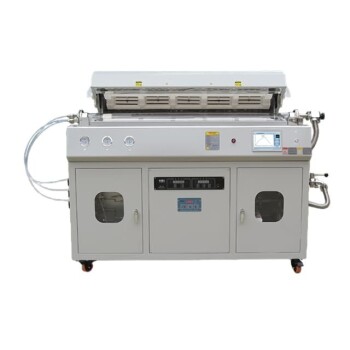
- 1200℃ Controlled Inert Nitrogen Atmosphere Furnace
- 1400℃ Controlled Inert Nitrogen Atmosphere Furnace
- 1700℃ Controlled Inert Nitrogen Atmosphere Furnace
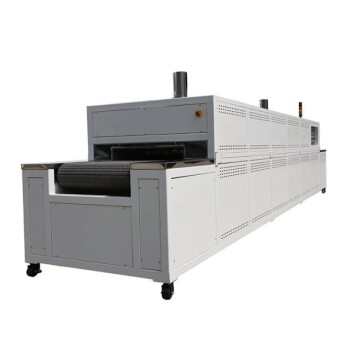
- Mesh Belt Controlled Atmosphere Furnace Inert Nitrogen Atmosphere Furnace
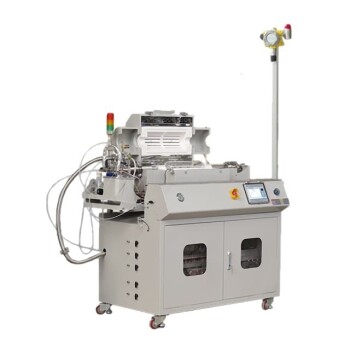
- Controlled Inert Nitrogen Hydrogen Atmosphere Furnace
People Also Ask
- What controlled-atmosphere furnace conditions are required for sintering powder metallurgy copper alloy compacts? Ideal Setup
- What types of gases are used in controlled atmosphere furnaces? Optimize Material Protection and Transformation
- What causes discrepancies between theoretical and experimental grain boundary mobility during ceramic sintering? Explained
- How do surface oxide layers on ceramic powders like silicon nitride affect sintering? Master Atmosphere Control
- Why is a controlled atmosphere furnace required for 316L debinding? Ensure Structural Integrity & Zero Cracks