
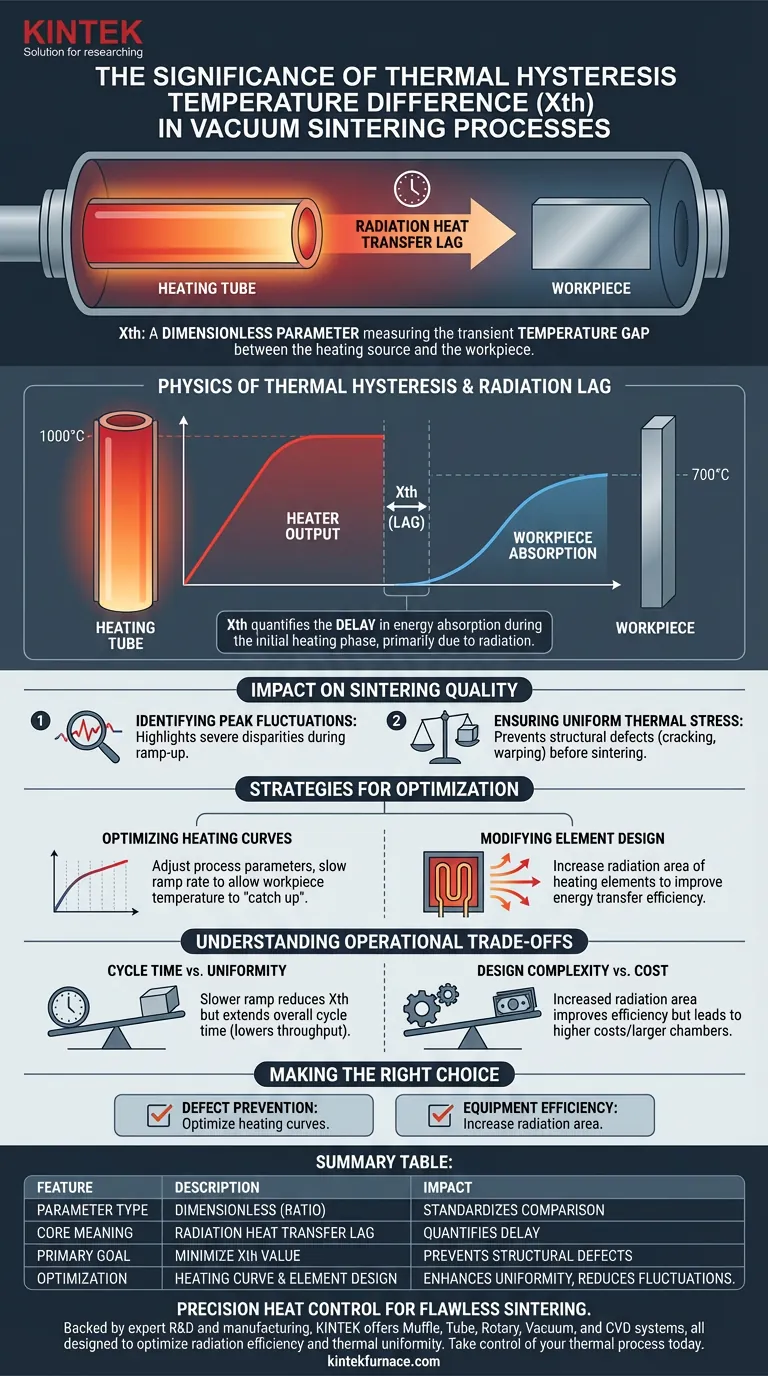
The thermal hysteresis temperature difference (Xth) is a dimensionless parameter that quantitatively measures the transient temperature gap between the heating source (tube) and the workpiece during vacuum sintering. This metric is significant because it defines the radiation heat transfer lag—the delay between the heater reaching a temperature and the workpiece absorbing that energy—which is critical for controlling quality during the initial heating phase.
The calculation of Xth allows operators to identify and control peak temperature fluctuations during the ramp-up phase. By minimizing this value, manufacturers can ensure uniform thermal stress, preventing defects caused by uneven heating.
The Physics of Thermal Hysteresis
Understanding Radiation Lag
In a vacuum environment, heat transfer relies primarily on radiation rather than convection. This mechanism creates an inherent delay, or lag, between the energy output of the heating tube and the energy absorption of the workpiece. Xth provides a specific numerical value to represent this delay.
The Role of the Parameter
Xth is a dimensionless parameter, meaning it describes a ratio or relationship rather than a raw temperature value. This allows for a standardized way to compare heating efficiency and lag across different furnace setups or process cycles.
Impact on Sintering Quality
Identifying Peak Fluctuations
The primary operational significance of Xth is its ability to highlight peak temperature fluctuations. These disparities are most severe during the initial heating phase when the furnace is ramping up from ambient temperatures.
Ensuring Uniform Thermal Stress
If the temperature difference between the heater and the part is too great, the workpiece experiences uneven expansion. By monitoring and reducing Xth, operators ensure uniform thermal stress. This prevents structural integrity issues, such as cracking or warping, before the material even reaches its final sintering temperature.
Strategies for Optimization
Optimizing Heating Curves
One of the most effective ways to reduce the thermal hysteresis effect is by adjusting the process parameters. Optimizing heating curves—specifically by slowing the ramp rate—allows the workpiece temperature to "catch up" to the heating tube, minimizing the Xth value.
Modifying Element Design
Optimization can also be achieved through hardware changes. Increasing the radiation area of the heating elements improves the efficiency of energy transfer. This physical change reduces the lag time, thereby lowering the Xth value naturally.
Understanding the Operational Trade-offs
Cycle Time vs. Uniformity
While minimizing Xth is ideal for quality, achieving a near-zero hysteresis often requires significantly slowing down the heating ramp. This extends the overall cycle time and can reduce production throughput.
Design Complexity vs. Cost
Increasing the radiation area of heating elements effectively reduces hysteresis but impacts furnace design. This approach may lead to higher equipment costs or require larger furnace chambers to accommodate the increased surface area of the heating elements.
Making the Right Choice for Your Goal
To effectively manage thermal hysteresis in your vacuum sintering process, consider your specific priorities:
- If your primary focus is defect prevention: Optimize your heating curves to minimize Xth, ensuring the workpiece experiences uniform stress during the critical initial heating phase.
- If your primary focus is equipment efficiency: Increase the radiation area of your heating elements to physically reduce the heat transfer lag without necessarily extending cycle times.
By quantifying the lag between your heater and your workpiece, you transform a hidden variable into a controllable process parameter.
Summary Table:
| Feature | Description | Impact on Sintering |
|---|---|---|
| Parameter Type | Dimensionless (Ratio) | Standardizes heating efficiency comparison |
| Core Meaning | Radiation heat transfer lag | Quantifies delay between heater and workpiece |
| Primary Goal | Minimize Xth value | Prevents structural defects like warping/cracking |
| Optimization | Heating curve & element design | Enhances uniformity and reduces peak fluctuations |
Precision Heat Control for Flawless Sintering
Thermal hysteresis can be the difference between a high-performance part and a costly failure. At KINTEK, we understand that controlling the Xth parameter requires more than just standard equipment—it requires precision engineering.
Backed by expert R&D and manufacturing, KINTEK offers Muffle, Tube, Rotary, Vacuum, and CVD systems, all designed to optimize radiation efficiency and thermal uniformity. Whether you need to refine your heating curves or require a customizable lab high-temp furnace tailored to your unique sintering needs, our team is ready to assist.
Take control of your thermal process today. Contact our experts now to discuss your custom furnace solution.
Visual Guide
References
- Mao Li, Hesong Li. Numerical simulation of the heating process in a vacuum sintering electric furnace and structural optimization. DOI: 10.1038/s41598-024-81843-8
This article is also based on technical information from Kintek Furnace Knowledge Base .
Related Products
- Vacuum Heat Treat Sintering Furnace Molybdenum Wire Vacuum Sintering Furnace
- Small Vacuum Heat Treat and Tungsten Wire Sintering Furnace
- 9MPa Air Pressure Vacuum Heat Treat and Sintering Furnace
- Vacuum Heat Treat Sintering Furnace with Pressure for Vacuum Sintering
- 2200 ℃ Tungsten Vacuum Heat Treat and Sintering Furnace
People Also Ask
- What are the main structural components of a vacuum sintering furnace? Unlock Precision in High-Temperature Processing
- How does vacuum sintering improve dimensional tolerances? Achieve Uniform Shrinkage and Precision
- What is the purpose of setting a mid-temperature dwell stage? Eliminate Defects in Vacuum Sintering
- What are the key components of a vacuum sintering furnace? Essential Parts for Precision Material Processing
- How does vacuum sintering contribute to cost reduction in material processing? Lower Expenses with Superior Parts



















