
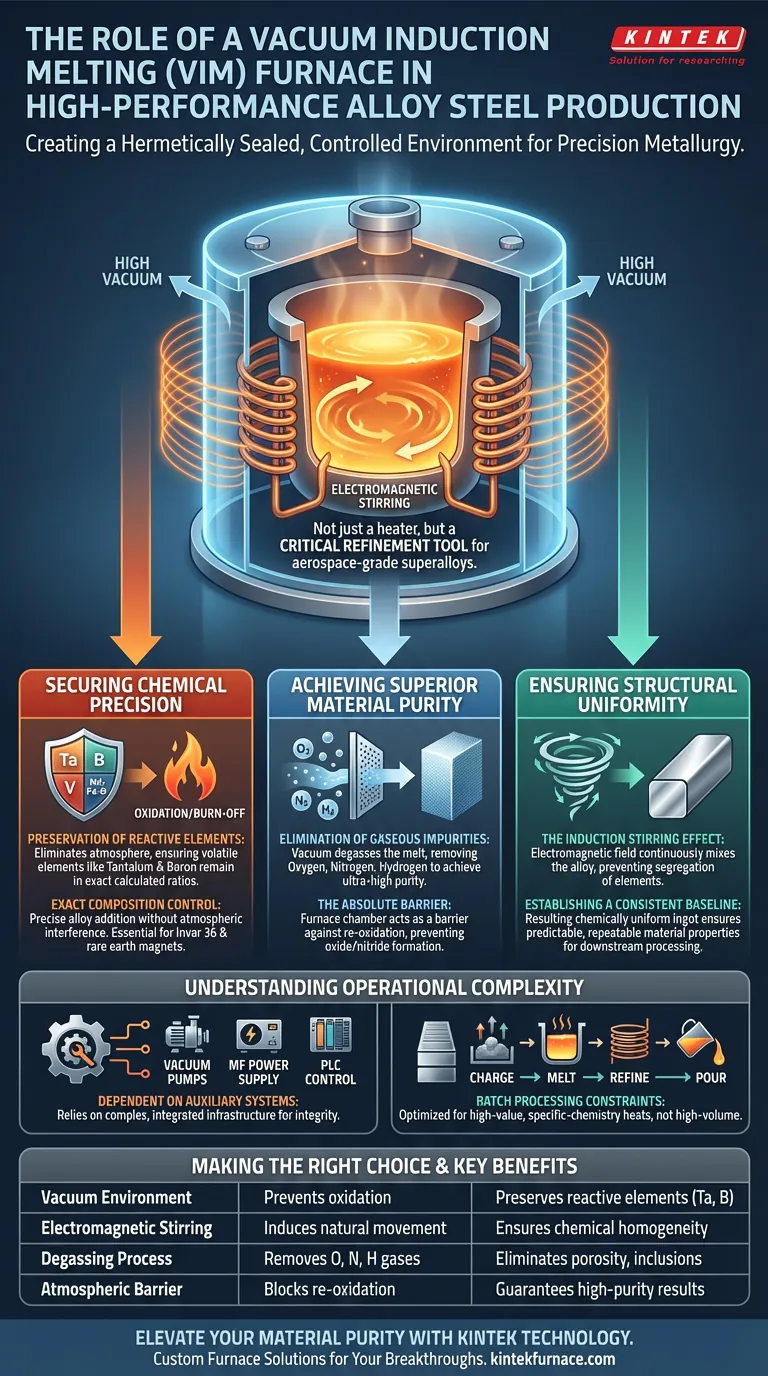
The primary role of a Vacuum Induction Melting (VIM) furnace is to create a hermetically sealed, controlled environment for processing high-performance alloys. By melting metal under a high vacuum, the furnace prevents the oxidative loss of reactive elements like tantalum and boron, ensuring the final chemical composition is precise. Additionally, the electromagnetic nature of the heating source induces a stirring effect, guaranteeing a chemically homogeneous ingot that serves as a reliable foundation for advanced manufacturing.
The VIM furnace is not simply a heating device; it is a critical refinement tool that eliminates atmospheric contamination and locks in the precise chemistry required for aerospace-grade superalloys and high-purity steels.
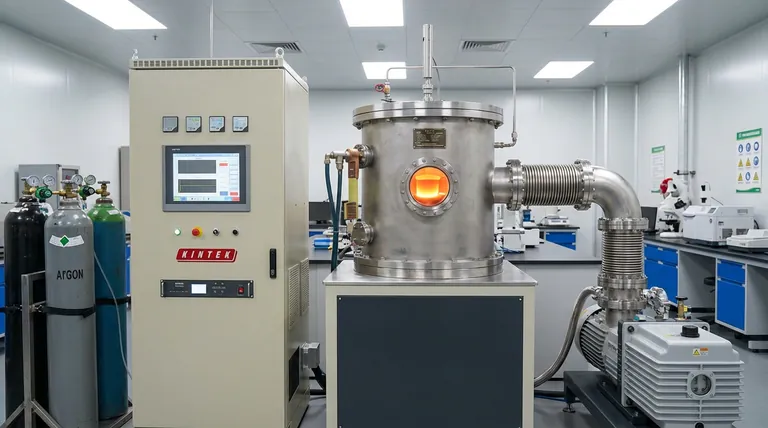
Securing Chemical Precision
Preservation of Reactive Elements
In open-air melting, reactive alloying elements such as tantalum, vanadium, and boron interact with oxygen and "burn off" before they can integrate into the steel.
The VIM furnace solves this by eliminating the atmosphere. This protection ensures that these volatile elements remain in the melt at the exact ratios calculated by the metallurgist.
Exact Composition Control
The vacuum environment allows for the precise addition of alloy components without the variable of atmospheric interference.
This capability is essential for materials like Invar 36 or rare earth magnets (such as Nd-Fe-B), where even slight deviations in chemical ratios can drastically alter physical or magnetic performance.
Achieving Superior Material Purity
Elimination of Gaseous Impurities
High-performance steels require a microstructure free from gas porosity and inclusions.
VIM technology effectively removes gaseous impurities, specifically oxygen, nitrogen, and hydrogen. The vacuum pressure draws these gases out of the molten metal, degassing the material to a level of purity that traditional melting methods cannot achieve.
The Absolute Barrier
The furnace chamber acts as an absolute barrier against re-oxidation.
By utilizing vacuum pumps or backfilling with high-purity inert gases like argon, the system creates a pristine environment. This prevents the formation of oxides and nitrides that would otherwise compromise the structural integrity of the final product.
Ensuring Structural Uniformity
The Induction Stirring Effect
A unique advantage of the VIM furnace is the electromagnetic field generated by the copper induction coil.
This field creates a natural stirring action within the molten metal bath. This movement continuously mixes the alloy, preventing segregation of heavier or lighter elements.
Establishing a Consistent Baseline
The result of this stirring is a chemically uniform ingot.
This uniformity is critical because it establishes a consistent base for subsequent thermal processing. Whether the material is destined for a turbine blade or a semiconductor, the VIM process ensures the material properties are predictable and repeatable throughout the entire ingot.
Understanding the Operational Complexity
Dependent on Auxiliary Systems
Unlike simple electric arc furnaces, a VIM system relies heavily on complex supporting infrastructure.
The supplementary references highlight the need for vacuum systems, medium frequency power supplies, and specialized tilting mechanisms. The performance of the furnace is entirely dependent on the integrity of the vacuum seal and the precise control of the PLC (Programmable Logic Controller).
Batch Processing Constraints
The VIM process is typically a batch operation involving charging, melting, refining, and pouring within a sealed chamber.
This makes it inherently different from continuous casting methods. It is optimized for high-value, specific-chemistry heats rather than high-volume, low-grade steel production.
Making the Right Choice for Your Goal
The VIM furnace is the industry standard for applications where material failure is not an option.
- If your primary focus is Chemical Stability: Use VIM to retain volatile elements like boron and tantalum that are critical for alloy strength.
- If your primary focus is Microstructural Cleanliness: Rely on VIM to degas the melt, removing hydrogen and nitrogen to prevent embrittlement and porosity.
- If your primary focus is Uniformity: Leverage the induction stirring effect to ensure the alloy composition is identical at every point in the ingot.
VIM technology transforms metal production from a bulk industrial process into a precise chemical science, enabling the creation of materials that define modern high-performance engineering.
Summary Table:
| Key Feature | Functional Role | Core Benefit |
|---|---|---|
| Vacuum Environment | Prevents oxidation and atmospheric contamination | Preserves reactive elements (Tantalum, Boron) |
| Electromagnetic Stirring | Induces natural movement in the molten bath | Ensures chemical homogeneity and uniformity |
| Degassing Process | Removes oxygen, nitrogen, and hydrogen gases | Eliminates porosity and structural inclusions |
| Atmospheric Barrier | Blocks re-oxidation via vacuum or inert gas | Guarantees high-purity, aerospace-grade results |
Elevate Your Material Purity with KINTEK Technology
Precision in metallurgy demands more than just heat; it requires an environment where chemistry is perfectly preserved. Backed by expert R&D and manufacturing, KINTEK offers high-performance Vacuum, Muffle, Tube, Rotary, and CVD systems, all customizable to meet your unique laboratory and production needs.
Whether you are developing aerospace-grade superalloys or high-purity steels, our advanced furnace solutions provide the control and uniformity your research deserves. Contact us today to discuss your custom furnace requirements and see how our expertise can drive your next material breakthrough.
Visual Guide
References
- Russell Goodall, Jack Haley. Development of a boron-containing reduced activation Ferritic-Martensitic (B-RAFM) steel. DOI: 10.1177/03019233241273484
This article is also based on technical information from Kintek Furnace Knowledge Base .
Related Products
- Vacuum Induction Melting Furnace
- 600T Vacuum Induction Hot Press Vacuum Heat Treat and Sintering Furnace
- Vacuum Heat Treat Sintering Furnace Molybdenum Wire Vacuum Sintering Furnace
- Vacuum Heat Treat Sintering Furnace with Pressure for Vacuum Sintering
- Vacuum Heat Treat Sintering and Brazing Furnace
People Also Ask
- What are the core functions of the High Vacuum Induction Melting (VIM) furnace? Optimize DD5 Superalloy Purification
- What are the technical advantages of using a Vacuum Induction Melting furnace in the development of advanced packaging steel?
- Why is a Vacuum Induction Melting furnace (VIM) used for Cu-Zn-Al-Sn alloys? Achieve Precision Composition Control
- What is the role of VIM and directional solidification in aero-engine blade substrates? Engineering Extreme Durability
- What are the advantages of using a VIM furnace to control residual oxygen pressure? Achieve Superior Metal Uniformity



















