
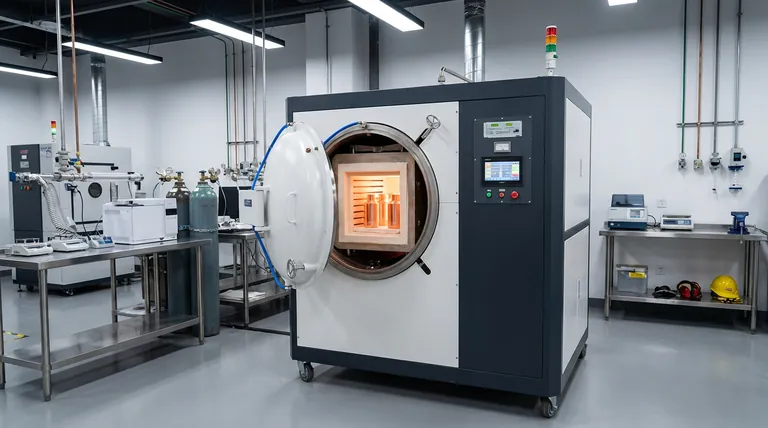
High-precision annealing serves as a critical microstructural reset for GRCop-42 components produced via Directed Energy Deposition (DED) or cold spray. By utilizing a highly stable thermal field at 700°C, the furnace induces essential recrystallization that homogenizes the material structure. This process is necessary to repair manufacturing inconsistencies and unlock the alloy's maximum thermal potential.
The core purpose of this post-processing step is to transform an uneven, printed microstructure into a uniform, high-performance state. It specifically drives a 20% increase in thermal conductivity, pushing the material’s capability to 390 W/mK.
Achieving Microstructural Uniformity
Eliminating Process Inconsistencies
Additive manufacturing methods, particularly cold spray, often leave behind significant microstructural non-uniformities.
A high-precision furnace corrects these irregularities. It provides the controlled environment needed to induce recrystallization, effectively normalizing the material structure across the entire part.
Refining Grain Size
For parts produced via Directed Energy Deposition (DED), the annealing process acts as a grain refiner.
The treatment reduces DED grain sizes to a precise 6.1 micrometers. This refinement is essential for ensuring consistent mechanical properties throughout the component.
Maximizing Thermal Performance
Controlling the Cr2Nb Phase
The defining feature of GRCop-42 is its Chromium-Niobium (Cr2Nb) precipitates.
Without proper post-processing, these precipitates may be unevenly distributed. The annealing furnace ensures a uniform dispersion of the Cr2Nb phase within the copper matrix.
Boosting Conductivity
The arrangement of the microstructure directly impacts how well the part conducts heat.
By optimizing the phase dispersion and grain structure, the annealing process increases thermal conductivity by 20%. This allows the final part to achieve a thermal conductivity of 390 W/mK, a critical metric for high-heat flux applications.
Understanding the Trade-offs
The Necessity of Precision
The term "high-precision" is not merely marketing; it is an engineering requirement.
The benefits described—specifically the uniform Cr2Nb dispersion and grain refinement—rely entirely on a stable thermal field.
Risks of Thermal Instability
If the furnace cannot maintain the precise 700°C environment, the recrystallization process will be inconsistent.
Fluctuations in temperature can lead to incomplete phase dispersion. This results in parts that fail to reach the target 390 W/mK conductivity, compromising their performance in demanding environments.
Making the Right Choice for Your Goal
To determine if this specific post-processing step is required for your application, consider your performance targets:
- If your primary focus is Maximum Heat Transfer: You must utilize high-precision annealing to achieve the 20% boost in conductivity required to reach 390 W/mK.
- If your primary focus is Material Consistency: This process is essential for eliminating the non-uniformities inherent in cold spray and DED processes to ensure a predictable lifespan.
Precise thermal management during post-processing is just as vital as the printing process itself for unlocking the full capabilities of GRCop-42.
Summary Table:
| Feature | Before Annealing (As-Printed) | After High-Precision Annealing (700°C) |
|---|---|---|
| Microstructure | Non-uniform / Process inconsistencies | Homogenized / Recrystallized |
| Thermal Conductivity | ~325 W/mK | 390 W/mK (20% Increase) |
| Grain Size (DED) | Larger / Irregular | Refined to 6.1 micrometers |
| Cr2Nb Phase | Uneven dispersion | Uniformly dispersed in Copper matrix |
| Performance | Variable / Inconsistent | Optimized for high-heat flux |
Unlock the Full Potential of Your GRCop-42 Components
Precision thermal management is the difference between a failed part and a high-performance heat exchanger. At KINTEK, we understand that additive manufacturing is only half the battle. Backed by expert R&D and world-class manufacturing, we provide the high-stability Vacuum and Muffle furnace systems necessary to achieve critical 700°C recrystallization and phase dispersion.
Whether you are refining DED grains or boosting Cold Spray conductivity, our customizable lab and industrial high-temp furnaces ensure your materials reach their 390 W/mK potential. Don't let thermal instability compromise your engineering—Contact KINTEK today to discuss your unique post-processing needs!
References
- Suhair Ghazi Mahdi. Comparative Study of Additive Manufacturing Techniques and Post-Processing on Microstructure and Properties of 17-4PH Stainless Steel and GRCop-42 Copper Alloy: Sintering Optimization vs Recrystallization Annealing. DOI: 10.22399/ijcesen.2657
This article is also based on technical information from Kintek Furnace Knowledge Base .
Related Products
- Controlled Inert Nitrogen Hydrogen Atmosphere Furnace
- High Temperature Muffle Oven Furnace for Laboratory Debinding and Pre Sintering
- Vacuum Heat Treat Sintering Furnace with Pressure for Vacuum Sintering
- High Pressure Laboratory Vacuum Tube Furnace
- 1400℃ Controlled Inert Nitrogen Atmosphere Furnace
People Also Ask
- How does hydrogen furnace annealing assist in preparing mechanically alloyed powders for compaction?
- How does atmospheric annealing in a controlled hydrogen furnace affect the cold compaction behavior of metal powders?
- What are the characteristics and uses of hydrogen atmosphere in furnaces? Achieve Superior Surface Purity and Bonding
- What are the characteristics and uses of hydrogen atmospheres in furnaces? Unlock Clean Metal Processing
- What controlled-atmosphere furnace conditions are required for sintering powder metallurgy copper alloy compacts? Ideal Setup








