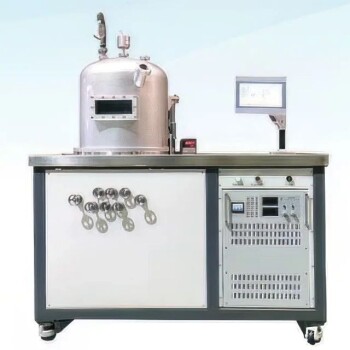
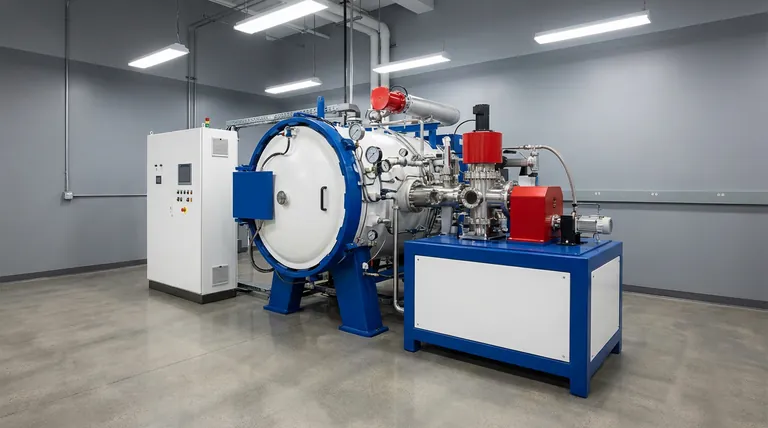
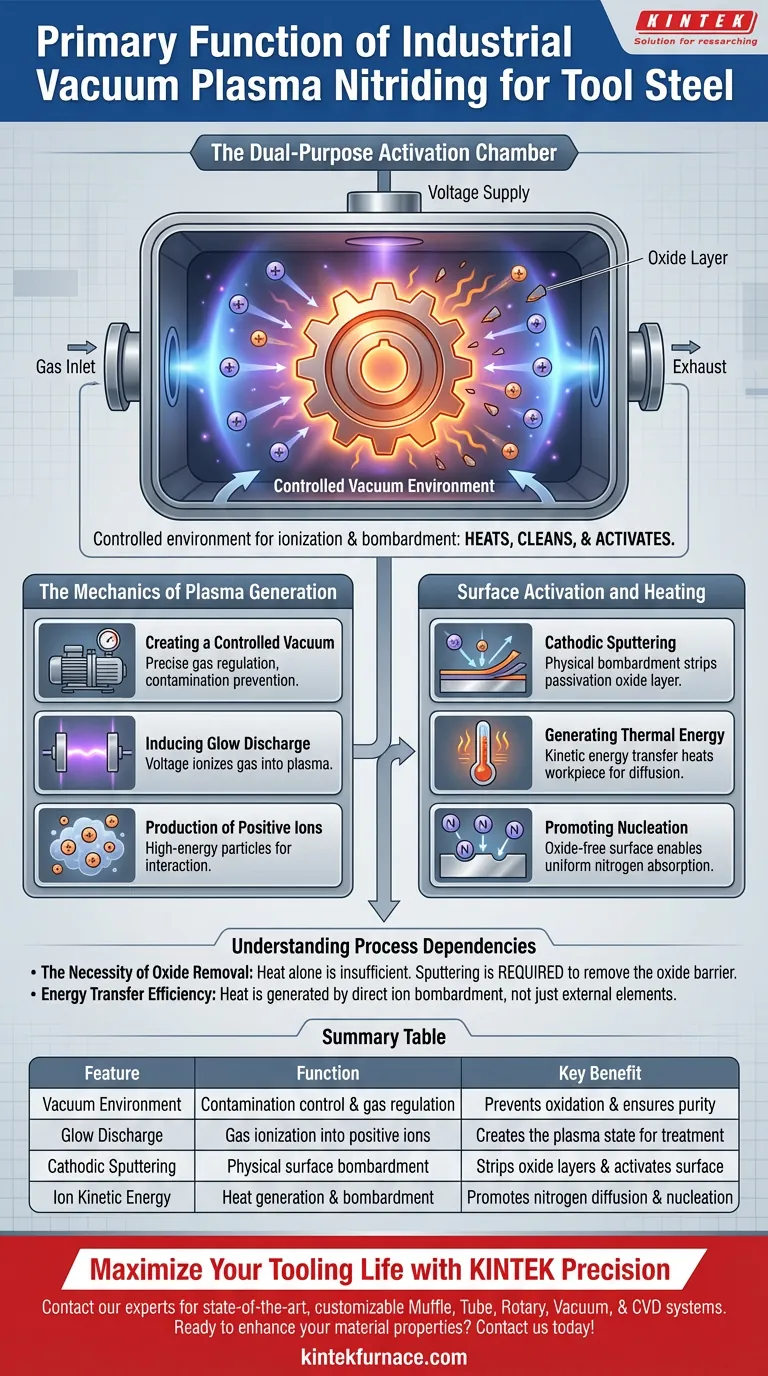
The primary function of industrial vacuum plasma nitriding equipment is to create a controlled environment that facilitates the ionization of gas and the subsequent bombardment of the workpiece. By applying voltage to induce a glow discharge, the equipment generates high-energy positive ions that physically strike the tool steel, simultaneously heating it and cleaning its surface to prepare it for nitrogen absorption.
The equipment acts as a dual-purpose activation chamber: it uses cathodic sputtering to strip away stubborn oxide layers while generating the thermal energy necessary for nitrogen to diffuse deep into the steel.
The Mechanics of Plasma Generation
Creating a Controlled Vacuum
The equipment first establishes a controlled vacuum environment. This is the fundamental prerequisite for the process, ensuring that the gas composition can be precisely regulated and preventing contamination from atmospheric gases.
Inducing Glow Discharge
Once the vacuum is established, the equipment applies voltage to the system. This electrical potential induces a glow discharge, a phenomenon where the gas within the chamber is ionized.
Production of Positive Ions
The ionization process converts the gas into positive ions. These are electrically charged, high-energy particles that are crucial for the physical interaction with the tool steel surface.
Surface Activation and Heating
Cathodic Sputtering
The positive ions are accelerated toward the workpiece, bombarding the surface with significant force. This bombardment produces a "sputtering" effect, effectively removing the passivation oxide layer.
Removing Barriers to Diffusion
Tool steel often has an oxide layer that inhibits chemical treatment. By physically stripping this layer via sputtering, the equipment exposes the fresh metal underneath, making it chemically active.
Generating Thermal Energy
The impact of these high-energy particles does more than just clean; it transfers kinetic energy into heat. This generates the thermal energy required to drive the diffusion of nitrogen into the steel matrix.
Promoting Nucleation
The combination of a clean, oxide-free surface and sufficient thermal energy promotes the adsorption and nucleation of nitrogen atoms. This ensures the nitriding layer forms uniformly and adheres strongly to the substrate.
Understanding Process Dependencies
The Necessity of Oxide Removal
A common misconception is that heat alone is sufficient for nitriding. However, without the cathodic sputtering provided by this equipment, the surface passivation layer on tool steel would act as a barrier, preventing nitrogen penetration regardless of the temperature.
Energy Transfer Efficiency
The process relies on the direct bombardment of the surface to generate heat. This means the efficiency of the thermal energy generation is directly tied to the intensity and control of the ion bombardment, rather than external heating elements alone.
Making the Right Choice for Your Goal
To maximize the effectiveness of vacuum plasma nitriding, consider how the equipment's functions align with your specific metallurgical requirements.
- If your primary focus is Surface Cleanliness: Ensure the equipment is calibrated to deliver sufficient sputtering energy to fully remove the passivation oxide layer before diffusion begins.
- If your primary focus is Diffusion Efficiency: Monitor the voltage and glow discharge stability to maintain the consistent thermal energy required for deep nitrogen penetration.
The ultimate value of this equipment lies in its ability to turn the tool steel surface into a highly active receptor for nitrogen through precise ionic bombardment.
Summary Table:
| Feature | Function in Plasma Nitriding | Key Benefit for Tool Steel |
|---|---|---|
| Vacuum Environment | Contamination control & gas regulation | Prevents oxidation & ensures purity |
| Glow Discharge | Gas ionization into positive ions | Creates the plasma state for treatment |
| Cathodic Sputtering | Physical surface bombardment | Strips oxide layers & activates surface |
| Ion Kinetic Energy | Heat generation & bombardment | Promotes nitrogen diffusion & nucleation |
Maximize Your Tooling Life with KINTEK Precision
Don't let passive oxide layers compromise your heat treatment. At KINTEK, we provide state-of-the-art industrial vacuum solutions designed to deliver superior surface activation and uniform nitrogen diffusion. Backed by expert R&D and world-class manufacturing, our systems—including Muffle, Tube, Rotary, Vacuum, and CVD systems—are fully customizable to meet the rigorous demands of your metallurgical processes.
Ready to enhance your material properties? Contact our technical experts today to find the perfect high-temperature furnace for your unique needs!
Visual Guide
References
- Magdalena Mokrzycka, Maciej Pytel. The influence of plasma nitriding process conditions on the microstructure of coatings obtained on the substrate of selected tool steels. DOI: 10.7862/rm.2024.1
This article is also based on technical information from Kintek Furnace Knowledge Base .
Related Products
- Vacuum Hot Press Furnace Machine for Lamination and Heating
- MPCVD Machine System Reactor Bell-jar Resonator for Lab and Diamond Growth
- Vacuum Induction Melting Furnace
- Small Vacuum Heat Treat and Tungsten Wire Sintering Furnace
- Vacuum Heat Treat Sintering Furnace with Pressure for Vacuum Sintering
People Also Ask
- What are the primary components of a vacuum hot press furnace? Master the Core Systems for Precise Material Processing
- What safety features are incorporated in vacuum hot press furnaces? Ensure Operator and Equipment Protection
- What are the benefits of the vacuum environment system in a vacuum hot press furnace? Unlock High-Density Sintering
- What industries benefit from the use of vacuum hot press furnaces? Unlock High-Performance Materials for Your Industry
- How does the uniaxial pressure applied by a vacuum hot press furnace affect the microstructure of ZrC-SiC materials?