
The primary function of an industrial muffle furnace in this context is to provide a stable, high-temperature environment—typically 500°C in an air atmosphere—to thermally treat carbon paper electrodes. This process acts as a critical activation step, designed to simultaneously clean the material and alter its surface chemistry.
By subjecting the carbon paper to controlled thermal oxidation, the furnace transforms the material's surface from hydrophobic to hydrophilic, ensuring optimal interaction with liquid electrolytes.
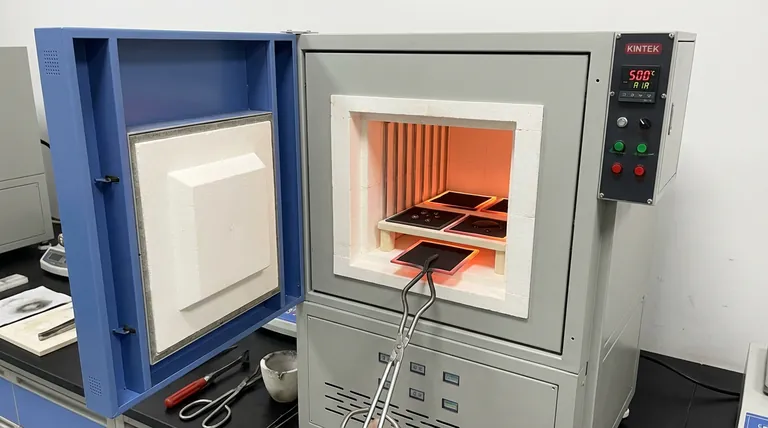
The Mechanisms of Surface Modification
Eliminating Organic Impurities
Raw carbon paper frequently contains residual organic contaminants left over from the manufacturing process.
The muffle furnace utilizes high heat to burn off these organic impurities. This results in a pristine carbon surface that is ready for chemical activation.
Introducing Active Functional Groups
Beyond simple cleaning, the furnace utilizes the air atmosphere to induce controlled oxidation of the carbon fibers.
This thermochemical treatment introduces oxygen-containing functional groups, such as carbonyl (C=O) groups, onto the fiber surface. These groups are the key drivers for changing how the electrode interacts with liquids.
Impact on Electrode Performance
Significantly Enhancing Wettability
Untreated carbon fibers are naturally hydrophobic, meaning they repel water and liquid electrolytes.
The oxygen functional groups introduced by the furnace dramatically increase hydrophilicity. This allows the electrolyte to penetrate the porous structure of the carbon paper rather than beading up on the surface.
Improving Contact Efficiency
For a battery to function efficiently, the active electrolyte must have intimate contact with the electrode surface.
The heat treatment ensures that the maximum possible surface area is utilized. This improves the contact efficiency between the electrolyte and the electrode.
Optimizing Reaction Kinetics
The presence of active functional groups does more than just attract water; it improves electrocatalytic activity.
This is particularly vital for applications like vanadium redox flow batteries, where optimized reaction kinetics directly translate to better battery performance.
Critical Process Constraints
The Risk of Over-Oxidation
While oxidation is the goal, carbon paper is susceptible to burning away completely if not managed correctly.
If the temperature exceeds the target (e.g., significantly above 500°C) or the holding time is too long, the carbon fibers will degrade. This compromises the mechanical integrity of the electrode.
Necessity of Uniformity
Inconsistent heating can lead to "hot spots" where parts of the paper are burned while others remain hydrophobic.
A muffle furnace (or box resistance furnace) is specifically chosen because it provides a uniform thermal environment, ensuring the entire batch receives the same level of activation.
Making the Right Choice for Your Goal
To maximize the utility of this process, align your furnace parameters with your specific engineering objectives:
- If your primary focus is surface purity: Ensure the furnace temperature is high enough to fully volatilize organic residues, but strictly capped to prevent structural fiber damage.
- If your primary focus is electrochemical performance: Prioritize precise control over the heating rate and holding time to maximize the density of active oxygen functional groups without degrading the material.
The muffle furnace is not merely a heating device; it is a precision activation tool that dictates the ultimate efficiency of the electrode interface.
Summary Table:
| Process Objective | Mechanism | Key Outcome |
|---|---|---|
| Impurity Removal | Thermal decomposition | Pristine, contaminant-free carbon surface |
| Surface Activation | Controlled oxidation | Introduction of oxygen-containing functional groups |
| Wettability Improvement | Chemistry modification | Transition from hydrophobic to hydrophilic state |
| Performance Optimization | Enhanced contact area | Improved reaction kinetics and battery efficiency |
Elevate Your Electrode Research with KINTEK Precision
Consistency is key when activating carbon paper electrodes. KINTEK’s high-temperature muffle and tube furnaces provide the precise thermal uniformity required to ensure optimal hydrophilicity without compromising material integrity.
Backed by expert R&D and manufacturing, KINTEK offers Muffle, Tube, Rotary, Vacuum, and CVD systems, all customizable for your unique lab or industrial needs. Don't risk over-oxidation or inconsistent batches—partner with the thermal processing experts.
Contact KINTEK today to find your custom furnace solution!
References
- Maedeh Pahlevaninezhad, Edward P.L. Roberts. Ammonium Bifluoride‐Etched MXene Modified Electrode for the All−Vanadium Redox Flow Battery. DOI: 10.1002/batt.202300473
This article is also based on technical information from Kintek Furnace Knowledge Base .
Related Products
- 1400℃ Muffle Oven Furnace for Laboratory
- 1200℃ Muffle Oven Furnace for Laboratory
- 1700℃ High Temperature Muffle Oven Furnace for Laboratory
- 1800℃ High Temperature Muffle Oven Furnace for Laboratory
- High Temperature Muffle Oven Furnace for Laboratory Debinding and Pre Sintering
People Also Ask
- What is the primary function of a high-temperature laboratory muffle furnace in chemical synthesis? Achieve Precision.
- How does a high-temperature laboratory muffle furnace affect material properties? Transform Anodic Oxide Films Fast
- What is the muffle furnace function in ilmenite oxidative roasting? Enhance Phase Change & Magnetic Separation
- What is the role of a laboratory high-temperature muffle furnace in H13 steel treatment? Optimize Tool Performance
- What is the function of a muffle furnace in MOF-derived zirconia conversion? Optimize Phase & Pore Engineering



















