
In the production of Zinc Oxide (ZnO) nanopowders, the primary function of a high-temperature muffle furnace is the calcination of dried precursors. This critical thermal process typically occurs at temperatures around 500 °C to remove organic impurities and facilitate the complete chemical transformation of the precursor into highly crystalline ZnO nanoparticles with a specific hexagonal wurtzite structure.
The muffle furnace acts as a controlled thermal reactor that drives the phase transition from amorphous precursors to crystalline nanopowders. By providing stable heat and an oxidizing atmosphere, it ensures the elimination of organic templates and the precision growth of the desired crystal lattice.
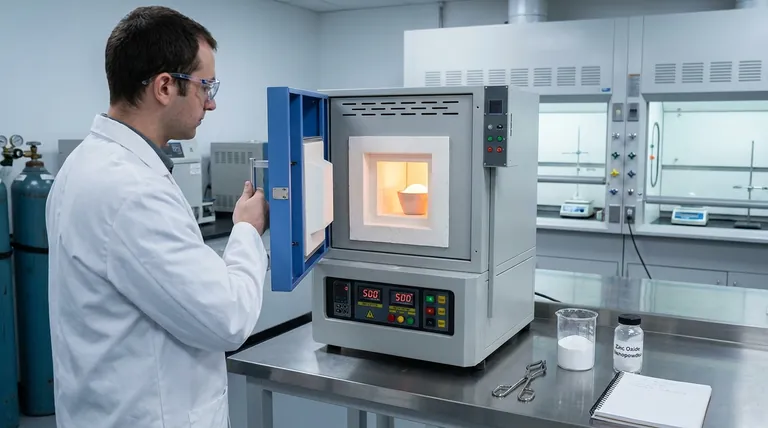
Driving Chemical and Structural Transformation
Facilitating Precursor Calcination
The muffle furnace provides the high-temperature environment necessary for the calcination of solid precipitates or dried precursors. This process involves heating the material—often at temperatures between 400 °C and 500 °C—to trigger the chemical breakdown of the starting compounds.
Enabling Phase Transition
Inside the furnace, zinc species undergo a systematic phase transition under controlled heat. This transition shifts the material from an amorphous or intermediate state into a definitive semiconductor crystal, specifically the hexagonal wurtzite structure.
Regulating Crystal Growth
The furnace's superior temperature control accuracy is vital for managing growth kinetics. By maintaining a stable thermal field, the furnace ensures that the crystals grow uniformly, which is essential for achieving the specific nano-scale dimensions and high crystalline quality required for functional materials.
Purification and Material Integrity
Oxidative Removal of Impurities
A major role of the furnace is the thermal decomposition and oxidative removal of residual organic matter, such as starch templates or salts. The oxidizing atmosphere within the muffle ensures that these impurities are completely eliminated, leaving behind a high-purity product.
Achieving High Crystallinity
By providing consistent and uniform heating, the muffle furnace minimizes defects within the powder. This results in high crystallinity, which is a prerequisite for the electronic and optical performance of Zinc Oxide in industrial applications.
Structural Protection via the Muffle
The "muffle" itself—a refractory chamber—protects the nanopowder from direct contact with heating elements. This ensures even heat distribution and prevents contamination, maintaining the chemical integrity of the semiconductor material during the long hours of thermal treatment.
Understanding the Trade-offs
Temperature Sensitivity
If the calcination temperature is too low, the precursor may not fully transform, leaving residual impurities that degrade the material's purity. Conversely, excessively high temperatures can lead to uncontrolled grain growth, causing the nanoparticles to sinter together and lose their desired surface area and "nano" characteristics.
Atmosphere Control
While a standard muffle furnace provides an oxidizing air atmosphere, failure to manage airflow can lead to incomplete combustion of organic templates. This results in carbon residues within the nanopowder, which can significantly alter the electrical conductivity and color of the final Zinc Oxide product.
How to Apply This to Your Project
Maximizing Nanopowder Quality
- If your primary focus is Phase Purity: Ensure the muffle furnace is calibrated to maintain a steady 500 °C to guarantee the full transition to the hexagonal wurtzite structure.
- If your primary focus is Particle Size Control: Optimize the duration of the calcination (e.g., 2 to 3 hours) and use the minimum effective temperature to prevent over-growth of the nanocrystals.
- If your primary focus is Removing Organic Templates: Ensure adequate ventilation or a sufficient oxidizing atmosphere within the furnace chamber to allow for the complete decomposition of carbon-based precursors.
The muffle furnace is the definitive tool for transforming raw chemical precursors into high-purity, crystalline Zinc Oxide nanopowders through precise thermal regulation.
Summary Table:
| Process Phase | Primary Function of Furnace | Key Outcome |
|---|---|---|
| Calcination | High-temp thermal decomposition (400-500°C) | Removal of organic impurities & templates |
| Phase Transition | Controlled thermal reaction environment | Amorphous to Hexagonal Wurtzite structure |
| Crystallization | Uniform heat distribution | High crystallinity & regulated grain growth |
| Purification | Oxidizing atmosphere | Complete elimination of carbon residues |
Elevate Your Nanomaterial Synthesis with KINTEK
Precision is the difference between ordinary powder and high-performance nanopowders. KINTEK provides industry-leading laboratory thermal solutions, including Muffle, Tube, Rotary, Vacuum, and CVD systems, all designed to meet the rigorous demands of material science.
Backed by expert R&D and advanced manufacturing, our furnaces offer the superior temperature uniformity and atmospheric control essential for achieving perfect phase transitions and high crystallinity in Zinc Oxide production. Whether you need a standard setup or a fully customizable system for unique research needs, KINTEK is your partner in innovation.
Ready to optimize your calcination process? Contact our experts today to find the perfect furnace for your lab!
References
- Basílio José Augusto José, M.D. Shinde. Colloidal stability and dielectric behavior of eco-friendly synthesized zinc oxide nanostructures from Moringa seeds. DOI: 10.1038/s41598-024-52093-5
This article is also based on technical information from Kintek Furnace Knowledge Base .
Related Products
- 1700℃ High Temperature Muffle Oven Furnace for Laboratory
- 1800℃ High Temperature Muffle Oven Furnace for Laboratory
- 1200℃ Muffle Oven Furnace for Laboratory
- 1400℃ Muffle Oven Furnace for Laboratory
- High Temperature Muffle Oven Furnace for Laboratory Debinding and Pre Sintering
People Also Ask
- What is the primary function of a high-temperature laboratory muffle furnace in chemical synthesis? Achieve Precision.
- How does a high-temperature laboratory muffle furnace affect material properties? Transform Anodic Oxide Films Fast
- What role does a muffle furnace play in BCZY712 electrolyte powder production? Achieve Perfect Phase Purity
- How does the two-stage sintering process contribute to the synthesis of MeCuFeO3 perovskite? Optimize crystal purity.
- What role does a muffle furnace play in sintering photocathodes? Enhance Electrode Conductivity & Catalytic Activity



















