
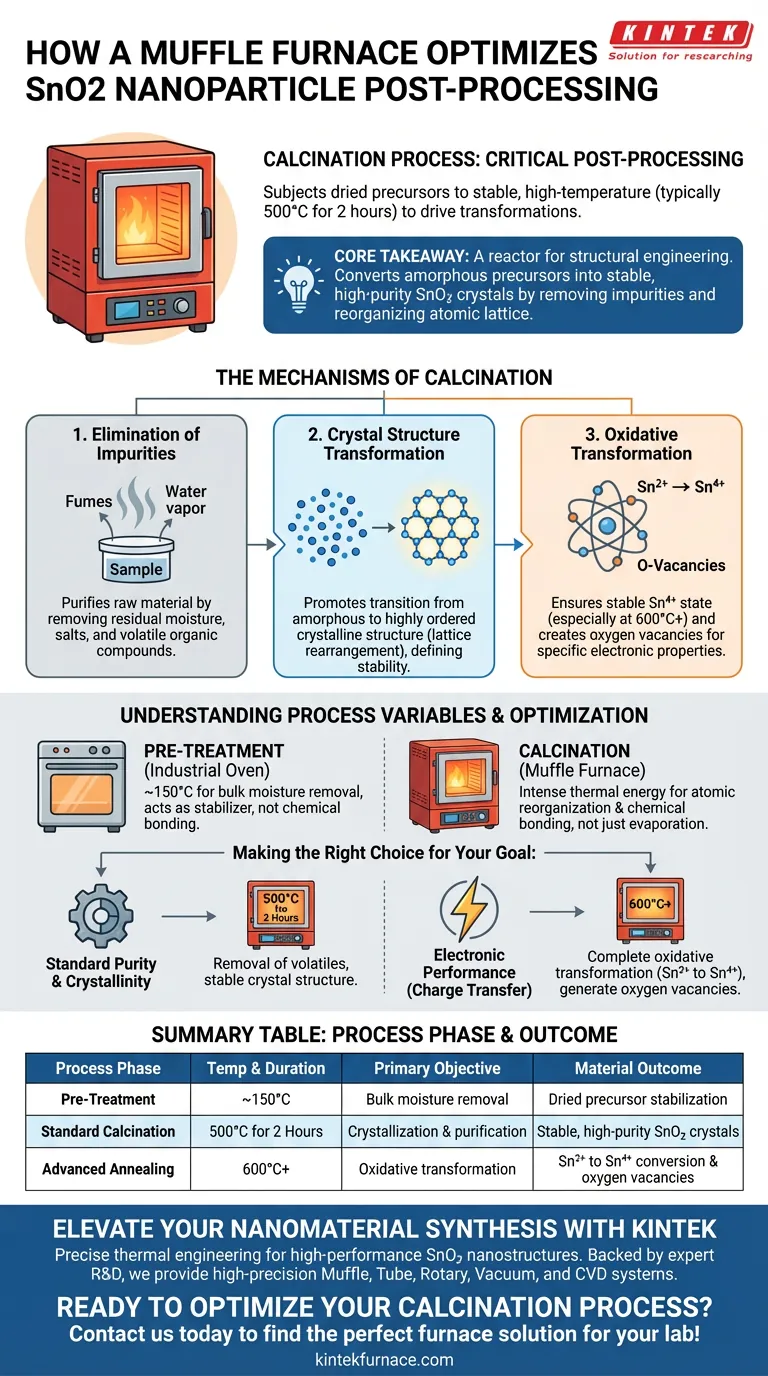
A muffle furnace serves as the critical mechanism for calcination during the final post-processing stages of Tin Oxide (SnO2) nanoparticle synthesis. It functions by subjecting dried precursors to a stable, high-temperature environment—typically 500 degrees Celsius for two hours—to drive the necessary chemical and physical transformations.
Core Takeaway: The muffle furnace is not merely a drying tool; it is a reactor for structural engineering. It removes volatile impurities and provides the thermal energy required to reorganize the atomic lattice, converting amorphous precursors into stable, high-purity SnO2 crystals.
The Mechanisms of Calcination
Elimination of Impurities
The initial function of the muffle furnace is the purification of the raw material.
Dried precursors often retain residual moisture, salts, or volatile organic compounds from the synthesis phase.
By maintaining a consistent high temperature, the furnace ensures these impurities are completely effectively removed, leaving behind only the desired metal oxide structure.
Crystal Structure Transformation
The most profound impact of the muffle furnace is on the crystallinity of the nanoparticles.
The heat treatment promotes the transition from an amorphous (disordered) state to a highly ordered crystalline structure.
This process, known as lattice rearrangement, allows the SnO2 nanopowders to achieve a specific degree of crystallinity, which is directly linked to the material's stability and performance.
Oxidative Transformation
While the primary goal is crystallization, the specific thermal environment also dictates the oxidation state of the tin.
Supplementary data suggests that high-temperature annealing (e.g., reaching up to 600°C in specific protocols) provides the energy necessary to oxidize Tin from the Sn2+ state to the stable Sn4+ state.
This oxidative step is vital for forming SnO2 nanostructures with precise electronic properties, such as induced oxygen vacancies.
Understanding Process Variables
The Temperature-Time Trade-off
While the primary standard for SnO2 is 500°C for two hours, variations in this protocol yield different results.
Lower temperatures may effectively dry the sample but fail to fully induce the phase transformation into a perfect crystal structure.
Conversely, significantly higher temperatures or prolonged times (as noted in supplementary protocols using 600°C) are used to manipulate charge transfer capabilities and oxidation states, but require more energy and precise control to prevent excessive grain growth.
Pre-Treatment vs. Calcination
It is important to distinguish the muffle furnace's role from earlier drying steps.
An industrial oven acts as a stabilizer, typically removing bulk moisture at lower temperatures (around 150°C).
The muffle furnace is distinct in its ability to provide the intense thermal energy required for chemical bonding and atomic reorganization, rather than simple evaporation.
Making the Right Choice for Your Goal
To optimize your SnO2 synthesis, align your furnace settings with your specific material requirements:
- If your primary focus is Standard Purity and Crystallinity: Adhere to the baseline protocol of 500°C for two hours to ensure the removal of volatiles and the formation of a stable crystal structure.
- If your primary focus is Electronic Performance (Charge Transfer): Consider protocols involving higher temperatures (e.g., 600°C) to drive complete oxidative transformation (Sn2+ to Sn4+) and generate oxygen vacancies.
Success in SnO2 post-processing relies on using the muffle furnace not just to heat the material, but to precisely engineer its final crystalline state.
Summary Table:
| Process Phase | Temperature & Duration | Primary Objective | Material Outcome |
|---|---|---|---|
| Pre-Treatment | ~150°C | Bulk moisture removal | Dried precursor stabilization |
| Standard Calcination | 500°C for 2 Hours | Crystallization & purification | Stable, high-purity SnO2 crystals |
| Advanced Annealing | 600°C+ | Oxidative transformation | Sn2+ to Sn4+ conversion & oxygen vacancies |
Elevate Your Nanomaterial Synthesis with KINTEK
Precise thermal engineering is the difference between amorphous precursors and high-performance SnO2 nanostructures. Backed by expert R&D and world-class manufacturing, KINTEK provides high-precision Muffle, Tube, Rotary, Vacuum, and CVD systems designed for the rigorous demands of advanced lab research.
Whether you require a standard high-temperature furnace or a fully customizable system tailored to your unique synthesis protocol, KINTEK delivers the temperature stability and uniformity your materials demand.
Ready to optimize your calcination process? Contact us today to find the perfect furnace solution for your lab!
Visual Guide
References
- Haewon Byeon, J. Sunil. Fabrication of and corrosion prevention mechanisms of tin oxide (SnO2) decorated reduced graphene oxide (rGO) for anodic protection of Zn metal surfaces. DOI: 10.4314/bcse.v38i2.12
This article is also based on technical information from Kintek Furnace Knowledge Base .
Related Products
- 1400℃ Muffle Oven Furnace for Laboratory
- 1200℃ Muffle Oven Furnace for Laboratory
- Laboratory Muffle Oven Furnace with Bottom Lifting
- High Temperature Muffle Oven Furnace for Laboratory Debinding and Pre Sintering
- 1800℃ High Temperature Muffle Oven Furnace for Laboratory
People Also Ask
- How does a high-temperature laboratory muffle furnace affect material properties? Transform Anodic Oxide Films Fast
- What is the primary function of a high-temperature laboratory muffle furnace in chemical synthesis? Achieve Precision.
- How does a muffle furnace facilitate Ag/ATP catalyst preparation? Optimize Calcination for Superior Performance
- What is the purpose of using a laboratory high-temperature muffle furnace for drying Fe-Ni-Co catalysts? Boost Purity
- What role does a muffle furnace play in refractory bricks? Enhance Performance and Durability Testing















