
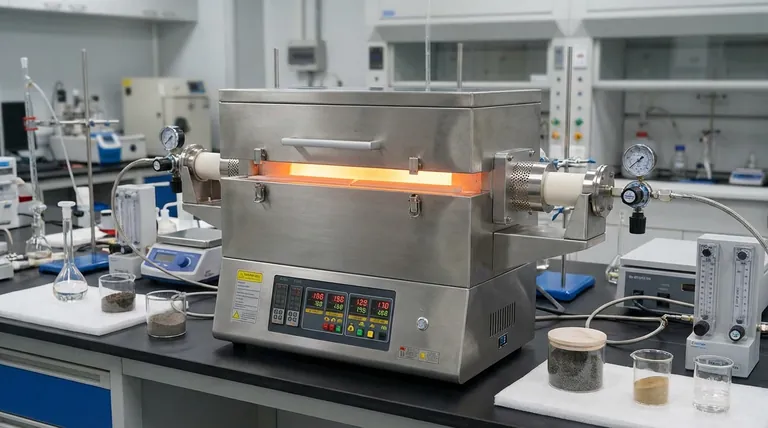
High-temperature calcination is the decisive activation step in catalyst preparation, serving as the bridge between raw precursors and a functional catalytic material. Its primary necessity is to pyrolyze metal salts loaded onto a carrier, converting them into stable metal oxides while eliminating volatile organic components. Additionally, the uniform thermal field provided by muffle or tube furnaces fosters a strong interaction between the active metals and the support, ensuring the catalyst resists leaching and maintains structural integrity.
The process is not merely about drying; it is a fundamental chemical modification that defines the catalyst's final phase and durability. By anchoring active sites to the support structure, calcination ensures the material can withstand rigorous reaction conditions without degrading.
Transforming Precursors into Active Phases
Pyrolysis of Metal Salts
The initial role of calcination is the chemical decomposition of metal precursors. As the temperature rises, metal salts (such as nitrates or acetylacetonates) break down and oxidize. This conversion turns transient precursor compounds into stable metal oxides (like palladium oxide or zinc oxide) which act as the active sites for future reactions.
Removal of Organic Templates
Synthesis often requires organic agents, such as the Pluronic P123 template, to guide structure formation. High-temperature treatment promotes the thermal decomposition of these organic networks. This effectively "cleans" the catalyst, leaving behind only the inorganic framework required for operation.
Formation of Solid-State Phases
Beyond simple decomposition, calcination facilitates complex solid-state reactions. Maintaining high temperatures (e.g., 1050 °C) allows for diffusion reactions that create specific crystalline structures, such as perovskite or spinel phases. These specific phases are often required to achieve the desired redox capacity and electronic properties.
Engineering the Micro-Structure
Optimizing Surface Area and Pores
Precise temperature regulation directly influences the physical texture of the catalyst. Calcination at optimal temperatures (often around 400 °C) removes blocking agents to achieve maximum specific surface area. It establishes the pore size distribution necessary for reactants to access the active sites.
Stabilizing the Support
The thermal treatment determines the crystallographic phase of the support material itself. For instance, converting aluminum precursors into gamma-alumina requires holding specific temperatures to fix the density of surface hydroxyl groups. This structural "setting" dictates how well subsequent metal ions will disperse and anchor during impregnation.
Enhancing Interaction and Durability
A uniform thermal field ensures that the active metal species bond strongly with the carrier material. This metal-support interaction is critical for preventing the active metals from leaching out during liquid-phase reactions. It locks the active components in place, significantly extending the catalyst's lifespan.
Understanding the Trade-offs
The Risk of Thermal Sintering
While heat is necessary for activation, excessive temperature is the primary enemy of catalyst performance. Heating a catalyst too high (e.g., 800 °C for certain materials) can cause severe sintering. This leads to the collapse of the pore structure and a drastic reduction in surface oxygen vacancies, effectively killing the catalyst's activity.
Balancing Crystallinity vs. Surface Area
There is an inherent conflict between forming a highly crystalline structure and maintaining a high surface area. Higher temperatures improve crystallinity and stability but tend to reduce the active surface area. Accurate temperature regulation is the only way to navigate this trade-off to match the specific needs of your chemical reaction.
Making the Right Choice for Your Goal
To maximize your catalyst's performance, you must tailor the calcination protocol to your specific objectives.
- If your primary focus is Maximum Activity (Surface Area): Target moderate temperatures (e.g., 400°C) to clear pores and ligands without inducing structure collapse or sintering.
- If your primary focus is Structural Stability (High Durability): Utilize higher temperatures (e.g., 800°C - 1000°C+) to induce solid-state diffusion and form robust phases like spinels or perovskites.
- If your primary focus is Particle Size Control: Consider using an atmosphere furnace with specific gases (like pure oxygen) to inhibit volume diffusion and promote the formation of finer, better-dispersed nano-powders.
Mastering calcination is not just about applying heat; it is about precisely engineering the thermodynamic environment to dictate the final destiny of your material.
Summary Table:
| Process Function | Key Outcome | Critical Control Point |
|---|---|---|
| Precursor Pyrolysis | Converts metal salts to stable oxides | Temperature Ramp Rate |
| Organic Removal | Eliminates templates/cleaning pores | Oxidation Atmosphere |
| Phase Formation | Creates perovskite or spinel structures | High Temp Hold (e.g. 1050°C) |
| Structural Setting | Enhances metal-support interaction | Thermal Uniformity |
| Texture Control | Optimizes surface area & pore size | Avoidance of Sintering |
Maximize Your Catalyst’s Potential with KINTEK
Achieve the perfect balance between crystallinity and surface area with our high-precision thermal solutions. Backed by expert R&D and manufacturing, KINTEK offers professional Muffle, Tube, Rotary, Vacuum, and CVD systems, along with other lab high-temp furnaces—all fully customizable to meet your unique catalyst pre-treatment needs.
Ready to engineer superior materials?
Contact our specialists today to find the ideal furnace for your lab!
References
- Ismaila Mudi, Joseph Wood. A Kinetic Model of Furfural Hydrogenation to 2-Methylfuran on Nanoparticles of Nickel Supported on Sulfuric Acid-Modified Biochar Catalyst. DOI: 10.3390/catal14010054
This article is also based on technical information from Kintek Furnace Knowledge Base .
Related Products
- 1700℃ High Temperature Laboratory Tube Furnace with Alumina Tube
- 1400℃ High Temperature Laboratory Tube Furnace with Alumina Tube
- 1700℃ High Temperature Muffle Oven Furnace for Laboratory
- 1800℃ High Temperature Muffle Oven Furnace for Laboratory
- 1200℃ Muffle Oven Furnace for Laboratory
People Also Ask
- How does zone-melting in tube furnaces synthesize bismuth micro-wires? Master Single-Crystal Thermoelectric Growth
- How are high-temperature laboratory tube furnaces applied in long-term vacuum homogenization heat treatments for intermetallic samples?
- How are high-temp tube furnaces used to measure diffusion coefficients per Fick's law? Master Precision Annealing
- How do high-temperature laboratory tube furnaces ensure environmental stability? Precision Thermal Reduction Tips
- How are high-temperature tube furnaces applied in testing ceramic-supported alloy membranes? Insights



















