
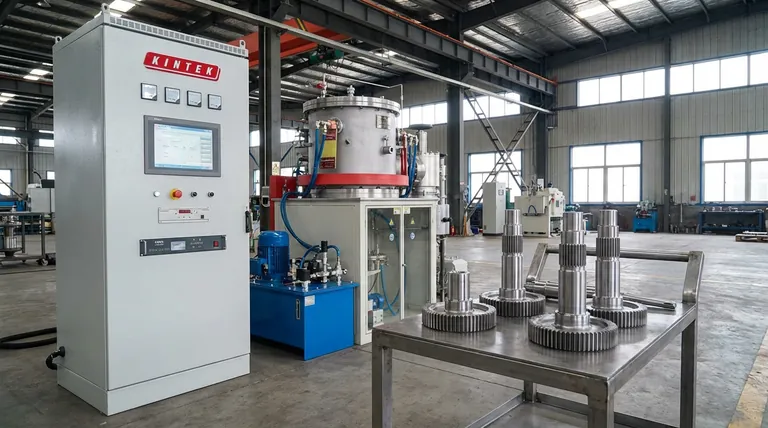
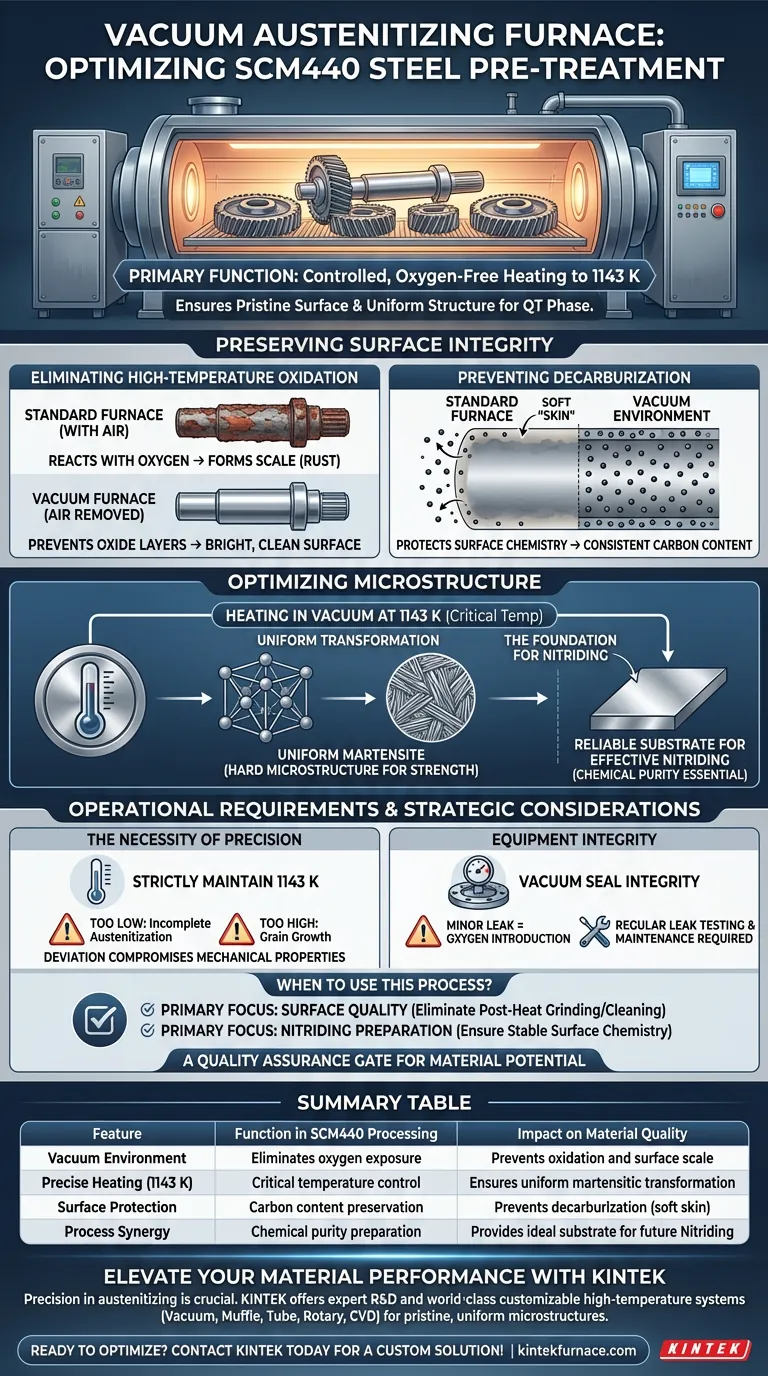
The primary function of an industrial-grade vacuum austenitizing furnace is to create a controlled, oxygen-free environment for heating SCM440 steel to precisely 1143 K during the Quenching and Tempering (QT) phase. By eliminating atmospheric exposure, this equipment ensures the steel reaches its critical transformation temperature without suffering from surface degradation.
To maximize the performance of SCM440 steel, you must treat the internal structure without damaging the exterior surface. The vacuum furnace solves this dual challenge by preventing oxidation and decarburization, delivering a pristine, uniform martensitic structure essential for future processing.
Preserving Surface Integrity
Eliminating High-Temperature Oxidation
When steel is heated to high temperatures in a standard atmosphere, it reacts with oxygen to form scale (rust).
The vacuum furnace removes air from the heating chamber. This prevents the formation of oxide layers, ensuring the steel retains a bright, clean surface throughout the heating cycle.
Preventing Decarburization
Carbon is the element responsible for the hardness and strength of SCM440 steel.
In standard furnaces, surface carbon can be leeched out into the atmosphere, leaving a soft "skin" on the part. The vacuum environment protects the surface chemistry, keeping the carbon content consistent from the core to the skin.
Optimizing Microstructure
Achieving Uniform Martensite
The specific temperature of 1143 K is critical for austenitizing SCM440.
Reaching this temperature in a vacuum allows the steel's crystal structure to transform uniformly. When the steel is subsequently quenched, it forms martensite, a hard microstructure that provides the necessary strength for industrial applications.
The Foundation for Nitriding
SCM440 is frequently subjected to nitriding (a surface hardening process) after the QT phase.
If the surface has been oxidized or decarburized during the initial heating, the nitriding process will be inconsistent or ineffective. The vacuum furnace ensures the surface is chemically pure, acting as a reliable foundation for this subsequent hardening.
Understanding the Operational Requirements
The Necessity of Precision
While vacuum furnaces offer superior quality, they require rigorous control.
The temperature must be maintained strictly at 1143 K. Any deviation can result in incomplete austenitization (too low) or grain growth (too high), compromising the mechanical properties of the steel.
Equipment Integrity
The benefits of this process rely entirely on the integrity of the vacuum seal.
Even a minor leak introduces oxygen, which defeats the purpose of the equipment. Regular maintenance and leak testing are required to ensure the "oxygen-free" status is absolute.
Strategic Considerations for SCM440 Processing
To determine if this process aligns with your manufacturing goals, consider the following:
- If your primary focus is Surface Quality: The vacuum furnace is essential to eliminate the need for aggressive post-heat-treatment grinding or cleaning to remove scale.
- If your primary focus is Nitriding Preparation: You must use vacuum austenitizing to ensure the surface chemistry acts as a stable substrate for nitrogen diffusion.
The vacuum austenitizing furnace is not merely a heating tool; it is a quality assurance gate that safeguards the material's potential before it ever undergoes final hardening.
Summary Table:
| Feature | Function in SCM440 Processing | Impact on Material Quality |
|---|---|---|
| Vacuum Environment | Eliminates oxygen exposure | Prevents oxidation and surface scale |
| Precise Heating (1143 K) | Critical temperature control | Ensures uniform martensitic transformation |
| Surface Protection | Carbon content preservation | Prevents decarburization (soft skin) |
| Process Synergy | Chemical purity preparation | Provides ideal substrate for future Nitriding |
Elevate Your Material Performance with KINTEK
Precision in the austenitizing phase is the difference between industrial-grade SCM440 and material failure. Backed by expert R&D and world-class manufacturing, KINTEK offers a comprehensive range of Vacuum, Muffle, Tube, Rotary, and CVD systems designed to meet the most rigorous lab and industrial standards.
Our high-temperature furnaces are fully customizable to your specific heating cycles, ensuring you achieve a pristine, uniform microstructure every time. Whether you are prepping for nitriding or requiring oxygen-free quenching, KINTEK provides the reliability you need to safeguard your material's integrity.
Ready to optimize your heat treatment process? Contact KINTEK today for a custom solution!
Visual Guide
References
- M.H. Kim, Osamu Umezawa. Influence of Prior Quenching and Tempering Treatment on Cementite Formation during Nitriding at 913 K for SCM440 Steel. DOI: 10.2355/isijinternational.isijint-2024-367
This article is also based on technical information from Kintek Furnace Knowledge Base .
Related Products
- Small Vacuum Heat Treat and Tungsten Wire Sintering Furnace
- Vacuum Heat Treat Sintering Furnace Molybdenum Wire Vacuum Sintering Furnace
- Vacuum Heat Treat Sintering Furnace with Pressure for Vacuum Sintering
- 9MPa Air Pressure Vacuum Heat Treat and Sintering Furnace
- Vacuum Heat Treat Sintering and Brazing Furnace
People Also Ask
- How does vacuum sintering improve dimensional tolerances? Achieve Uniform Shrinkage and Precision
- What are the key components of a vacuum sintering furnace? Essential Parts for Precision Material Processing
- What is the purpose of setting a mid-temperature dwell stage? Eliminate Defects in Vacuum Sintering
- What are the main structural components of a vacuum sintering furnace? Unlock Precision in High-Temperature Processing
- What are the main types of sintering furnaces? Find the Perfect Match for Your Materials



















