In the vacuum carbothermal reduction of magnesium, the primary function of a planetary ball mill is to perform high-energy mechanical mixing. This process ensures the raw materials, magnesium oxide (MgO) and graphite (C) powders, are dispersed into an exceptionally uniform mixture, which is a critical prerequisite for the subsequent high-temperature reaction.
The planetary ball mill is not merely a mixer; it is an enabler. By ensuring intimate, microscopic contact between solid reactants, it directly governs the rate, efficiency, and ultimate success of the entire magnesium production process.
The Core Principle: Enabling a Solid-State Reaction
Understanding the Process Context
The overall goal is to produce magnesium vapor from magnesium oxide using carbon as a reducing agent (MgO + C → Mg(g) + CO(g)). This reaction is conducted at very high temperatures, such as 1723 K, and under a high vacuum.
The vacuum environment is crucial as it lowers the thermodynamic temperature required for the reaction, saving significant energy. The entire process relies on the physical interaction between solid particles.
The Challenge of Solid-State Reactions
Unlike reactions in a liquid or gas phase where molecules can move freely, reactants in a solid-state reaction can only interact at their surfaces. The reaction's progress is therefore entirely dependent on the available surface area and the proximity of the reactant particles.
Without thorough mixing, large pockets of unreacted magnesium oxide or graphite will remain, severely limiting the process yield.
The Role of High-Energy Milling
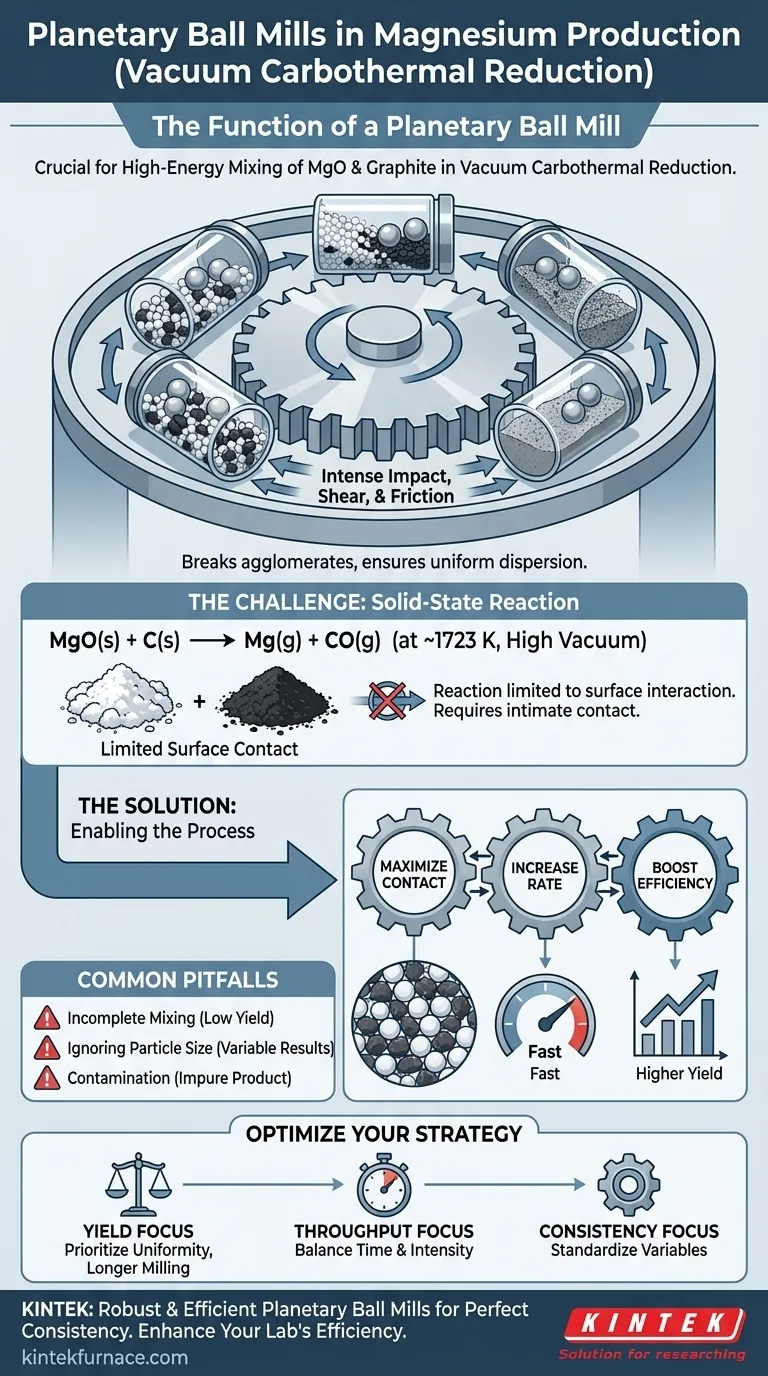
A planetary ball mill uses intense mechanical forces—impact, shear, and friction—generated by the grinding balls and the rotating vial. This high-energy action achieves two essential outcomes.
First, it breaks down particle agglomerates, ensuring the individual grains of MgO and graphite are thoroughly dispersed. Second, it guarantees this dispersion is uniform throughout the entire batch, creating the necessary conditions for an efficient reaction.
The Direct Impact of Milling on Process Efficiency
Maximizing Microscopic Contact
The key function of the mill is to create maximum contact points between the magnesium oxide and graphite particles. This intimate, microscopic contact is the single most important factor for the reduction reaction to proceed efficiently.
Influencing Reaction Rate
A more uniform mixture with greater particle contact directly increases the rate of the reduction reaction. When more MgO particles are in direct contact with carbon particles at the target temperature, the conversion to magnesium vapor happens much more quickly.
Boosting Conversion Efficiency
Proper milling leads to higher conversion efficiency, meaning more of the raw magnesium oxide is successfully converted into magnesium. A poorly mixed batch results in wasted raw materials and energy, as the heat and vacuum are applied to material that cannot fully react.
Common Pitfalls in Material Preparation
Incomplete or Insufficient Mixing
The most common failure point is simply not milling the materials for a long enough duration or at a high enough intensity. This results in a non-uniform mixture that directly translates to a low yield.
Ignoring Initial Particle Characteristics
The starting particle size and morphology of the MgO and graphite powders can affect the milling process. Assuming one set of milling parameters will work for all raw material batches is a frequent mistake.
Potential for Contamination
The grinding media (balls and vial) can wear down during high-energy milling, potentially introducing contaminants into the raw material mixture. Choosing the right, durable materials for the mill components is critical to ensure the purity of the final product.
Optimizing Your Raw Material Preparation
The milling step is not just a preliminary task; it is a critical control point for the entire process. Your approach to it should be dictated by your primary production goal.
- If your primary focus is maximizing yield: Prioritize achieving the most uniform and intimate mixture possible, even if it requires longer milling times and careful characterization.
- If your primary focus is increasing throughput: Experiment to find the optimal balance of milling time and intensity that produces an acceptable conversion efficiency in the shortest duration.
- If your primary focus is process consistency: Standardize every variable in the milling process, from the raw material specifications to the milling duration, speed, and ball-to-powder ratio.
Ultimately, mastering this preparation stage is the foundational step toward predictable and efficient magnesium production.
Summary Table:
| Function | Impact on Magnesium Production |
|---|---|
| High-Energy Mechanical Mixing | Creates a uniform, intimate mixture of MgO and graphite powders. |
| Maximizes Microscopic Contact | Directly increases the rate and efficiency of the solid-state reduction reaction. |
| Prevents Incomplete Reactions | Eliminates pockets of unreacted material, boosting final yield and purity. |
Ready to Optimize Your Magnesium Production Process?
The uniformity of your raw material mixture is the foundation of a successful vacuum carbothermal reduction. Backed by expert R&D and manufacturing, KINTEK offers a range of robust and efficient planetary ball mills designed for high-energy mechanical mixing, ensuring your MgO and graphite powders achieve the perfect consistency for maximum conversion efficiency.
Our mills are built for durability to minimize contamination and are customizable to meet your specific production goals, whether you prioritize maximum yield, increased throughput, or process consistency.
Contact our experts today to discuss how KINTEK's solutions can enhance your lab's efficiency and ensure predictable results in your magnesium production.
Visual Guide
Related Products
- Electric Rotary Kiln Continuous Working Small Rotary Furnace Kiln for Pyrolysis Plant Heating
- Electric Rotary Kiln Pyrolysis Furnace Plant Machine Small Rotary Kiln Calciner
- Electric Rotary Kiln Small Rotary Furnace Biomass Pyrolysis Plant Rotating Furnace
- High Temperature Muffle Oven Furnace for Laboratory Debinding and Pre Sintering
- Multi Heating Zones CVD Tube Furnace Machine for Chemical Vapor Deposition Equipment
People Also Ask
- What are the advantages of electric rotary kilns compared to fuel-fired ones? Boost Precision and Efficiency in Your Process
- What materials can be processed in an electric rotary kiln? Versatile Solutions for Advanced Materials
- What advantages do electric rotary kilns offer over fuel-based kilns? Boost Efficiency and Purity in Your Process
- What are the primary applications of electric rotary kilns? Precision Thermal Processing for High-Value Materials
- How do electric rotary kilns achieve high thermal efficiency? Unlock Over 95% Thermal Efficiency