
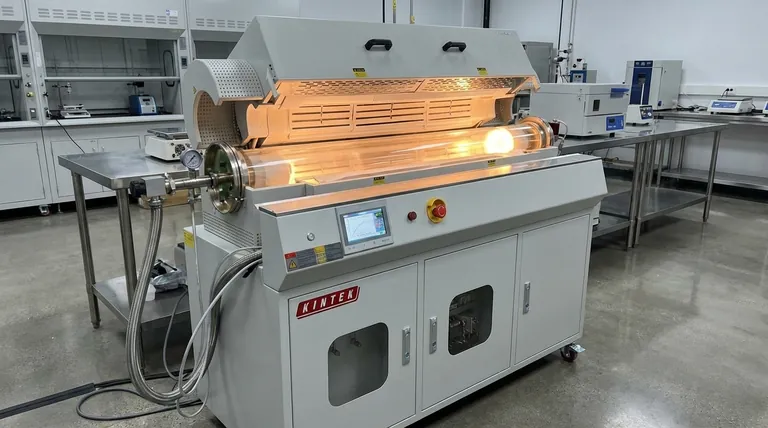
At its core, a rotary tube furnace is an integrated system built around four primary components: a rotating process tube, a stationary furnace body containing a heating system, a drive mechanism to turn the tube, and a control system to manage temperature and rotation. These parts work in concert to continuously mix and uniformly heat materials as they pass through the furnace.
A rotary tube furnace is not just a collection of parts; it is a dynamic system designed for a single purpose: achieving unparalleled thermal and compositional uniformity in continuous or batch processing by constantly tumbling the material through a precisely controlled heating environment.
The Core of the System: The Furnace and Tube
The physical structure of the furnace is what contains the entire thermal process. It consists of the outer body and the internal rotating tube where the work happens.
The Rotating Tube (Process Chamber)
This is the heart of the furnace. It's a cylindrical tube, often mounted at a slight angle, that holds the material being processed. Its rotation is what ensures every particle is exposed to the heat source uniformly.
The tube itself is typically made of heat-resistant metal alloys or ceramic materials, and it may be lined with refractory materials like bricks or castable cement to protect it from extreme temperatures and chemical corrosion.
The Furnace Body (Housing)
The furnace body is the stationary outer shell, usually constructed from welded steel plates. It houses the heating elements and the rotating tube, providing structural support and insulation to contain the high temperatures and ensure energy efficiency.
The Engine of Heat: The Heating and Control System
This system is responsible for generating, applying, and regulating the heat—the central function of any furnace. Its design dictates the precision and efficiency of the entire process.
The Heat Source
Heat is generated either by electric heating elements or gas burners. This is typically an indirect-fired design, meaning the heat source is outside the process tube and heats the tube's exterior wall. Heat is then transferred to the material inside through conduction, convection, and radiation.
Multiple Thermal Control Zones
For sophisticated processing, the furnace is often divided into multiple, independently controlled heating zones along its length. This allows for the creation of a precise temperature profile, enabling different process steps (like drying, calcining, and cooling) to occur sequentially as the material travels through the tube.
The Temperature Control System
This is the brain of the operation. It consists of sensors (thermocouples) and controllers that monitor the temperature in each zone and adjust the power to the heating elements to maintain exact setpoints. This system is often integrated with the rotation controls.
The Mechanics of Motion: Drive and Material Handling
The mechanical components are what make the furnace a rotary system, enabling the continuous flow and mixing that define its function.
The Drive Mechanism
A motor-driven system, typically using gears or driven rollers, is responsible for rotating the tube. Variable speed control is a critical feature, as it allows operators to adjust the material's residence time inside the furnace, directly impacting the degree of heating and mixing.
Feed and Discharge Systems
For continuous operation, a reliable feed system introduces raw material into the elevated end of the tube. On the opposite, lower end, a discharge system collects the processed material as it exits. The design of these systems is crucial for maintaining process stability and atmosphere control.
Understanding the Trade-offs and Limitations
While powerful, the design of a rotary tube furnace introduces specific challenges that must be managed for successful operation.
Mechanical Complexity
The rotating seals, drive gear, and support rollers are moving parts that experience significant thermal and mechanical stress. They require regular inspection and maintenance to prevent failure and costly downtime.
Atmosphere Integrity
Maintaining a pure, controlled atmosphere (such as inert gas) inside the furnace can be difficult. The seals at the feed and discharge ends of the rotating tube are critical points of potential leakage that must be meticulously engineered and maintained.
Process Scalability
The physics of heat transfer and material flow can change significantly with the diameter and length of the tube. Scaling a process from a small lab furnace to a large production unit requires careful engineering to ensure consistent results.
Matching Components to Your Processing Goal
The importance of each component depends entirely on your specific application.
- If your primary focus is material uniformity: The drive mechanism's variable speed control and the internal design of the tube (e.g., with flights or lifters) are your most critical considerations.
- If your primary focus is high-temperature processing: The choice of tube material and the quality of the refractory furnace lining are paramount to ensure longevity and prevent contamination.
- If your primary focus is continuous, high-volume production: The reliability of the drive mechanism and the design of the feed and discharge systems will determine your operational efficiency.
- If your primary focus is precise thermal profiles: Look for a furnace with multiple, independently managed thermal control zones to optimize your process from start to finish.
By understanding how these components function as a system, you can effectively evaluate, operate, and master your thermal processing objectives.
Summary Table:
| Component | Key Function | Key Features |
|---|---|---|
| Rotating Tube | Holds and mixes materials for uniform heating | Made of heat-resistant alloys/ceramics, often angled |
| Furnace Body | Houses heating elements and provides insulation | Welded steel construction, refractory lining |
| Heating System | Generates and applies heat | Electric or gas indirect-fired, multiple control zones |
| Control System | Manages temperature and rotation | Sensors, controllers, integrated with drive |
| Drive Mechanism | Rotates the tube for material flow | Variable speed control, motor-driven with gears/rollers |
| Feed/Discharge Systems | Handles material input and output | Ensures continuous operation and atmosphere control |
Ready to optimize your thermal processing with a custom rotary tube furnace? At KINTEK, we leverage exceptional R&D and in-house manufacturing to provide advanced high-temperature furnace solutions tailored to your unique needs. Our product line includes Rotary Furnaces, Muffle Furnaces, Tube Furnaces, Vacuum & Atmosphere Furnaces, and CVD/PECVD Systems, all backed by strong deep customization capabilities. Whether you're in research or production, we can help you achieve unparalleled uniformity and efficiency. Contact us today to discuss how we can support your laboratory goals!
Visual Guide

Related Products
- Vacuum Sealed Continuous Working Rotary Tube Furnace Rotating Tube Furnace
- Laboratory Vacuum Tilt Rotary Tube Furnace Rotating Tube Furnace
- Split Multi Heating Zone Rotary Tube Furnace Rotating Tube Furnace
- Inclined Rotary Plasma Enhanced Chemical Deposition PECVD Tube Furnace Machine
- Inclined Rotary Plasma Enhanced Chemical Deposition PECVD Tube Furnace Machine
People Also Ask
- What is the purpose of rotary tube furnaces? Achieve Uniform Heat Treatment for Powders and Granules
- What are the key advantages of using a rotary tube furnace? Achieve Dynamic, Uniform Heating for Powders
- How does the amount of material processed vary between batch and continuous rotary tube furnaces? Scale Your Production Efficiently
- What are the advantages of rotary tube furnaces in fuel compatibility? Boost Efficiency and Cut Costs
- What is the temperature range of some rotary tube furnaces? Achieve Uniform Heating Up to 1200°C



















