
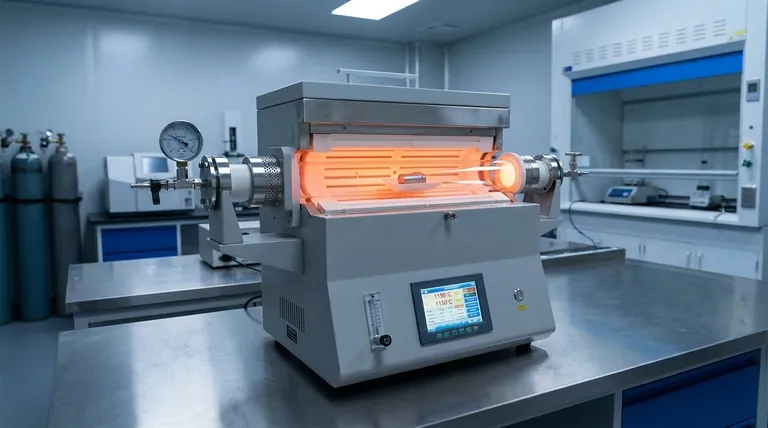
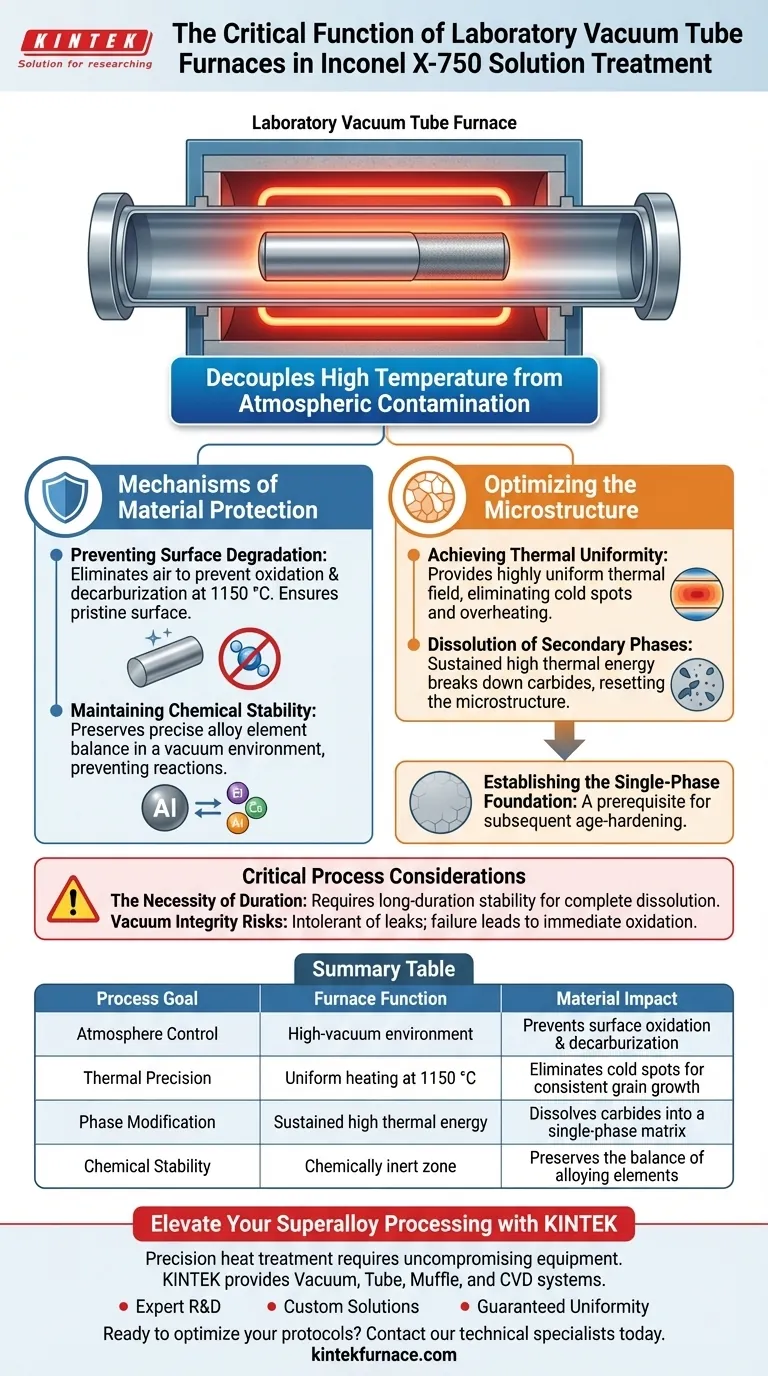
A laboratory vacuum tube furnace serves as a critical process control tool for the solution treatment of Inconel X-750, specifically designed to decouple high temperature from atmospheric contamination. Its primary function is to maintain a vacuum environment at temperatures around 1150 °C to prevent surface degradation while facilitating necessary microstructural changes.
The core value of this equipment is its ability to create a chemically inert, thermally uniform zone. This allows carbide phases to fully dissolve into the alloy matrix without the risk of oxidation, creating the essential "blank slate" required for subsequent hardening processes.
Mechanisms of Material Protection
Preventing Surface Degradation
At the high temperatures required for solution treatment (1150 °C), nickel-based superalloys are highly reactive to oxygen. The furnace utilizes a vacuum environment to remove air from the processing chamber.
By eliminating the atmosphere, the furnace actively prevents oxidation and decarburization. This ensures the material surface remains pristine even during long-duration treatment cycles.
Maintaining Chemical Stability
Inconel X-750 relies on a precise balance of alloying elements for its superalloy properties. Exposure to reactive gases could alter this chemical composition.
The vacuum environment preserves the chemical stability of these elements. It ensures they remain within the alloy rather than reacting with the environment, preserving the material's integrity.
Optimizing the Microstructure
Achieving Thermal Uniformity
Successful solution treatment requires that every part of the sample experiences the exact same temperature profile. The tube furnace design is engineered to provide a highly uniform thermal field.
This consistency eliminates cold spots or overheating. It ensures that the microstructural changes described below occur evenly throughout the entire cross-section of the component.
Dissolution of Secondary Phases
The primary metallurgical goal of this process is the modification of the alloy's internal structure. Specifically, phases such as carbides must be dissolved back into the primary matrix.
The furnace provides the sustained, high thermal energy required to break these phases down fully. This resets the microstructure of the alloy.
Establishing the Single-Phase Foundation
By dissolving carbides and homogenizing the structure, the furnace creates a uniform, single-phase organizational foundation.
This state is not the final product but a prerequisite. It prepares the Inconel X-750 for subsequent age-hardening, ensuring that future precipitation hardening occurs predictably and effectively.
Critical Process Considerations
The Necessity of Duration
The reference highlights that these solution treatments are "long-duration" processes. The furnace must be capable of maintaining stable conditions over extended periods.
Shortcuts in time often lead to incomplete dissolution of phases. The equipment must be robust enough to hold the vacuum and temperature steady until the microstructural conversion is complete.
Vacuum Integrity Risks
Because the process relies on the absence of atmosphere, the system is intolerant of leaks.
Any breach in vacuum integrity at 1150 °C will lead to immediate oxidation. The reliability of the furnace seals and pumps is as critical as the heating elements themselves.
Applying This to Your Heat Treatment Protocol
To maximize the effectiveness of your solution treatment for Inconel X-750, align your equipment settings with your specific metallurgical goals:
- If your primary focus is surface finish: rigorous vacuum maintenance is required to prevent decarburization and oxidation during the heating cycle.
- If your primary focus is mechanical uniformity: verify the furnace provides a strictly uniform thermal field to ensure complete dissolution of carbides across the entire part.
The vacuum tube furnace is not just a heater; it is a stability chamber that ensures the alloy is chemically and structurally prepared for high-performance applications.
Summary Table:
| Process Goal | Furnace Function | Material Impact |
|---|---|---|
| Atmosphere Control | High-vacuum environment | Prevents surface oxidation & decarburization |
| Thermal Precision | Uniform heating at 1150 °C | Eliminates cold spots for consistent grain growth |
| Phase Modification | Sustained high thermal energy | Dissolves carbides into a single-phase matrix |
| Chemical Stability | Chemically inert zone | Preserves the balance of alloying elements |
Elevate Your Superalloy Processing with KINTEK
Precision heat treatment of Inconel X-750 requires equipment that never compromises on thermal stability or vacuum integrity. KINTEK provides industry-leading laboratory high-temp furnaces—including Vacuum, Tube, Muffle, and CVD systems—engineered to deliver the exact conditions your materials demand.
Why partner with KINTEK?
- Expert R&D: Our systems are designed for high-performance metallurgy.
- Custom Solutions: Tailor tube dimensions and vacuum levels to your specific research needs.
- Guaranteed Uniformity: Ensure complete carbide dissolution with our superior heating element technology.
Ready to optimize your solution treatment protocols? Contact our technical specialists today to find the perfect customizable furnace for your laboratory.
Visual Guide
References
- Guilherme Maziero Volpato, Márcio C. Fredel. Influence of a Standard Heat Treatment on the Microstructure and Properties of Inconel X‐750 Produced by Laser Powder Bed Fusion. DOI: 10.1002/adem.202500306
This article is also based on technical information from Kintek Furnace Knowledge Base .
Related Products
- Vacuum Hot Press Furnace Machine Heated Vacuum Press Tube Furnace
- Vacuum Sealed Continuous Working Rotary Tube Furnace Rotating Tube Furnace
- High Pressure Laboratory Vacuum Tube Furnace
- Laboratory Vacuum Tilt Rotary Tube Furnace Rotating Tube Furnace
- Magnesium Extraction and Purification Condensing Tube Furnace
People Also Ask
- Why use Vacuum Hot Press (VHP) for ZnS Ceramics? Achieve Superior IR Transparency and Mechanical Strength
- What are the benefits of the vacuum environment system in a vacuum hot press furnace? Unlock High-Density Sintering
- What safety features are incorporated in vacuum hot press furnaces? Ensure Operator and Equipment Protection
- What temperature control features do vacuum hot press furnaces have? Achieve Precision in High-Temp Material Processing
- How have vacuum hot press furnaces transformed material processing? Achieve Superior Density and Purity



















