
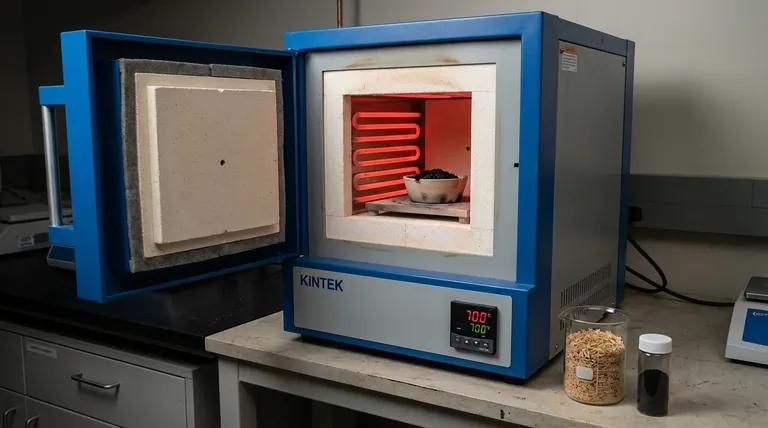
The primary function of a high-temperature muffle furnace in this specific context is to execute controlled pyrolysis. By subjecting biomass, such as poplar sawdust, to sustained high heat (typically 700°C), the furnace facilitates the thermal decomposition necessary to convert raw organic material into stable biochar.
Core Takeaway The muffle furnace does not merely burn the material; it provides a precise thermal environment to transform biomass into a carbonaceous carrier. This process engineers a material with a massive surface area and complex pore structure, creating the essential physical foundation required to host and support nickel ferrite (NiFe2O4) nanoparticles.
The Role of Thermal Transformation
Creating the Thermal Environment
The production of biochar requires a stable, high-temperature setting that standard heating methods cannot reliably maintain.
The muffle furnace isolates the sample and holds it at a specific temperature—specifically 700°C for one hour in this application.
Converting Biomass to Biochar
At these temperatures, the raw biomass (e.g., sawdust) undergoes pyrolysis.
This creates a carbonaceous carrier, stripping away volatile organic compounds and leaving behind a carbon-rich skeleton.
Engineering the Composite Foundation
Developing Pore Structure
The heat treatment within the furnace is responsible for generating a well-developed pore structure within the material.
Without this high-temperature processing, the material would lack the internal cavities necessary for advanced composite applications.
Maximizing Surface Area
The thermal degradation process significantly increases the specific surface area of the resulting biochar.
This high surface area is critical because it provides more "real estate" for chemical interactions in the final application.
Supporting Nanoparticles
The ultimate goal of this thermal preparation is to create an ideal host for NiFe2O4 (nickel ferrite) nanoparticles.
The porous, high-surface-area biochar acts as a scaffold, ensuring the nanoparticles are distributed effectively rather than clumping together.
Understanding the Trade-offs
Batch vs. Continuous Processing
Muffle furnaces are typically designed for batch processing, making them excellent for research and precise synthesis but potentially slower for large-scale industrial throughput.
Atmosphere Limitations
While excellent for providing heat, standard muffle furnaces may have limitations in controlling the gas atmosphere compared to tube furnaces.
However, for the purpose of creating the carbonaceous carrier described, they provide the necessary contamination-free heating required to ensure the purity of the biochar.
Making the Right Choice for Your Goal
If your primary focus is Structural Integrity: Ensure the furnace maintains a consistent 700°C, as temperature fluctuations can lead to incomplete pyrolysis and a weak carbon structure.
If your primary focus is Nanoparticle Loading: Prioritize the duration of the heat treatment (e.g., the full one hour), as this time is critical for fully developing the pore structure that holds the nickel ferrite.
The muffle furnace is the critical tool that transforms raw biological waste into a sophisticated, engineered nanomaterial support.
Summary Table:
| Process Parameter | Role in Biochar Preparation | Impact on NiFe2O4/Biochar Composite |
|---|---|---|
| Controlled Pyrolysis | Sustained heat at 700°C for 1 hour | Converts biomass into a stable carbonaceous carrier |
| Pore Engineering | Thermal decomposition of volatiles | Develops complex internal cavities for nanoparticle hosting |
| Surface Area Boost | High-temp skeletal transformation | Maximizes available sites for chemical interaction |
| Scaffold Formation | Creating a rigid carbon skeleton | Prevents nanoparticle clumping and ensures uniform distribution |
Elevate Your Material Research with KINTEK
Precision is non-negotiable when engineering advanced NiFe2O4/biochar composites. KINTEK provides industry-leading thermal solutions designed for researchers and manufacturers who demand excellence. Backed by expert R&D and manufacturing, we offer a comprehensive range of Muffle, Tube, Rotary, Vacuum, and CVD systems, all of which are fully customizable to meet your specific pyrolysis and synthesis requirements.
Whether you are scaling up biochar production or refining nanoparticle loading, our high-temperature furnaces ensure the thermal stability and contamination-free environment your project deserves.
Ready to optimize your synthesis process? Contact KINTEK today to find your perfect furnace solution!
References
- Huagen Liang, Fu Chen. Facile preparation of NiFe2O4/biochar composite adsorbent for efficient adsorption removal of antibiotics in water. DOI: 10.1007/s44246-023-00094-w
This article is also based on technical information from Kintek Furnace Knowledge Base .
Related Products
- 1700℃ High Temperature Muffle Oven Furnace for Laboratory
- 1800℃ High Temperature Muffle Oven Furnace for Laboratory
- 1200℃ Muffle Oven Furnace for Laboratory
- 1400℃ Muffle Oven Furnace for Laboratory
- High Temperature Muffle Oven Furnace for Laboratory Debinding and Pre Sintering
People Also Ask
- What is the primary function of a high-temperature laboratory muffle furnace in chemical synthesis? Achieve Precision.
- How does a high-temperature laboratory muffle furnace affect material properties? Transform Anodic Oxide Films Fast
- What role does a muffle furnace play in BCZY712 electrolyte powder production? Achieve Perfect Phase Purity
- How does the two-stage sintering process contribute to the synthesis of MeCuFeO3 perovskite? Optimize crystal purity.
- How does a muffle furnace impact Ni/MgAl2O4 catalysts? Optimize Stability and Catalytic Performance



















