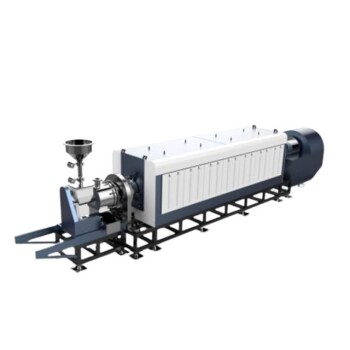
The high-temperature electric muffle furnace acts as the primary thermal reactor for the oxidative pyrolysis of sulfur-containing brown coal. It provides a precisely regulated air environment capable of reaching working temperatures up to 1250°C. This allows researchers to manipulate heating rates and final temperatures—ranging from 500°C to 1200°C—to determine their specific effects on the yield and elemental composition of the resulting char residues.
The muffle furnace provides the essential thermal stability and atmospheric control required to simulate various pyrolysis modes. By accurately managing the heat intensity and oxygen exposure, it enables the study of how brown coal transforms into carbonized residue or ash under specific oxidative conditions.
Precision Thermal and Atmospheric Control
Managing the Oxidative Environment
The muffle furnace provides a controlled air environment, which is critical for oxidative pyrolysis. Unlike traditional inert pyrolysis, this process allows for a managed interaction between oxygen and the coal sample at high temperatures.
Achieving High-Temperature Thresholds
With a capability of reaching 1250°C, the furnace allows for the study of coal behavior far beyond standard carbonization levels. This high thermal ceiling is necessary to observe the complete decomposition of complex organic structures found in brown coal.
Simulating Variable Heating Rates
The equipment can simulate both rapid oxidative pyrolysis and slow heating patterns. Controlling the rate of temperature rise is vital for understanding how the speed of thermal shock influences the release of volatiles and the stability of the remaining sulfur-containing char.
Impact on Material Transformation
Determining Char Yield and Composition
By maintaining a constant temperature phase, the furnace facilitates the thermal degradation of the coal. This process allows researchers to measure the final yield of char and analyze its elemental makeup, providing data on how much carbon and sulfur remain trapped in the solid residue.
Driving Volatile Removal
The heat provided by the muffle furnace drives the devolatilization process, where moisture and gases are expelled. In the context of sulfur-containing coal, this function is critical for tracking how sulfur species are either released into the gas phase or fixed into the inorganic ash.
Facilitating Phase Changes and Ashing
At specific temperatures, such as the standard 815°C, the furnace can perform complete incineration. This removes all organic matter to leave behind stable inorganic oxide residues, which are then used to determine the coal’s total ash yield and mineral content.
Understanding Technical Trade-offs
Oxygen Exposure vs. Char Quality
While oxidative pyrolysis in a muffle furnace is useful for simulation, high oxygen levels can lead to excessive combustion. If the air intake is not strictly monitored, the furnace may incinerate the carbon that was intended to be preserved as char, skewing the results of the residue analysis.
Uniformity vs. Sample Size
Muffle furnaces provide a uniform thermal field, but their static nature can lead to temperature gradients within larger samples. To ensure reproducible results, researchers must use small, thin-layer samples to guarantee that the core of the coal reaches the target temperature simultaneously with the surface.
Heating Rate Limitations
While these furnaces are excellent for steady-state temperatures, they may have thermal inertia limitations. Achieving truly "instantaneous" flash pyrolysis can be difficult compared to specialized drop-tube reactors, as the heating elements and refractory brick require time to adjust to rapid set-point changes.
How to Apply This to Your Research Goal
Selecting the Right Parameters
When utilizing a high-temperature muffle furnace for brown coal analysis, your temperature and atmosphere settings must align with your specific analytical objectives.
- If your primary focus is determining ash mineralogy: Set the furnace to a steady 815°C with high air circulation to ensure complete incineration of all organic components.
- If your primary focus is studying char yield and sulfur retention: Utilize a slow heating rate (e.g., 10°C per minute) up to 500°C–700°C to allow for the gradual release of volatiles without total sample combustion.
- If your primary focus is simulating industrial boiler conditions: Aim for the higher temperature range of 1000°C to 1200°C to observe how rapid thermal exposure impacts the structural densification of the residue.
The precision of the muffle furnace transforms coal pyrolysis from a simple heating process into a repeatable, scientific simulation of complex thermochemical behavior.
Summary Table:
| Key Feature | Function in Oxidative Pyrolysis | Research Impact |
|---|---|---|
| High-Temp Ceiling | Operates up to 1250°C | Enables complete decomposition studies |
| Atmospheric Control | Regulated air environment | Simulates specific oxidative conditions |
| Heating Rate Control | Simulates thermal shock | Tracks sulfur stability & volatile release |
| Thermal Stability | Provides a uniform thermal field | Ensures repeatable char residue analysis |
Optimize Your Pyrolysis Research with KINTEK
Advance your thermochemical research with KINTEK’s high-precision thermal solutions. As specialists in laboratory equipment and consumables, KINTEK offers a comprehensive range of customizable high-temperature furnaces—including muffle, tube, rotary, vacuum, CVD, and atmosphere furnaces—specifically designed to meet the rigorous demands of coal analysis and material science.
Our equipment ensures the uniform heating and precise atmospheric control necessary for repeatable, scientific simulations. Whether you are analyzing sulfur retention or industrial boiler conditions, we provide the tools for superior accuracy.
Contact KINTEK today to find your custom furnace solution!
References
- Yuliya Tsvetkova, D. N. Podlesniy. Thermal decomposition of sulfur brown coal. DOI: 10.1051/e3sconf/202449803001
This article is also based on technical information from Kintek Furnace Knowledge Base .
Related Products
- 1700℃ High Temperature Muffle Oven Furnace for Laboratory
- 1800℃ High Temperature Muffle Oven Furnace for Laboratory
- 1200℃ Muffle Oven Furnace for Laboratory
- 1400℃ Muffle Oven Furnace for Laboratory
- High Temperature Muffle Oven Furnace for Laboratory Debinding and Pre Sintering
People Also Ask
- What is the primary function of a high-temperature laboratory muffle furnace in chemical synthesis? Achieve Precision.
- How does a high-temperature laboratory muffle furnace affect material properties? Transform Anodic Oxide Films Fast
- What role does a muffle furnace play in BCZY712 electrolyte powder production? Achieve Perfect Phase Purity
- How does the two-stage sintering process contribute to the synthesis of MeCuFeO3 perovskite? Optimize crystal purity.
- What is the role of a high-temperature muffle furnace in guava leaf carbonization? Master Precise Pyrolysis Control