
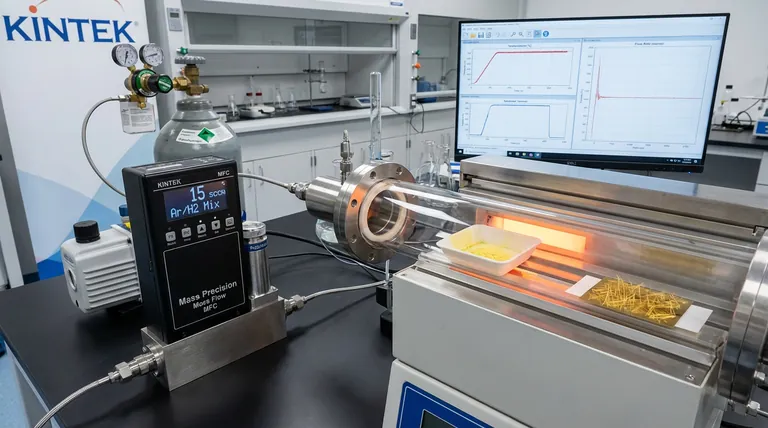
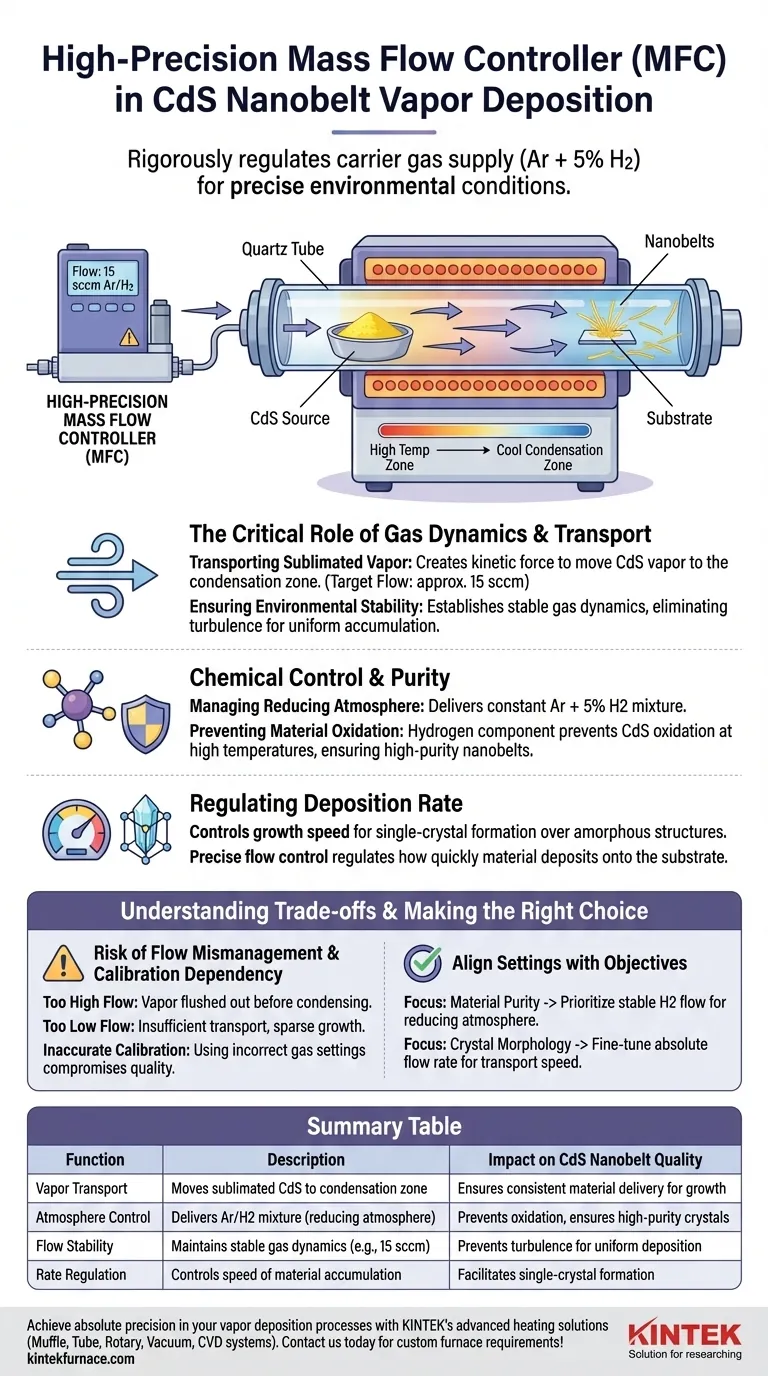
The primary function of a high-precision mass flow controller (MFC) in this setup is to rigorously regulate the supply of carrier gas to the tube furnace. Specifically, it controls the flow rate of a gas mixture—typically argon with 5% hydrogen—to ensuring the precise environmental conditions required for the vapor deposition process.
By establishing a stable gas dynamic environment, the MFC guarantees the consistent transport of sublimated vapor and maintains a reducing atmosphere, which is essential for growing high-quality, single-crystal CdS nanobelts.
The Critical Role of Gas Dynamics
Transporting Sublimated Vapor
The fundamental physical task of the MFC is to manage the movement of the carrier gas.
In this specific application, the controller often maintains a flow rate around 15 sccm (standard cubic centimeters per minute).
This flow creates the kinetic force necessary to transport sublimated CdS vapor from the source material to the cooler condensation zone where growth occurs.
Ensuring Environmental Stability
Vapor deposition is highly sensitive to turbulence or stagnation.
A high-precision MFC creates a stable gas dynamic environment within the furnace tube.
This stability eliminates fluctuations that could disrupt the uniform accumulation of material on the substrate.
Chemical Control and Purity
Managing the Reducing Atmosphere
The process utilizes a specific gas mixture, such as argon combined with 5% hydrogen.
The MFC ensures that the ratio and total volume of this mixture remain constant throughout the deposition cycle.
Preventing Material Oxidation
The hydrogen component in the gas stream acts as a reducing agent.
By precisely delivering this hydrogen, the MFC prevents the oxidation of the CdS material at high temperatures.
This protection is a vital guarantee for obtaining high-purity nanobelts rather than oxidized byproducts.
Regulating the Deposition Rate
The flow rate is not just a transport mechanism; it is a control variable for growth speed.
The hydrogen component helps regulate how quickly the material deposits onto the substrate.
Precise control here allows for the formation of single-crystal structures rather than amorphous or poly-crystalline films.
Understanding the Trade-offs
The Risk of Flow Mismanagement
While high precision is the goal, an incorrect flow setting can be detrimental.
If the flow is too high, the vapor may be flushed out of the tube before it can condense properly.
If the flow is too low, the vapor transport may be insufficient, leading to sparse or uneven growth.
Calibration Dependency
The "high precision" of an MFC is only as good as its calibration.
Reling heavily on an MFC assumes the device is accurately calibrated for the specific gas mixture (Ar/H2) being used.
Using a controller calibrated for Nitrogen or pure Argon without adjustment factors will result in inaccurate flow rates and compromised crystal quality.
Making the Right Choice for Your Goal
To maximize the quality of your CdS nanobelts, align your MFC settings with your specific objectives:
- If your primary focus is Material Purity: Prioritize the stability of the hydrogen mixture flow to maintain a constant reducing atmosphere and prevent oxidation.
- If your primary focus is Crystal Morphology: Fine-tune the absolute flow rate (e.g., sticking strictly to 15 sccm) to control the vapor transport speed and deposition kinetics.
Ultimate control over your gas flow is the defining factor in transitioning from basic material synthesis to high-quality single-crystal engineering.
Summary Table:
| Function | Description | Impact on CdS Nanobelt Quality |
|---|---|---|
| Vapor Transport | Moves sublimated CdS to the condensation zone | Ensures consistent material delivery for growth |
| Atmosphere Control | Delivers Ar/H2 mixture (reducing atmosphere) | Prevents oxidation and ensures high-purity crystals |
| Flow Stability | Maintains stable gas dynamics (e.g., 15 sccm) | Prevents turbulence to allow uniform deposition |
| Rate Regulation | Controls the speed of material accumulation | Facilitates single-crystal formation over amorphous structures |
Achieve absolute precision in your vapor deposition processes with KINTEK's advanced heating solutions. Backed by expert R&D and manufacturing, KINTEK offers Muffle, Tube, Rotary, Vacuum, and CVD systems, all customizable to your unique research needs. Whether you are synthesizing high-purity nanobelts or complex semiconductor materials, our high-precision systems provide the stability and control required for consistent, high-quality results. Contact us today to discuss your custom furnace requirements with our technical team!
Visual Guide
References
- Yao Liu, Yingkai Liu. High-response formamidine bromide lead hybrid cadmium sulfide photodetector. DOI: 10.3788/col202422.022502
This article is also based on technical information from Kintek Furnace Knowledge Base .
Related Products
- Split Chamber CVD Tube Furnace with Vacuum Station CVD Machine
- Custom Made Versatile CVD Tube Furnace Chemical Vapor Deposition CVD Equipment Machine
- High Pressure Laboratory Vacuum Tube Furnace
- Multi Heating Zones CVD Tube Furnace Machine for Chemical Vapor Deposition Equipment
- 1200℃ Controlled Inert Nitrogen Atmosphere Furnace
People Also Ask
- What role does a Tube Furnace play in the CVD growth of carbon nanotubes? Achieve High-Purity CNT Synthesis
- What are the operational and maintenance requirements for a CVD tube furnace? Ensure Precision for Thin Film Deposition
- How does a CVD tube furnace achieve high purity in gate media preparation? Master Precision Control for Flawless Films
- What are the advantages of using a CVD tube furnace for preparing gate dielectrics? Achieve High-Quality Thin Films for Transistors
- What improvements can be made to the bonding force of gate dielectric films using a CVD tube furnace? Enhance Adhesion for Reliable Devices



















