
The critical role of a high-vacuum environment is to create a clear, unobstructed path for magnesium vapor. By lowering the system pressure to 10-15 Pa, the process essentially removes air and other gas molecules that would otherwise obstruct the volatilized magnesium. This allows the magnesium vapor to travel directly and rapidly to the condenser, which is the key to maximizing both the recovery rate and the final purity of the material.
In the vacuum separation of aluminum-magnesium alloys, high temperature makes magnesium want to evaporate, but the high vacuum is what allows it to escape efficiently. Without this clear path, the entire process is throttled by gas-phase collisions, severely limiting yield.
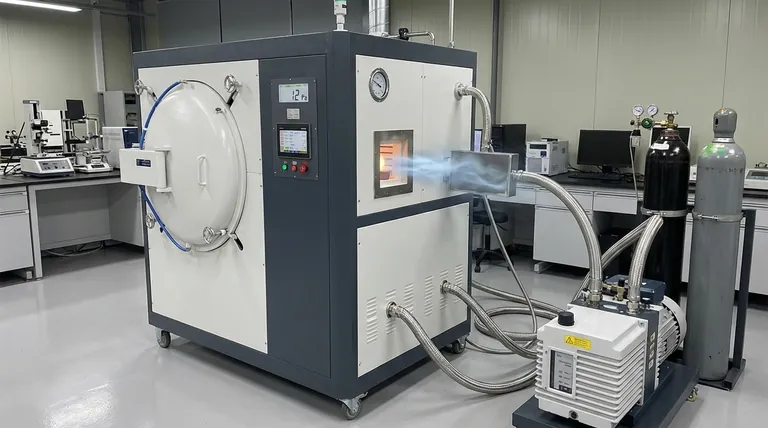
The Core Principles of Vacuum Separation
To understand why a 10-15 Pa vacuum is so effective, we must look at the two fundamental conditions required for separation: the driving force and the transport path.
The Driving Force: Temperature and Vapor Pressure
The process begins by heating the Al-Mg alloy to a high temperature, such as 1373 K (1100 °C). This high temperature gives the magnesium atoms enough thermal energy to overcome the forces holding them in the liquid metal.
This results in a significantly increased saturated vapor pressure for magnesium, creating a strong thermodynamic drive for it to transition from a liquid to a gas.
The Transport Path: Clearing the Way with Vacuum
While high temperature provides the impetus for magnesium to evaporate, the vacuum provides the opportunity. By evacuating the furnace chamber to 10-15 Pa, we remove the vast majority of residual gas molecules.
This creates an environment where the mean free path—the average distance a molecule can travel before colliding with another—is significantly extended.
The Mean Free Path Explained
Think of the mean free path as the difference between running across a crowded room versus an empty field.
In an atmospheric or low-vacuum environment (the crowded room), magnesium vapor molecules constantly collide with air molecules, scattering in random directions and losing energy.
In a high-vacuum environment of 10-15 Pa (the empty field), the magnesium vapor can travel in a nearly straight line, directly from the molten alloy to the cooler condenser surface for collection.
Consequences of an Inadequate Vacuum
Failing to achieve or maintain the target vacuum level directly undermines the efficiency of the separation process.
Increased Intermolecular Collisions
If the pressure is too high, the mean free path shrinks dramatically. The volatilized magnesium vapor will collide repeatedly with residual gas molecules.
Reduced Transport Efficiency and Backflow
These collisions slow the magnesium vapor down and scatter it. A significant portion may be deflected back towards the molten alloy surface instead of reaching the condenser.
Lower Recovery Rate and Purity
The direct result of this inefficient transport is a lower yield. Less magnesium is successfully captured, and the process becomes economically unviable.
Understanding the Trade-offs
While essential, operating at high vacuum introduces specific engineering and economic considerations.
Equipment and Energy Costs
Achieving and holding a vacuum of 10-15 Pa requires specialized, high-performance vacuum pumps and a robust, hermetically sealed furnace. This represents a significant capital investment and ongoing energy cost.
Process Sensitivity
High-vacuum systems are highly sensitive to leaks. Even a minor leak can compromise the pressure, drastically reducing the mean free path and crippling the separation efficiency. This demands rigorous maintenance and monitoring.
The Purity vs. Throughput Balance
The combination of high temperature and high vacuum is designed for maximum recovery and purity. However, the overall process speed is governed by factors like heating rates and the pumping capacity of the vacuum system. It is a precise and controlled process, not an instantaneous one.
Making the Right Choice for Your Goal
The level of vacuum is not just a parameter; it is the central control mechanism for the entire process.
- If your primary focus is maximizing magnesium recovery and purity: Maintaining a stable, high vacuum in the 10-15 Pa range is non-negotiable, as it is the direct mechanism for enabling efficient material transport.
- If your primary focus is process reliability and consistency: Your efforts should center on the integrity of the vacuum system, as pressure fluctuations are the most common cause of poor yield and inconsistent results.
- If your primary focus is troubleshooting low yield: Before examining temperature or material factors, the first diagnostic step should always be to verify the vacuum level and check the system for leaks.
Ultimately, controlling the vacuum is controlling the efficiency and success of the entire separation.
Summary Table:
| Role of High Vacuum (10-15 Pa) | Impact on Separation Process |
|---|---|
| Extends Mean Free Path | Allows magnesium vapor to travel directly to the condenser, minimizing collisions and backflow. |
| Enables Efficient Transport | Maximizes recovery rate by providing a clear, unobstructed path for vaporized magnesium. |
| Ensures High Purity | Reduces contamination by removing residual gas molecules that could interfere with condensation. |
| Prevents Process Throttling | Avoids yield loss caused by gas-phase collisions in inadequate vacuum conditions. |
Optimize Your Aluminum-Magnesium Alloy Separation Process with KINTEK
Struggling with low magnesium recovery rates or inconsistent results? The key to maximizing yield and purity lies in precise high-vacuum control. At KINTEK, we specialize in designing robust vacuum furnace systems that deliver the stable 10-15 Pa environment essential for efficient separation.
Our expert engineering and customizable solutions—including Vacuum and CVD systems—ensure your process operates at peak performance, saving you time, resources, and materials.
Ready to enhance your recovery rates? Contact us today to discuss how our high-temperature vacuum furnaces can be tailored to your unique operational needs.
Visual Guide

Related Products
- 2200 ℃ Tungsten Vacuum Heat Treat and Sintering Furnace
- High Pressure Laboratory Vacuum Tube Furnace
- 2200 ℃ Graphite Vacuum Heat Treat Furnace
- Molybdenum Vacuum Heat Treat Furnace
- 9MPa Air Pressure Vacuum Heat Treat and Sintering Furnace
People Also Ask
- How does a tungsten-heated vacuum sintering furnace prepare (TbxY1-x)2O3 ceramics? Achieve 99%+ Density & Purity
- What wear-resistance enhancements are achieved by powder coating? The Role of Vacuum Sintering Furnaces
- How do compaction pressure and vacuum sintering optimize porous ceramics? Maximize Density & Toughness
- What role does a high-temperature vacuum sintering furnace play in the densification of WC-10(Ni, Ni/Co) alloys?
- What core role does a high-temperature vacuum sintering furnace play in Sm:YAG ceramics? Mastering Optical Clarity



















