
The core role of a Vacuum Induction Melting (VIM) furnace in ODS steel preparation is to create a pristine, homogenized molten baseline. Specifically for Fe-13Cr steel, the VIM furnace utilizes a high-vacuum or inert gas environment to prevent atmospheric contamination while leveraging electromagnetic stirring to ensure additives are distributed uniformly throughout the melt.
Core Insight: The VIM furnace is not merely a heater; it is a precision synthesis platform. Its ability to simultaneously eliminate atmospheric impurities and vigorously stir the melt via induction currents makes it the foundational tool for researching both the mechanical addition and in-situ synthesis of nanoparticles in ODS steel.
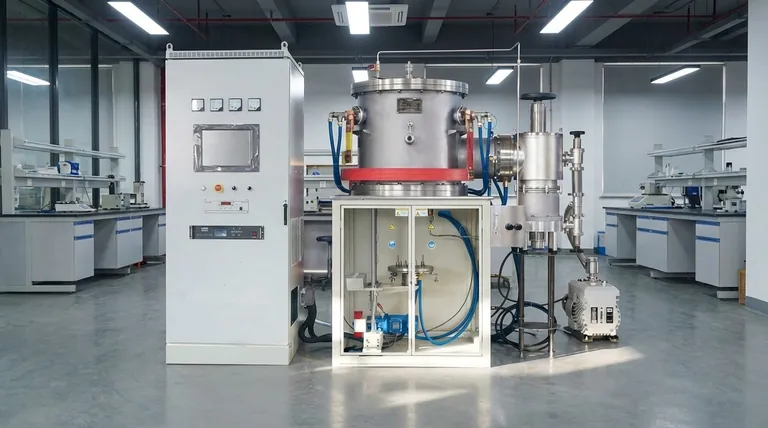
Establishing a Controlled Environment
Eliminating Atmospheric Contamination
The primary challenge in preparing Oxide Dispersion Strengthened (ODS) steel is preventing unwanted oxides from forming before the engineered nanoparticles are introduced.
The VIM furnace addresses this by operating in a highly controlled vacuum or inert gas atmosphere.
This isolation effectively blocks oxygen and nitrogen from the atmosphere, ensuring the liquid metal (Fe-13Cr) remains pure and free from environmental contamination.
Achieving High-Temperature Melts
ODS steel preparation requires reaching significant thermal thresholds to ensure complete alloying.
Through high-frequency induction heating, the VIM furnace provides precise temperature control up to 2200°C.
This high thermal capacity ensures the complete melting of the steel matrix, preparing it for the introduction or synthesis of dispersion agents.
Achieving Compositional Uniformity
The Mechanism of Electromagnetic Stirring
Melting the steel is only the first step; the critical requirement for ODS steel is the uniform dispersion of elements.
The VIM furnace utilizes electromagnetic stirring, a natural byproduct of the induction currents used to heat the metal.
This non-contact stirring mechanism promotes a macro-uniform distribution of additives within the melt pool, which is superior to static melting methods.
Facilitating Nanoparticle Synthesis
The VIM furnace acts as the central research platform for the two main methods of creating the oxide dispersion.
It supports mechanical addition, where particles are physically introduced to the stirred melt.
It also supports in-situ synthesis, where the chemical conditions within the melt are manipulated to generate nanoparticles internally.
Understanding the Trade-offs
While VIM is essential for purity and mixing, it requires careful management of specific processing variables.
Volatilization of Elements
The high vacuum required to remove gases like oxygen and nitrogen can have a side effect.
High vapor pressure alloying elements (like Manganese) may evaporate or "boil off" under deep vacuum conditions.
Operators must often switch to a partial pressure of inert gas (like Argon) after the initial refining stage to retain these volatile elements.
Refractory Interactions
The cleanliness of the steel is limited by the furnace lining.
Because the melt is aggressively stirred and heated to extreme temperatures (2200°C), there is a risk of the molten metal reacting with the crucible material.
This can re-introduce impurities if the refractory material is not carefully selected to match the chemistry of the Fe-13Cr melt.
Making the Right Choice for Your Goal
When utilizing VIM for ODS steel preparation, tailor your process parameters to your specific research objective.
- If your primary focus is Purity: Prioritize high-vacuum durations early in the melt to maximize degassing and minimize atmospheric impurities.
- If your primary focus is Particle Distribution: Maximize the use of induction stirring frequencies to ensure macro-uniformity of additives before casting.
- If your primary focus is Compositional Accuracy: Monitor vacuum levels closely to prevent the evaporative loss of volatile alloying elements during the high-temperature hold.
The VIM furnace is the gatekeeper of quality, determining the initial purity and homogeneity upon which all subsequent ODS steel properties rely.
Summary Table:
| Feature | Role in ODS Steel Preparation | Key Benefit |
|---|---|---|
| Vacuum Environment | Eliminates atmospheric O2 and N2 | Prevents unwanted oxidation and contamination |
| Induction Heating | Reaches temperatures up to 2200°C | Ensures complete melting of the Fe-13Cr matrix |
| Electromagnetic Stirring | Vigorous non-contact mixing | Achieves macro-uniform distribution of nano-particles |
| Atmosphere Control | Switchable vacuum/inert gas | Prevents loss of volatile alloying elements |
Elevate Your Advanced Materials Research with KINTEK
Precision in Oxide Dispersion Strengthened (ODS) steel begins with the perfect melt. Backed by expert R&D and manufacturing, KINTEK offers high-performance Vacuum, CVD, Muffle, and Tube furnace systems specifically engineered to meet the rigorous demands of modern metallurgy.
Whether you require customized VIM furnaces for nanoparticle synthesis or specialized Rotary and Vacuum systems for material refining, our equipment provides the thermal accuracy and atmospheric control necessary for your breakthroughs.
Ready to optimize your lab's high-temperature processing? Contact our engineering team today to discuss your unique research needs and discover how our customizable solutions can enhance your production efficiency.
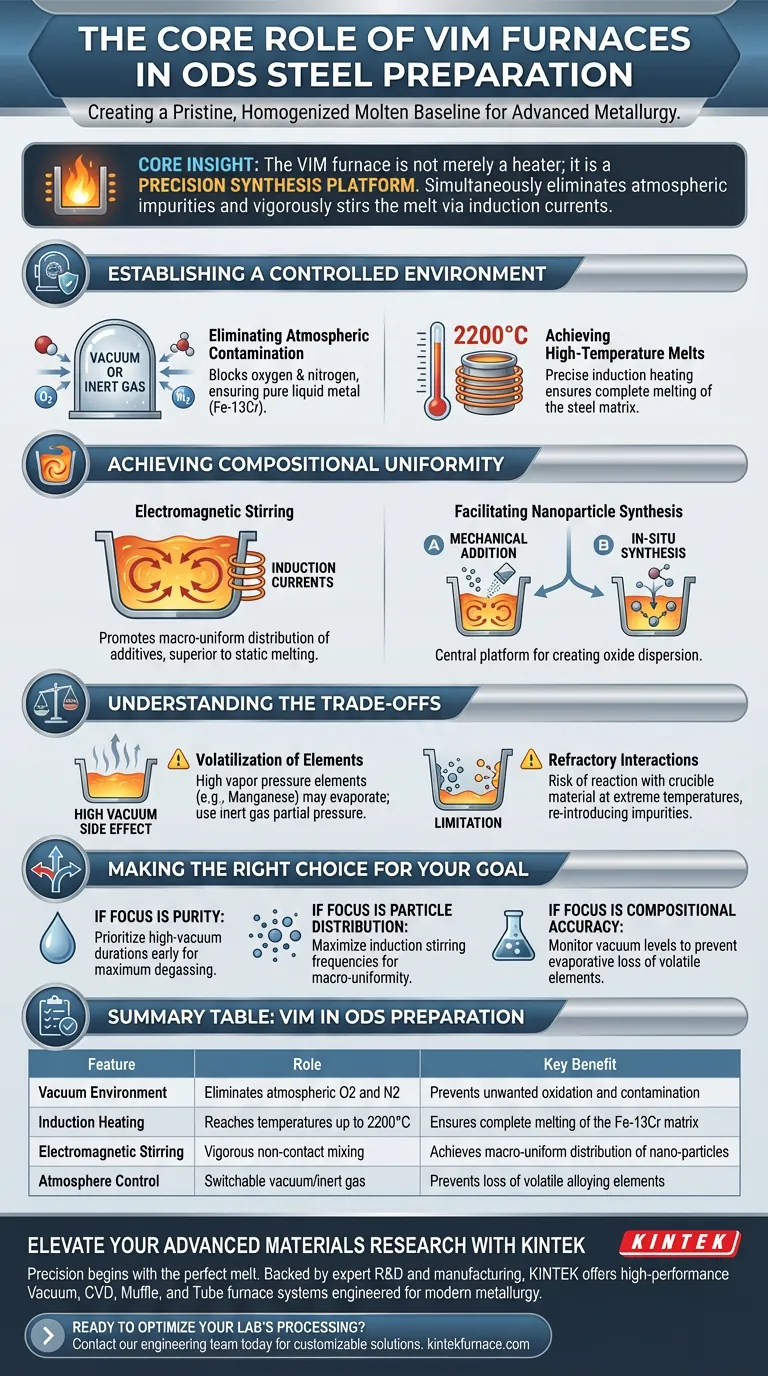
Visual Guide
References
- Alexandr Panichkin, Alexandr Arbuz. RESEARCH OF INJECTION METHODS FOR Y2O3 NANOPARTICLES INTO NICKEL- FREE STAINLESS STEEL DURING INDUCTION VACUUM REMELTING. DOI: 10.59957/jctm.v59.i1.2024.20
This article is also based on technical information from Kintek Furnace Knowledge Base .
Related Products
- Vacuum Induction Melting Furnace
- 600T Vacuum Induction Hot Press Vacuum Heat Treat and Sintering Furnace
- Small Vacuum Heat Treat and Tungsten Wire Sintering Furnace
- Vacuum Heat Treat Sintering and Brazing Furnace
- Vacuum Heat Treat Sintering Furnace Molybdenum Wire Vacuum Sintering Furnace
People Also Ask
- What are the core functions of the High Vacuum Induction Melting (VIM) furnace? Optimize DD5 Superalloy Purification
- What are the advantages of using a VIM furnace to control residual oxygen pressure? Achieve Superior Metal Uniformity
- What is the role of VIM and directional solidification in aero-engine blade substrates? Engineering Extreme Durability
- What are the technical advantages of using a Vacuum Induction Melting furnace in the development of advanced packaging steel?
- What role does a Vacuum Induction Melting furnace play in the production of high-aluminum nickel-based superalloys?



















