
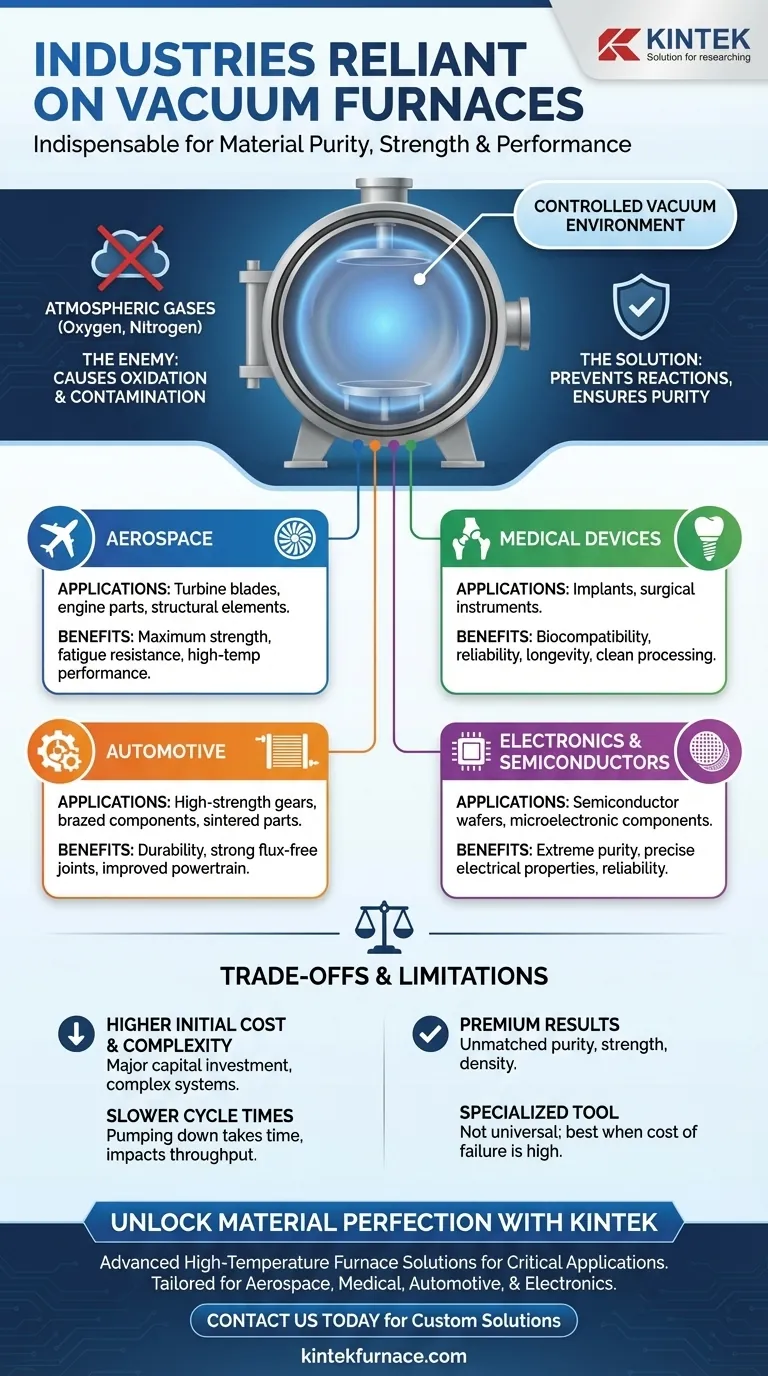
In short, vacuum furnaces are indispensable in any industry where material purity, strength, and performance are non-negotiable. The most prominent users are the aerospace, medical, automotive, and electronics sectors, each relying on the controlled vacuum environment to produce components that would fail if processed in a standard atmospheric furnace.
The defining value of a vacuum furnace is control. By removing atmospheric gases, it prevents contamination and unwanted chemical reactions like oxidation, enabling the creation of materials with exceptional purity, strength, and specific properties that are impossible to achieve with conventional heating methods.
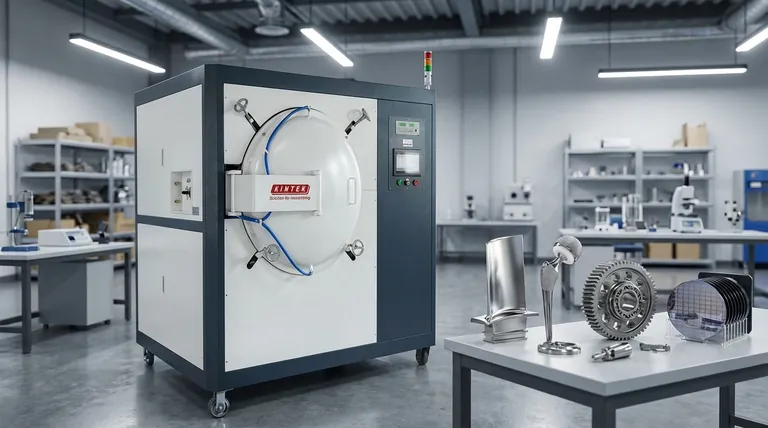
The Core Problem: Why Atmosphere Is the Enemy
To understand why these industries invest heavily in vacuum technology, you must first understand the problem they are solving. During high-temperature processing, the gases in the air (primarily oxygen and nitrogen) can be highly reactive.
Preventing Oxidation and Contamination
At high temperatures, most metals will readily react with oxygen, forming a brittle, undesirable oxide layer. A vacuum furnace removes the oxygen, preventing this oxidation and ensuring the material's surface and internal structure remain clean and uncompromised.
This is critical for parts that require a pristine finish or for processes like brazing, where oxides would prevent the filler metal from properly bonding the components.
Ensuring Material Purity and Consistency
For advanced alloys used in aerospace or medical implants, even trace amounts of atmospheric gases can alter the material's chemical composition. This can degrade its mechanical properties, such as strength, fatigue resistance, and corrosion resistance.
A vacuum environment ensures that the alloy's composition remains exactly as designed, leading to predictable, reliable, and consistent performance from one batch to the next.
Enabling High-Temperature Processes
Some advanced materials and processes, like sintering or the heat treatment of refractory metals, require extremely high temperatures. At these temperatures, the reactivity with air is so aggressive that processing is only possible in a vacuum or a highly controlled inert gas environment.
Key Industrial Applications: A Breakdown
The need for a controlled environment drives the adoption of vacuum furnaces across several high-stakes industries. Each sector leverages this technology to solve a specific set of material challenges.
Aerospace: For Mission-Critical Strength
The aerospace industry uses vacuum furnaces for heat-treating critical components like turbine blades, engine parts, and structural elements. The process ensures maximum strength, fatigue resistance, and high-temperature performance, where even a minor material flaw could lead to catastrophic failure.
Medical Devices: For Biocompatibility and Reliability
Vacuum furnaces are essential for manufacturing medical implants like artificial joints, dental implants, and surgical instruments. The clean processing environment prevents surface contamination, ensuring the final product is biocompatible and won't be rejected by the body. It also provides the strength and longevity required for devices that must perform for decades.
Automotive: For High-Performance Components
In the automotive sector, vacuum furnaces are used to create high-strength gears, precision-sintered parts, and brazed aluminum components like radiators and heat exchangers. Vacuum brazing allows for strong, flux-free joints, while heat treatment improves the durability of powertrain and transmission parts in high-performance vehicles.
Electronics and Semiconductors: For Electrical Precision
Manufacturing semiconductor wafers and microelectronic components requires extreme purity. A vacuum environment prevents atmospheric contaminants from altering the precise electrical properties of the materials. This ensures the reliability and performance of everything from microchips to advanced sensors.
Metallurgy and Tooling: For Fundamental Material Properties
At a more fundamental level, vacuum furnaces are used in powder metallurgy to sinter metal powders into dense, solid parts with superior strength. They are also used to create high-purity metals and alloys and to heat-treat tool and die steels, hardening them for a longer operational life.
Understanding the Trade-offs and Limitations
While powerful, vacuum furnaces are not a universal solution. Their value is tied to solving specific problems, and they come with significant trade-offs compared to conventional furnace technology.
Higher Initial Cost and Complexity
Vacuum furnaces represent a major capital investment. They require complex vacuum pump systems, robust chamber construction, and sophisticated control systems, making them significantly more expensive to purchase and maintain than atmospheric furnaces.
Slower Cycle Times
Achieving a deep vacuum is not instantaneous. The time required to pump down the chamber to the target pressure, run the thermal process, and then cool the parts before breaking the vacuum results in longer overall cycle times compared to processing in air. This can impact high-volume production throughput.
Not Ideal for All Processes
Some thermal processes, known as case hardening, specifically require the presence of a reactive gas (like carbon or nitrogen) to diffuse into the surface of a part. While some vacuum furnaces can accommodate this with partial pressures of specific gases, a dedicated atmospheric or carburizing furnace is often more efficient.
Making the Right Choice for Your Goal
The decision to use a vacuum furnace must be driven by the end goal for your material or component. It is a specialized tool for achieving premium results.
- If your primary focus is maximum strength and purity for critical applications: A vacuum furnace is often the only way to meet the stringent requirements of aerospace, medical, or advanced electronics.
- If your primary focus is creating strong, flux-free joints: Vacuum brazing is the superior method for complex assemblies, particularly with reactive materials like aluminum or titanium.
- If your primary focus is creating dense, high-strength parts from metal powders: Vacuum sintering provides unmatched density, purity, and mechanical properties compared to other methods.
- If your primary focus is high-volume heat treatment where surface oxidation is acceptable or easily removed: A conventional atmospheric furnace is a more cost-effective and faster solution.
Ultimately, a vacuum furnace is an investment in material perfection, chosen when the cost of failure far outweighs the cost of the process.
Summary Table:
| Industry | Key Applications | Primary Benefits |
|---|---|---|
| Aerospace | Turbine blades, engine parts, structural elements | Maximum strength, fatigue resistance, high-temperature performance |
| Medical | Artificial joints, dental implants, surgical instruments | Biocompatibility, reliability, longevity |
| Automotive | High-strength gears, brazed aluminum components, sintered parts | Durability, strong flux-free joints |
| Electronics | Semiconductor wafers, microelectronic components | Extreme purity, precise electrical properties |
Unlock Material Perfection with KINTEK's Advanced Vacuum Furnaces
Leveraging exceptional R&D and in-house manufacturing, KINTEK provides diverse laboratories with advanced high-temperature furnace solutions. Our product line, including Muffle, Tube, Rotary Furnaces, Vacuum & Atmosphere Furnaces, and CVD/PECVD Systems, is complemented by our strong deep customization capability to precisely meet unique experimental requirements. Whether you're in aerospace, medical, automotive, or electronics, our vacuum furnaces deliver unparalleled purity, strength, and performance for your critical applications. Contact us today to discuss how we can tailor a solution for your needs and elevate your material processing to the next level!
Visual Guide
Related Products
- Vacuum Hot Press Furnace Machine Heated Vacuum Press Tube Furnace
- Vacuum Hot Press Furnace Machine Heated Vacuum Press
- 600T Vacuum Induction Hot Press Vacuum Heat Treat and Sintering Furnace
- 2200 ℃ Tungsten Vacuum Heat Treat and Sintering Furnace
- Vacuum Heat Treat Sintering Furnace with Pressure for Vacuum Sintering
People Also Ask
- Why use Vacuum Hot Press (VHP) for ZnS Ceramics? Achieve Superior IR Transparency and Mechanical Strength
- What safety features are incorporated in vacuum hot press furnaces? Ensure Operator and Equipment Protection
- What are the benefits of the vacuum environment system in a vacuum hot press furnace? Unlock High-Density Sintering
- What is the significance of the vacuum environment for sintering stainless steel? Unlock High-Density Purity
- Which process parameters must be optimized for specific materials in a vacuum hot press furnace? Achieve Optimal Density and Microstructure



















