
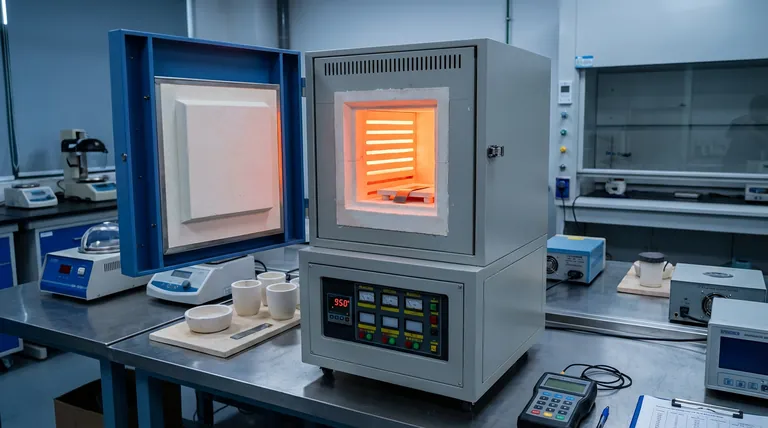
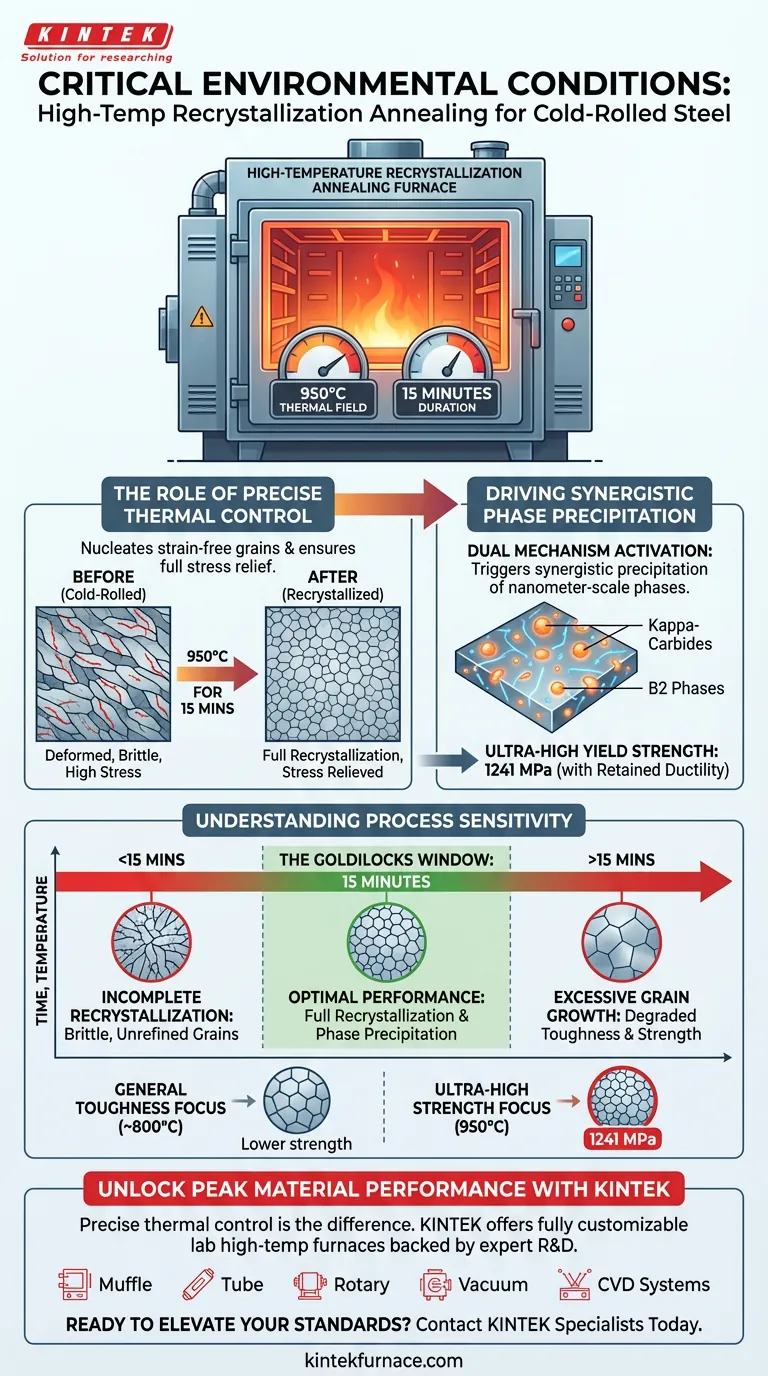
The primary environmental condition provided by a high-temperature recrystallization annealing furnace is a precisely controlled thermal field maintained at 950°C. To ensure the final material properties are achieved, this specific temperature must be sustained for a duration of 15 minutes. This strict process window is essential for fully recrystallizing the cold-rolled microstructure and eliminating internal residual stresses.
Core Takeaway The furnace does not simply heat the material; it creates a specific 950°C thermal environment that triggers a dual mechanism: full microstructural recrystallization and the synergistic precipitation of nanometer-scale phases. This precise combination is required to unlock an ultra-high yield strength of 1241 MPa without sacrificing the material's ductility.
The Role of Precise Thermal Control
Achieving Full Recrystallization
The fundamental purpose of this furnace environment is to induce complete recrystallization. Cold rolling deforms the steel's grain structure, making it hard but brittle.
By holding the environment at 950°C, the furnace provides the thermal energy necessary for new, strain-free grains to nucleate and replace the deformed microstructure.
Eliminating Residual Stresses
Cold working introduces significant internal stress within the steel lattice. The 15-minute thermal exposure ensures these stresses are fully relieved.
If the environment fails to maintain this temperature or duration, residual stresses may remain, leading to potential warping or failure in service.
Driving Synergistic Phase Precipitation
Inducing Nanometer-Scale Precipitates
Beyond simple stress relief, the 950°C environment serves a critical metallurgical function. It drives the synergistic precipitation of specific hardening phases: kappa-carbides and B2 phases.
These precipitates form at the nanometer scale, dispersed throughout the steel matrix.
Creating Ultra-High Strength
The presence of these specific precipitates is what elevates the material's performance. They act as reinforcement, pushing the yield strength to an ultra-high 1241 MPa.
Crucially, because the thermal field is so precisely controlled, this strength increase does not come at the expense of ductility.
Understanding Process Sensitivity
Temperature Specificity vs. General Annealing
It is critical to distinguish between general annealing and this specific high-performance treatment. While standard annealing at lower temperatures (e.g., 800°C) can produce a uniform austenitic fine-grain structure, it may not trigger the precipitation required for maximum strength.
The 950°C target is not arbitrary; it is the activation energy threshold for the specific kappa-carbide and B2 phase formation described.
The Risk of Time Deviation
The 15-minute duration acts as a "Goldilocks" window. A shorter duration may result in incomplete recrystallization, leaving brittle, unrefined grains.
Conversely, extending the time significantly beyond this window risks excessive grain growth, which could degrade the material's toughness and yield strength.
Making the Right Choice for Your Goal
To select the correct processing parameters, you must align the furnace conditions with your specific mechanical requirements.
- If your primary focus is Ultra-High Strength (1241 MPa): You must utilize the 950°C thermal environment to ensure the precipitation of kappa-carbides and B2 phases.
- If your primary focus is General Toughness: A lower temperature range (around 800°C) may suffice to refine the grain structure, though it will likely result in lower yield strength than the high-temperature process.
The difference between standard steel and ultra-high-performance material lies entirely in the precision of the thermal environment.
Summary Table:
| Process Parameter | Requirement | Metallurgical Impact |
|---|---|---|
| Target Temperature | 950°C | Nucleates strain-free grains & triggers phase precipitation |
| Dwell Time | 15 Minutes | Ensures full stress relief & prevents grain coarsening |
| Key Mechanisms | Dual Phase | Synergistic precipitation of kappa-carbides and B2 phases |
| Mechanical Result | Ultra-High Strength | Yield strength of 1241 MPa with retained ductility |
Unlock Peak Material Performance with KINTEK
Precise thermal control is the difference between standard steel and ultra-high-performance materials. At KINTEK, we understand that maintaining a strict 950°C environment requires world-class engineering. Backed by expert R&D and manufacturing, we offer Muffle, Tube, Rotary, Vacuum, and CVD systems, along with other lab high-temp furnaces—all fully customizable to meet your unique metallurgical needs.
Ready to elevate your research and production standards? Contact our specialists today to find your perfect furnace solution.
Visual Guide
References
- Changwei He, Yiran Zhou. Nanosized κ-Carbide and B2 Boosting Strength Without Sacrificing Ductility in a Low-Density Fe-32Mn-11Al Steel. DOI: 10.3390/nano15010048
This article is also based on technical information from Kintek Furnace Knowledge Base .
Related Products
- High Temperature Muffle Oven Furnace for Laboratory Debinding and Pre Sintering
- 1700℃ High Temperature Laboratory Tube Furnace with Alumina Tube
- Laboratory Muffle Oven Furnace with Bottom Lifting
- 1700℃ Controlled Inert Nitrogen Atmosphere Furnace
- Vertical Laboratory Quartz Tube Furnace Tubular Furnace
People Also Ask
- What thermal phenomena occur during polymer binder burnout in ceramic green bodies? Lab Furnace Guide
- What role does a high-temperature muffle furnace play in STFO synthesis? Achieve Pure Perovskite Results
- Why is controlled heat treatment in a muffle furnace necessary for calcined clay? Achieve Optimal Pozzolanic Activity
- How does a high-temperature muffle furnace facilitate the formation of LaNbxAl1−xO3+δ perovskite structures? Key Roles
- What role does a high-temperature muffle furnace play in the multi-stage synthesis of Li0.5MnFe1.5O4? Key to Pure Spinel



















