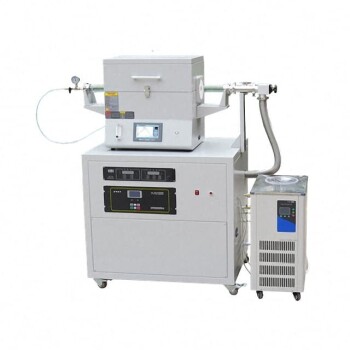
Precise temperature management is the fundamental requirement for a high-temperature muffle furnace during the final molding of composite photocatalysts. For most titanium dioxide (TiO2) based composites, this involves maintaining a stable environment, typically around 500°C, to ensure the transition to the active anatase phase while preventing the loss of critical chemical dopants.
Accurate temperature control is the single most important factor determining the final pollutant-removal efficiency of a catalyst. It ensures the material reaches its highest catalytic activity without suffering from structural degradation or the loss of active surface sites.
The Impact of Temperature on Phase and Dopant Stability
Maximizing Anatase Phase Formation
The primary goal of thermal treatment at approximately 500°C is to facilitate the complete conversion of TiO2 from an amorphous state to the anatase phase. This specific crystalline structure is significantly more active for photocatalysis than other phases. Precise control prevents the material from transitioning into the less active rutile phase, which occurs at higher temperatures.
Preservation of Critical Dopants
Many high-performance photocatalysts rely on dopants such as Nitrogen (N) or Cerium (Ce) to enhance their light-harvesting capabilities. If the muffle furnace exceeds the target temperature, these dopants can be "burned off" or lost through volatilization. Maintaining a strict thermal ceiling ensures these elements remain embedded within the catalyst lattice.
Preventing Grain Sintering
Excessive heat leads to a phenomenon known as sintering, where individual catalyst particles fuse together. This significantly reduces the specific surface area and closes off active pores, leading to a dramatic drop in catalytic performance. A stable, controlled temperature prevents this loss of morphology.
Morphological Development and Impurity Removal
Removal of Organic Templates and Residues
The muffle furnace is used to decompose organic template agents and surfactants used during the synthesis process. By heating the material to specific ranges (often 350°C to 450°C), the furnace reveals internal structures, such as the hollow channels in S-1 zeolites. This process is essential for exposing the internal active sites of the composite.
Conversion of Precursor Nitrates
Thermal treatment serves to convert precursor metal nitrates into stable, functional metal oxides like SnO2. This chemical transformation provides the necessary foundation for subsequent reduction steps and ensures the catalyst is chemically stable during wastewater treatment cycles.
Enhancing Coating Density and Adhesion
In applications involving spin-coated samples, a programmable muffle furnace promotes the rearrangement of nanoparticles. This controlled heat input evaporates solvents and increases the density of the coating. The result is a more robust structure that better adheres to substrates and resists corrosion from chloride ions.
Strengthening Heterojunctions and Interfaces
Promoting Interfacial Interaction
Secondary calcination, often performed at 400°C, is used to strengthen the bond between different materials, such as LaMnO3 and g-C3N4. This thermal curing facilitates stronger chemical bonding or physical embedding at the interface. These robust connections are vital for creating stable Z-scheme heterojunctions.
Improving Electron-Hole Separation
A well-defined interface between composite components enhances the separation of photo-generated electrons and holes. By using the muffle furnace to create a stable thermal environment (sometimes as high as 660°C), manufacturers ensure that active components like ZnO and TiO2 are firmly attached to carriers like bentonite. This stability is critical for the recyclability of the catalyst.
Understanding the Trade-offs: Heat vs. Activity
Achieving the perfect thermal profile requires balancing activation energy against structural integrity. While higher temperatures generally improve crystallinity and remove more impurities, they also increase the risk of surface area loss through grain growth.
Furthermore, while a "burn-off" at 650°C is excellent for determining fiber content in composite resins, that same temperature might destroy the delicate surface chemistry of a doped photocatalyst. You must calibrate the furnace specifically to the thermal tolerance of your active dopants and the phase-transition temperature of your base semiconductor.
Applying Thermal Control to Your Synthesis
To achieve the best results with your muffle furnace, tailor your temperature profile to the specific structural goal of your photocatalyst.
- If your primary focus is Phase Purity (TiO2): Maintain a precise window around 500°C to ensure anatase formation while avoiding the rutile transition.
- If your primary focus is Porosity and Surface Area: Use lower-range temperatures (350°C - 450°C) to burn off templates without triggering grain sintering.
- If your primary focus is Heterojunction Stability: Utilize a stable, high-temperature soak (up to 660°C) to ensure active particles are firmly cured onto their support carriers.
- If your primary focus is Dopant Retention: Implement strict upper-limit controls to prevent the loss of volatile elements like Nitrogen or Cerium.
By treating the muffle furnace as a precision instrument rather than a simple heating element, you can maximize the photocatalytic potential of your composite materials.
Summary Table:
| Focus Area | Target Temperature | Key Benefit/Requirement |
|---|---|---|
| Phase Purity (TiO2) | ~500°C | Maximizes active anatase phase; prevents rutile transition. |
| Porosity & Surface Area | 350°C - 450°C | Decomposes organic templates while preventing grain sintering. |
| Dopant Retention | Strict Thermal Ceiling | Prevents volatilization of critical elements like Nitrogen (N) or Cerium (Ce). |
| Heterojunction Stability | Up to 660°C | Strengthens chemical bonding between components for better electron-hole separation. |
| Coating Density | Programmable Ramps | Promotes nanoparticle rearrangement and solvent evaporation for robust adhesion. |
Precision Heating for Advanced Material Synthesis
Achieving the perfect photocatalytic activity requires more than just heat—it requires absolute thermal precision. At KINTEK, we specialize in providing high-performance laboratory equipment designed for the rigorous demands of material science.
Our comprehensive range of customizable high-temperature furnaces—including muffle, tube, rotary, vacuum, CVD, and atmosphere furnaces—ensures stable environments for phase transitions and dopant preservation. Whether you are developing Z-scheme heterojunctions or scaling up TiO2 production, KINTEK offers the reliability and accuracy your research deserves.
Ready to elevate your lab's efficiency? Contact us today to find the perfect thermal solution for your unique synthesis needs!
References
- Wei Zhang, Xuchao Yan. Optimization of Preparation Conditions of Modified Oyster Shell Powder/Ce-N-TiO<sub>2</sub> by Response Surface Methodology (RSM). DOI: 10.4236/jep.2023.141002
This article is also based on technical information from Kintek Furnace Knowledge Base .
Related Products
- 1700℃ High Temperature Muffle Oven Furnace for Laboratory
- 1200℃ Muffle Oven Furnace for Laboratory
- 1800℃ High Temperature Muffle Oven Furnace for Laboratory
- High Temperature Muffle Oven Furnace for Laboratory Debinding and Pre Sintering
- 1400℃ Muffle Oven Furnace for Laboratory
People Also Ask
- What is the primary function of a high-temperature laboratory muffle furnace in chemical synthesis? Achieve Precision.
- How does a high-temperature laboratory muffle furnace affect material properties? Transform Anodic Oxide Films Fast
- What role does a muffle furnace play in BCZY712 electrolyte powder production? Achieve Perfect Phase Purity
- How does a muffle furnace impact Ni/MgAl2O4 catalysts? Optimize Stability and Catalytic Performance
- How does the two-stage sintering process contribute to the synthesis of MeCuFeO3 perovskite? Optimize crystal purity.