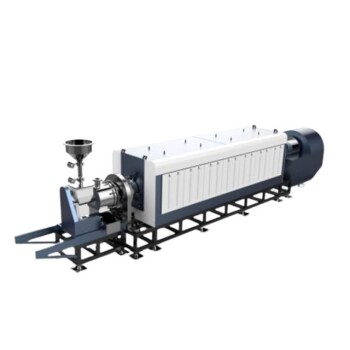
The primary advantage of using a high-temperature muffle furnace for biomass pyrolysis is a significantly higher carbon recovery rate—approximately 14.0% compared to just 2.33% for hydrothermal methods. This process utilizes intense thermal decomposition in an oxygen-free environment to effectively remove volatile components and establish a robust, high-porosity carbon framework that is difficult to achieve through hydrothermal carbonization alone.
High-temperature muffle furnaces provide the thermal intensity and environmental control necessary to maximize carbon yields and structural integrity, outperforming hydrothermal methods in both production efficiency and material quality.
Enhanced Yield and Structural Integrity
Superior Carbon Recovery Rates
Sequential synthesis using a muffle furnace for pyrolysis yields a carbon dot recovery rate of approximately 14.0%. In stark contrast, standalone hydrothermal carbonization typically achieves a much lower recovery rate of around 2.33%.
Intensive Thermal Decomposition
The muffle furnace induces more intense thermal decomposition by operating at higher temperatures (often between 400°C and 800°C). This intensity increases the formation rate of carbon nuclei, which are the building blocks of high-quality carbon materials.
Formation of a Robust Carbon Framework
By precisely managing high temperatures, such as 700°C for coconut shells, the furnace effectively eliminates volatile components. This removal is critical for promoting the development of a stable and robust carbon framework.
Precise Control of Material Properties
Development of High Porosity
Muffle furnaces facilitate the creation of materials with extreme porosity, reaching levels as high as 81.08%. This is achieved through controlled heating rates and sufficient residence time, allowing for the complete removal of volatile matter.
Optimization of Specific Surface Area
Accurate temperature management is essential for the complete thermal degradation of lignocellulose. This process promotes a well-developed microporous structure, significantly increasing the specific surface area required for effective contaminant adsorption.
Increased Fixed Carbon Content
The furnace environment induces the breaking and recombining of carbon-carbon bonds. This transforms low-energy-density raw biomass into stable biochar characterized by high fixed carbon content and increased energy density.
Superior Process Control Mechanisms
Guaranteed Anaerobic Environments
Using an atmosphere control system with inert gases like nitrogen (N2), the muffle furnace eliminates oxygen from the chamber. This ensures a pure anaerobic pyrolysis process, preventing oxidative combustion and maintaining the purity of the resulting biochar.
Systematic Component Decomposition
Precise control over the heating rate (e.g., 10°C per minute) allows for the systematic decomposition of cellulose, hemicellulose, and lignin. This gradual breakdown is vital for tailoring the pore structure and chemical characteristics of the final activated carbon matrix.
Understanding the Trade-offs
While muffle furnace pyrolysis offers superior yields and structural control, it requires higher energy inputs compared to lower-temperature hydrothermal methods. The process also demands more sophisticated atmosphere control systems to maintain an oxygen-free environment, which can increase operational complexity. Furthermore, the high temperatures involved may lead to the loss of certain functional groups that are sometimes preserved in the milder conditions of hydrothermal synthesis.
How to Apply This to Your Project
Success in biomass conversion depends on aligning your equipment choice with your specific material requirements and output goals.
- If your primary focus is maximizing carbon dot yield: Utilize a muffle furnace for pyrolysis followed by post-treatment to achieve recovery rates up to six times higher than hydrothermal methods.
- If your primary focus is developing high-porosity filters: Opt for muffle furnace pyrolysis with a controlled heating rate (10°C/min) to reach porosity levels exceeding 80%.
- If your primary focus is producing high-energy-density biochar: Use a muffle furnace at temperatures around 500°C to ensure the complete removal of volatiles and a high fixed carbon content.
By leveraging the thermal intensity and atmospheric precision of a muffle furnace, you can transform raw biomass into high-performance carbon materials with unparalleled efficiency.
Summary Table:
| Feature | High-Temp Muffle Furnace Pyrolysis | Hydrothermal Carbonization |
|---|---|---|
| Carbon Recovery Rate | ~14.0% (High Yield) | ~2.33% (Low Yield) |
| Porosity Level | Up to 81.08% | Significantly Lower |
| Thermal Intensity | High (400°C - 800°C) | Low to Moderate |
| Environment Control | Pure Anaerobic (Inert Gas) | Aqueous/Pressure-based |
| Structural Result | Robust, stable carbon framework | Less stable, lower fixed carbon |
Elevate Your Biomass Research with KINTEK Precision
Unlock the full potential of your carbon materials with KINTEK’s advanced high-temperature solutions. As specialists in laboratory equipment, we provide a comprehensive range of muffle, tube, rotary, vacuum, CVD, and atmosphere furnaces specifically designed to meet the rigorous demands of biomass pyrolysis and material synthesis.
Whether you are aiming for maximum carbon recovery rates or precisely controlled microporous structures, our customizable furnaces offer the atmospheric purity and heating accuracy your project requires. Contact KINTEK today to discuss your unique needs and request a quote—let us help you transform raw biomass into high-performance carbon with unparalleled efficiency.
References
- Subramani Krishnaraj Rajkishore, Ruben Sakrabani. Novel Synthesis of Carbon Dots from Coconut Wastes and Its Potential as Water Disinfectant. DOI: 10.3390/su151410924
This article is also based on technical information from Kintek Furnace Knowledge Base .
Related Products
- 1700℃ High Temperature Muffle Oven Furnace for Laboratory
- 1800℃ High Temperature Muffle Oven Furnace for Laboratory
- 1200℃ Muffle Oven Furnace for Laboratory
- 1400℃ Muffle Oven Furnace for Laboratory
- High Temperature Muffle Oven Furnace for Laboratory Debinding and Pre Sintering
People Also Ask
- What is the primary function of a high-temperature laboratory muffle furnace in chemical synthesis? Achieve Precision.
- How does a high-temperature laboratory muffle furnace affect material properties? Transform Anodic Oxide Films Fast
- What role does a muffle furnace play in BCZY712 electrolyte powder production? Achieve Perfect Phase Purity
- How does a muffle furnace impact Ni/MgAl2O4 catalysts? Optimize Stability and Catalytic Performance
- What role does a muffle furnace play in sintering photocathodes? Enhance Electrode Conductivity & Catalytic Activity