
At its core, a muffle furnace is a high-temperature chamber designed for material transformation and analysis. Its primary applications include quantitative chemical analysis like ashing, the heat treatment of metals to alter their properties, and the manufacturing of ceramics, glass, and other advanced materials that require precise thermal processing in a controlled environment.
The essential value of a muffle furnace lies in its ability to deliver extremely uniform and precisely controlled heat while isolating the material from direct contact with the heating elements and combustion contaminants. This unique combination makes it an indispensable tool for any process where material purity and predictable structural changes are paramount.
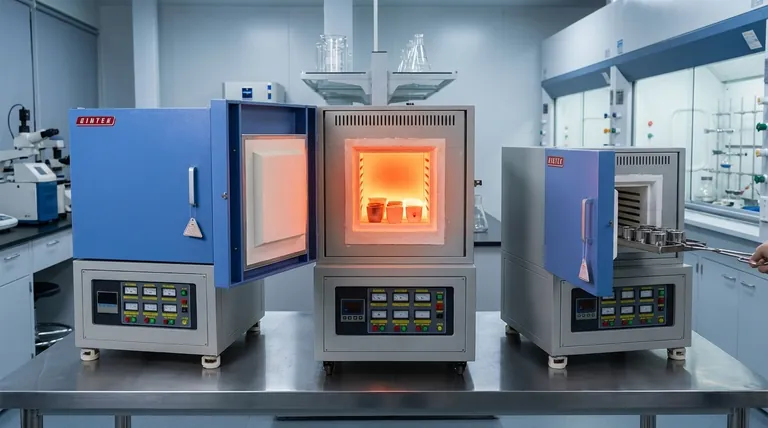
The Core Principle: Isolated, Controlled Heat
A muffle furnace's design is the key to its versatility. Unlike a simple oven, it contains an insulated outer chamber that holds the heating elements and an inner chamber—the "muffle"—that holds the sample.
How a Muffle Furnace Works
Modern electric muffle furnaces generate intense heat via conduction, convection, and blackbody radiation from heating elements surrounding the muffle. This energy heats the chamber's interior without any combustion occurring inside.
The muffle itself is typically made from a high-temperature ceramic material. It acts as a barrier, ensuring the sample is not contaminated by any byproducts or direct contact with the heating coils.
The Critical Benefit of Isolation
This isolation is the furnace's defining feature. For applications like ashing, where the goal is to burn away all organic matter to weigh the remaining inorganic residue, any external contamination would render the results useless.
The muffle ensures that the only thing affecting the sample is pure, controlled heat.
The Importance of Precision and Uniformity
Muffle furnaces can reach temperatures as high as 1,800°C (3,272°F). More importantly, they provide exceptionally uniform heating throughout the chamber.
This prevents hot spots and ensures that the entire sample undergoes the same thermal process, which is critical for consistent results in metallurgy and ceramics production.
Primary Applications in Research and Analysis
In laboratory and R&D settings, the muffle furnace is a workhorse for preparing and testing materials under extreme thermal conditions.
Gravimetric Analysis (Ashing)
The most common analytical use is determining the ash content of a sample. The material is heated to a high temperature to completely combust all organic components.
What remains is the inorganic ash, which can then be weighed to determine its percentage of the original sample. This is standard practice in food science, environmental testing, and materials analysis.
Materials Research
Scientists use muffle furnaces to study how new alloys, polymers, and composites behave under thermal stress. This allows them to determine material durability, thermal expansion coefficients, and degradation points.
Key Uses in Manufacturing and Metallurgy
In industrial settings, muffle furnaces are used to fundamentally change the properties of materials, enabling the creation of finished goods.
Heat Treatment of Metals
This broad category includes several processes designed to alter the mechanical properties of metals like steel and copper.
- Hardening: Heating and then rapidly cooling a metal to increase its hardness and wear resistance.
- Annealing: Heating and slowly cooling a metal to soften it, improve ductility, and relieve internal stresses.
- Brazing & Soldering: Joining metal parts using a filler metal that is melted in the furnace.
- Sintering: Fusing metallic powders together by heating them below their melting point. This is fundamental to powder metallurgy and metal injection molding (MIM).
Ceramics, Glass, and Enamel Production
Creating ceramics and glass requires precise, uniform heating to ensure structural integrity and prevent cracking. Muffle furnaces are used for firing clay, melting and shaping glass, and applying enamel coatings to metal surfaces.
The clean, isolated environment prevents discoloration and impurities from ruining the final product.
Understanding the Trade-offs
While powerful, a muffle furnace is not always the perfect tool. Understanding its limitations is key to using it effectively.
Atmosphere Control
A standard muffle furnace operates in an air atmosphere. While it isolates the sample from combustion contaminants, it does not protect it from oxidation.
For processes requiring an inert or reactive gas environment (e.g., using argon or nitrogen), a specialized controlled-atmosphere furnace is necessary.
Heating and Cooling Rates
Due to their significant thermal mass and heavy insulation, muffle furnaces generally heat up and cool down more slowly than other heating systems. This can be a disadvantage in high-throughput production but is often a benefit for processes like annealing that require slow, controlled cooling.
Energy Consumption
Reaching and maintaining temperatures over 1,000°C is an energy-intensive process. For continuous industrial applications, energy cost is a significant operational consideration.
Making the Right Choice for Your Application
Selecting the right thermal processing tool depends entirely on your end goal.
- If your primary focus is analytical purity (e.g., ashing): The key benefit is the isolated chamber that prevents sample contamination and ensures accurate results.
- If your primary focus is altering metal properties (e.g., heat treating): The uniform heating and precise temperature control ensure consistent and predictable changes to the material's microstructure.
- If your primary focus is creating new materials (e.g., ceramics or sintering): The furnace's ability to execute controlled temperature profiles without introducing contaminants is essential for final product integrity.
By understanding its core functions of isolation and precision, you can leverage the muffle furnace as a powerful tool for material transformation and analysis.
Summary Table:
| Application Area | Key Uses | Primary Benefits |
|---|---|---|
| Research & Analysis | Gravimetric analysis (ashing), materials research | Isolated heating, precise temperature control, prevents contamination |
| Manufacturing & Metallurgy | Heat treatment (hardening, annealing), brazing, sintering, ceramics/glass production | Uniform heating, predictable material changes, high-temperature capability |
Unlock the full potential of your laboratory with KINTEK's advanced high-temperature furnace solutions! Leveraging exceptional R&D and in-house manufacturing, we provide diverse labs with reliable muffle, tube, rotary, vacuum, atmosphere furnaces, and CVD/PECVD systems. Our strong deep customization capability ensures we precisely meet your unique experimental needs, enhancing efficiency and accuracy in material analysis and heat treatment. Contact us today to discuss how our tailored solutions can drive your success!
Visual Guide

Related Products
- 1400℃ Muffle Oven Furnace for Laboratory
- 1700℃ High Temperature Muffle Oven Furnace for Laboratory
- 1800℃ High Temperature Muffle Oven Furnace for Laboratory
- 1200℃ Muffle Oven Furnace for Laboratory
- High Temperature Muffle Oven Furnace for Laboratory Debinding and Pre Sintering
People Also Ask
- How does a high-temperature laboratory muffle furnace affect material properties? Transform Anodic Oxide Films Fast
- What is the primary function of a high-temperature laboratory muffle furnace in chemical synthesis? Achieve Precision.
- How is a laboratory high-temperature muffle furnace utilized to achieve the specific crystalline structure of LaFeO3 catalysts?
- How does a laboratory high-temperature muffle furnace contribute to the final formation of Bismuth Oxide nanosheets?
- What is the role of a laboratory high-temperature muffle furnace in H13 steel treatment? Optimize Tool Performance



















