
For horizontal tube furnaces, your primary options for zonal heating are single-zone configurations designed for thermal uniformity and multi-zone configurations that offer precise control over temperature profiles. A single-zone furnace uses one continuous heating element, often paired with water-cooled ends to create a consistent hot zone. A multi-zone furnace divides the heated length into multiple, independently controlled sections to create specific temperature gradients or to extend the uniform hot zone by compensating for heat loss at the ends.
The choice between single-zone and multi-zone heating is not about which is superior, but which configuration best serves your experimental goal. Your decision hinges on whether your process requires a single, stable temperature or a carefully engineered temperature profile along the length of the sample tube.
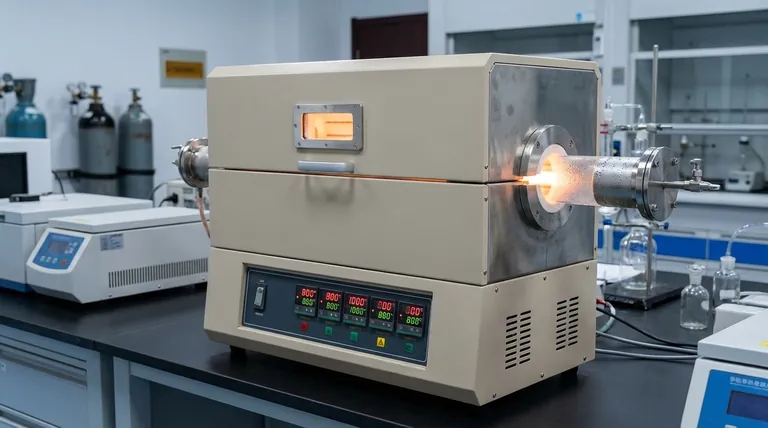
The Goal: Uniformity vs. Temperature Gradient
The fundamental difference between single and multi-zone furnaces lies in the thermal environment they are designed to create. Your application's requirements will dictate which approach is necessary.
The Single-Zone Approach: Maximizing Uniformity
A single-zone furnace is the standard for applications requiring a stable, uniform temperature across the entire sample. This design uses one heating element and one controller.
It is ideal for processes like annealing, calcination, or tempering, where consistency is key. The length of the truly uniform hot zone is typically about half the total heated length.
The Multi-Zone Approach: Engineering a Profile
A multi-zone furnace divides the heated length into distinct sections, most commonly three zones (a center zone and two end zones). Each zone has its own heating element and thermocouple, allowing for independent temperature control.
This enables you to create a temperature gradient, which is essential for processes like chemical vapor deposition (CVD) and certain types of crystal growth.
Extending Uniformity with Multiple Zones
Counter-intuitively, a multi-zone furnace can also be used to create a longer and more uniform hot zone than a single-zone model.
By setting the end zones to a slightly higher temperature than the center, you can actively compensate for the natural heat loss that occurs at the ends of the furnace. This flattens the temperature profile and extends the usable uniform area.
Key Components That Define a Zone
The effectiveness of any zonal configuration depends on the interplay of several key components that control heat generation and containment.
Heating Elements
The heating element material dictates the furnace's maximum operating temperature. The most common materials are Kanthal (up to 1200°C), Silicon Carbide (SiC, up to 1500°C), and Molybdenum Disilicide (MoSi2, up to 1800°C).
Water-Cooled End Caps
These are not merely an optional accessory; they are critical for defining the thermal profile. By actively cooling the ends of the process tube, they create a sharp temperature drop-off.
This action effectively isolates the hot zone, preventing heat from escaping and ensuring the temperature within the zone is more uniform and predictable.
Control Systems
Zonal heating is meaningless without precise control. Simple electronic panels are sufficient for single-zone furnaces, but multi-zone systems require more advanced software.
Data Acquisition and Control Software (DACS) allows you to program, monitor, and record the temperature of each zone independently, enabling the creation of complex thermal profiles and ensuring process repeatability.
Understanding the Trade-offs
Choosing a zonal heating strategy involves balancing performance with complexity and cost. Understanding these trade-offs is crucial for making an informed investment.
Cost and Complexity
A multi-zone furnace is inherently more complex. It requires multiple heating elements, thermocouples, and power controllers, leading to a significantly higher initial cost compared to a single-zone furnace of the same size.
Operational Simplicity
A single-zone furnace is straightforward: you set one temperature. A multi-zone furnace requires more sophisticated programming to define the relationship between the zones, which adds a layer of operational planning.
Process Flexibility
The primary advantage of a multi-zone furnace is its flexibility. It can be programmed to run as a single-zone furnace, create a gradient, or be optimized for maximum uniformity, making it a more versatile long-term asset.
Making the Right Choice for Your Process
Your decision should be driven entirely by the thermal requirements of your specific application.
- If your primary focus is consistent, uniform heating for standard processes like annealing: A single-zone furnace with water-cooled end caps is the most direct and cost-effective solution.
- If your primary focus is creating a temperature gradient for CVD or crystal growth: A multi-zone furnace is essential and provides the necessary control.
- If your primary focus is achieving the highest possible uniformity over the longest possible area: A three-zone furnace, programmed to compensate for end losses, is the superior technical choice.
Ultimately, selecting the correct zonal configuration begins with a clear understanding of the thermal conditions your process demands.
Summary Table:
| Zonal Heating Option | Key Features | Ideal Applications |
|---|---|---|
| Single-Zone Configuration | One heating element, uniform temperature, cost-effective | Annealing, calcination, tempering |
| Multi-Zone Configuration | Multiple independently controlled zones, temperature gradients or extended uniformity | CVD, crystal growth, high-uniformity processes |
Ready to enhance your lab's thermal processing capabilities? At KINTEK, we leverage exceptional R&D and in-house manufacturing to provide advanced high-temperature furnace solutions tailored to your needs. Our product line includes Muffle, Tube, Rotary Furnaces, Vacuum & Atmosphere Furnaces, and CVD/PECVD Systems, with strong deep customization to precisely meet unique experimental requirements. Whether you need single-zone or multi-zone heating for processes like annealing or CVD, we can help you achieve superior results. Contact us today to discuss how our furnaces can optimize your experiments and drive innovation!
Visual Guide

Related Products
- Vertical Laboratory Quartz Tube Furnace Tubular Furnace
- Vacuum Sealed Continuous Working Rotary Tube Furnace Rotating Tube Furnace
- Split Multi Heating Zone Rotary Tube Furnace Rotating Tube Furnace
- High Pressure Laboratory Vacuum Tube Furnace
- 1700℃ High Temperature Laboratory Tube Furnace with Alumina Tube
People Also Ask
- What are the key differences between single-zone and multi-zone vertical tube furnaces? Choose the Right Furnace for Your Lab
- What are the main characteristics of vertical tube furnaces? Optimize Your Lab with Space-Saving, Uniform Heating
- What makes a vertical tube furnace easy to operate? Discover Intuitive Automation for Precision Heating
- How are wafers loaded and unloaded in a vertical tube furnace? Achieve Precision and Purity in Wafer Processing
- How do heat treatment processes influence the configuration of a vertical tube furnace? Optimize for Quenching, Annealing, and More



















