
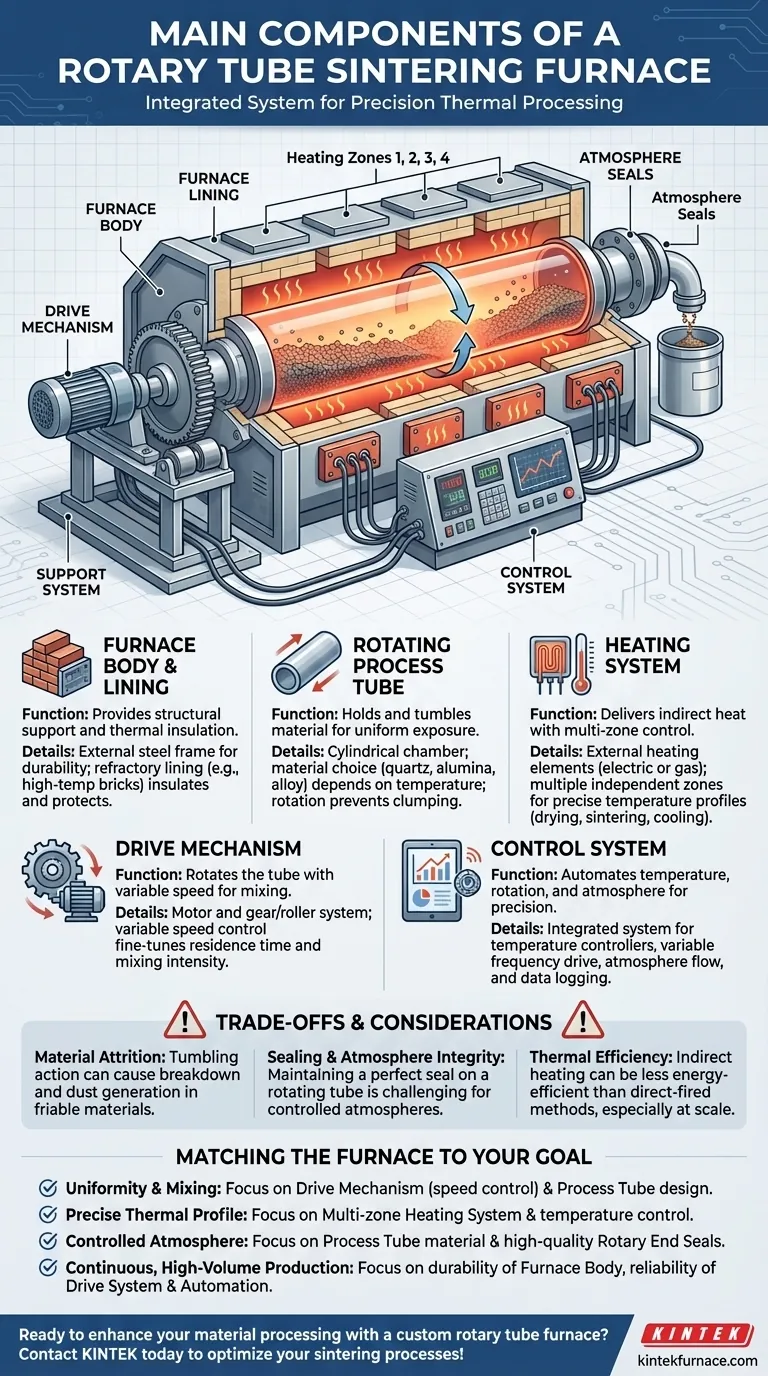
At its core, a rotary tube sintering furnace is an integrated system with five primary components: the furnace body and lining, the rotating process tube, the heating system, the drive mechanism, and the control system. These parts work in concert to provide a dynamic, precisely controlled thermal environment for processing materials, often in a continuous fashion.
The fundamental purpose of a rotary tube furnace is not just to heat material, but to ensure unparalleled process uniformity. Its design combines controlled rotation for constant mixing with zoned heating to guarantee every particle experiences the exact same thermal journey.
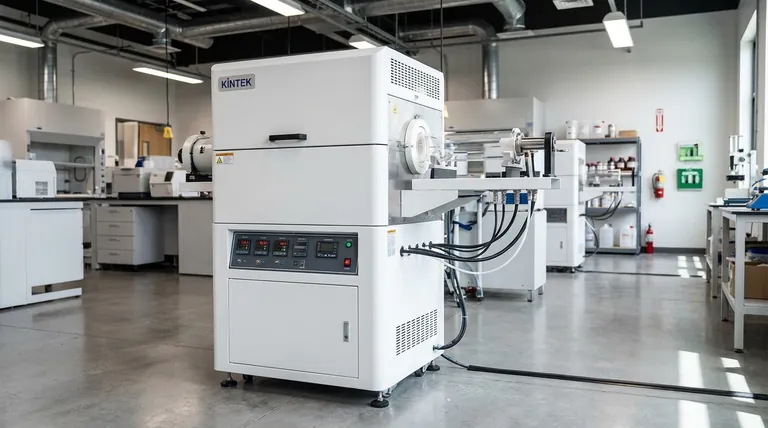
The Core Components and Their Functions
Understanding how a rotary tube furnace achieves its results requires looking at each major component and its specific role in the overall process. The system is logically divided between the upper furnace section, which houses the thermal and mechanical elements, and the lower section, which contains the electronic controls.
The Furnace Body and Lining
The furnace body is the external steel structure that provides the physical framework for the entire system. It is engineered for durability and to safely contain the high-temperature components within.
Inside the body is the furnace lining, which is constructed from refractory materials like high-temperature bricks or moldable ceramics. This lining serves two critical functions: it insulates the furnace to maximize thermal efficiency and minimize heat loss, and it protects the steel body from the extreme internal temperatures.
The Rotating Process Tube
The process tube is the heart of the furnace. This is the cylindrical chamber that rotates on its axis and contains the material being processed. The choice of tube material—often quartz, alumina, or a specialized metal alloy—is dictated by the required maximum temperature and chemical compatibility with the process atmosphere and material.
Its rotation ensures the material inside is constantly tumbling, which prevents clumping and guarantees every particle is uniformly exposed to the heat source and any controlled atmosphere.
The Heating System
Most modern rotary tube furnaces use an indirect heating design. This means the heating elements (either electric resistance or gas burners) are located outside the process tube. Heat is transferred to the tube via radiation and convection.
A critical feature is the use of multiple thermal control zones. The furnace's length is divided into several independently controlled heating zones. This allows for the creation of a precise temperature profile along the tube, enabling complex processes that might require distinct drying, sintering, and cooling stages within a single pass.
The Drive and Rotation Mechanism
The drive mechanism is the electromechanical system responsible for rotating the process tube. It typically consists of a motor connected to a drive gear or a system of driven rollers that support and turn the tube.
Advanced systems offer variable speed control, allowing operators to fine-tune the rotation speed. This directly influences how long the material resides in the furnace and the degree of mixing it undergoes, making it a key parameter for process optimization.
The Control and Automation System
The electronic control system is the brain of the operation. Housed in the lower part of the furnace assembly, this system integrates temperature controllers for each heating zone, a variable frequency drive for the rotation motor, and flow controllers for managing the process atmosphere.
Modern systems feature a high degree of automation, allowing for pre-programmed recipes, data logging, and remote monitoring. This ensures process repeatability, precision, and operational safety.
Understanding the Trade-offs and Considerations
While highly effective, the design of a rotary tube furnace presents specific challenges and limitations that must be understood for successful implementation.
Material Attrition and Dust Generation
The tumbling action that ensures uniform heating can be a drawback for friable or delicate materials. The constant mixing can cause particles to break down, leading to material attrition and the generation of fine dust, which can be a process concern.
Sealing and Atmosphere Integrity
Maintaining a perfect seal at both ends of a constantly rotating tube is mechanically challenging. While sophisticated seals exist, they are points of potential failure. Any leakage can compromise the integrity of the controlled atmosphere, which is critical for many sintering and calcination processes.
Thermal Efficiency
Because heat must be transferred indirectly through the tube wall to the material, the process can be less thermally efficient than direct-fired methods. This can lead to higher energy consumption, particularly in very large-scale industrial applications.
Matching the Furnace to Your Processing Goal
The choice and specification of a rotary tube furnace should be driven by your primary technical objective.
- If your primary focus is process uniformity and mixing: The key components are the drive mechanism's control over rotation speed and the design of the process tube, which may include internal flights or lifters to enhance tumbling.
- If your primary focus is a precise thermal profile: The critical system is the multi-zone heating and its associated temperature control instrumentation, which allows for distinct process stages.
- If your primary focus is processing in a controlled atmosphere: Pay close attention to the process tube material and, most importantly, the design and quality of the rotary end seals to ensure gas integrity.
- If your primary focus is continuous, high-volume production: The durability of the furnace body, the reliability of the drive system, and the sophistication of the automation system are paramount for long-term, repeatable operation.
Ultimately, understanding how these core components function and interact is the key to specifying a system that delivers the precise, repeatable results your process demands.
Summary Table:
| Component | Function |
|---|---|
| Furnace Body and Lining | Provides structural support and thermal insulation |
| Rotating Process Tube | Holds and tumbles material for uniform exposure |
| Heating System | Delivers indirect heat with multi-zone control |
| Drive Mechanism | Rotates the tube with variable speed for mixing |
| Control System | Automates temperature, rotation, and atmosphere for precision |
Ready to enhance your material processing with a custom rotary tube furnace? At KINTEK, we leverage exceptional R&D and in-house manufacturing to provide advanced high-temperature furnace solutions. Our product line, including Muffle, Tube, Rotary Furnaces, Vacuum & Atmosphere Furnaces, and CVD/PECVD Systems, is complemented by strong deep customization capabilities to precisely meet your unique experimental requirements. Whether you need precise thermal profiles, controlled atmospheres, or continuous production, we can deliver reliable, efficient systems tailored to your lab. Contact us today to discuss how we can optimize your sintering processes!
Visual Guide
Related Products
- Vacuum Sealed Continuous Working Rotary Tube Furnace Rotating Tube Furnace
- Laboratory Vacuum Tilt Rotary Tube Furnace Rotating Tube Furnace
- Split Multi Heating Zone Rotary Tube Furnace Rotating Tube Furnace
- Inclined Rotary Plasma Enhanced Chemical Deposition PECVD Tube Furnace Machine
- Inclined Rotary Plasma Enhanced Chemical Deposition PECVD Tube Furnace Machine
People Also Ask
- What is the purpose of rotary tube furnaces? Achieve Uniform Heat Treatment for Powders and Granules
- What are the key advantages of using a rotary tube furnace? Achieve Dynamic, Uniform Heating for Powders
- What are the advantages of rotary tube furnaces in fuel compatibility? Boost Efficiency and Cut Costs
- How does the amount of material processed vary between batch and continuous rotary tube furnaces? Scale Your Production Efficiently
- What is the temperature range of some rotary tube furnaces? Achieve Uniform Heating Up to 1200°C



















