
In materials science, the key takeaway is that tubular furnaces are indispensable tools for precision thermal processing. Their value comes from providing an exceptionally controlled environment, which is fundamental for synthesizing new materials, analyzing material properties under specific conditions, and ensuring the repeatable results required for both research and industrial production.
While a furnace's basic function is heating, its true value in materials science lies in creating an exceptionally controlled and uniform thermal environment. This precision is what enables scientists to isolate variables, prevent contamination, and reliably create or test materials with specific, predictable properties.
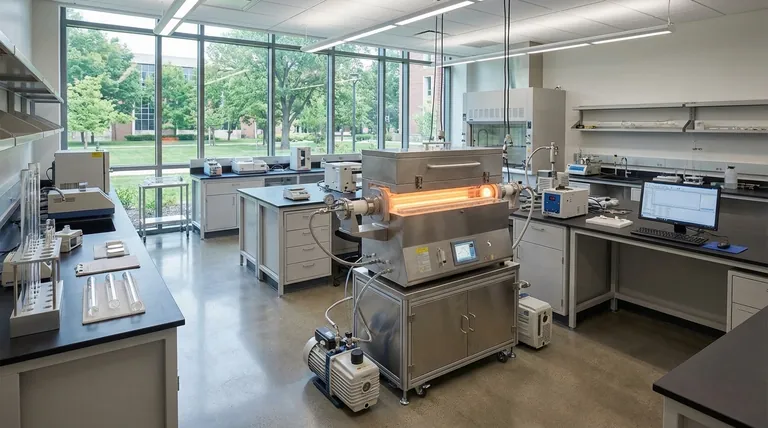
The Core Function: Precision Thermal Control
A tubular furnace is more than just a heater; it is a carefully engineered instrument designed to deliver precise thermal energy to a sample. This control is the foundation of its utility in materials science.
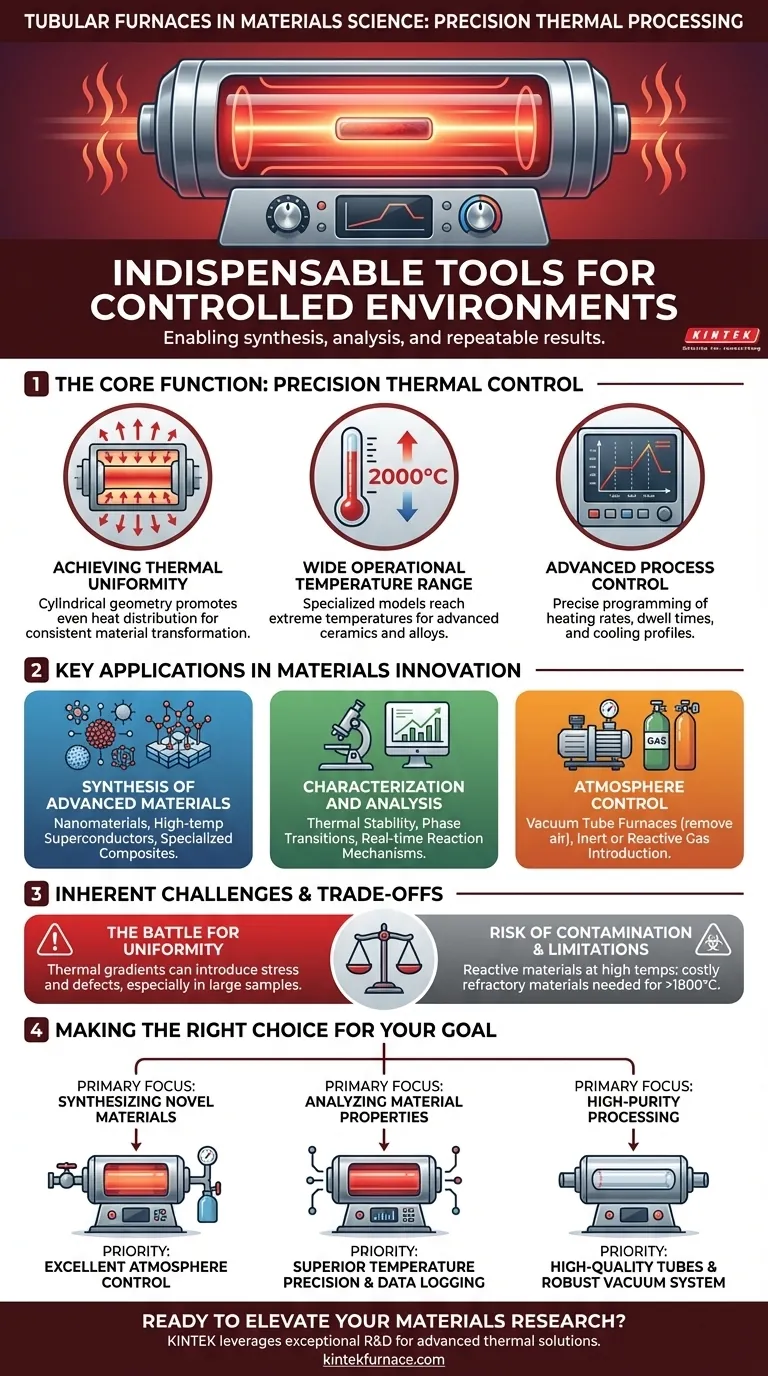
Achieving Thermal Uniformity
The cylindrical geometry of a tubular furnace is intentional. It promotes even heat distribution around the sample, creating a uniform temperature zone. This uniformity is critical for preventing uneven material properties, ensuring that the entire sample undergoes the same transformation simultaneously.
A Wide Operational Temperature Range
Modern tubular furnaces can operate across a vast temperature spectrum, with some specialized models reaching up to 2000°C. This capability is essential for processing advanced materials like high-performance ceramics and alloys that require extreme heat for formation or testing.
Advanced Process Control
These furnaces are equipped with sophisticated controllers that allow for precise programming of heating rates, dwell times, and cooling profiles. This enables researchers to study phase transitions, thermal stability, and the kinetics of chemical reactions with high accuracy.
Key Applications in Materials Innovation
The control offered by tubular furnaces directly enables groundbreaking work in the development and understanding of new materials.
Synthesis of Advanced Materials
The furnace provides the specific energy and environmental conditions required to create novel substances. This includes the synthesis of nanomaterials, advanced ceramics, high-temperature superconducting materials, and specialized composite materials.
Characterization and Analysis
Scientists use these furnaces to test the limits of materials. By subjecting samples to controlled thermal cycles, they can study thermal stability, identify phase transition behaviors, and observe chemical reaction mechanisms in real-time.
Atmosphere Control
Many processes require a specific atmosphere to prevent unwanted reactions or to actively participate in the material's formation. Vacuum tube furnaces are used to remove air, preventing oxidation and contamination, while other systems allow for the introduction of inert or reactive gases.
Understanding the Inherent Challenges and Trade-offs
Despite their advantages, effectively using a tubular furnace requires navigating several engineering and scientific challenges. Objectivity demands we acknowledge these limitations.
The Battle for Thermal Uniformity
While the design promotes uniformity, achieving a perfectly even temperature zone, especially with large samples or at extreme temperatures, remains a significant challenge. Thermal gradients can introduce stress and create defects in the final material.
The Risk of Contamination
At high temperatures, materials become more reactive. There is always a risk that the sample will interact with the furnace tube material (e.g., quartz or alumina) or with trace impurities in the atmosphere. This is a critical concern for high-purity applications.
Material and Design Limitations
The performance of a furnace is ultimately limited by the materials it is made from. Reaching and sustaining temperatures above 1800°C requires expensive and specialized heating elements and refractory materials, representing a trade-off between operational capability and cost.
Making the Right Choice for Your Goal
Your specific research or production goal dictates the type of furnace and process control you need.
- If your primary focus is synthesizing novel materials: Prioritize a furnace with excellent atmosphere control (vacuum or specific gases) to precisely manage the reaction environment.
- If your primary focus is analyzing material properties: You need superior temperature precision and integrated data logging to accurately correlate thermal events with material behavior.
- If your primary focus is high-purity processing: Invest in high-quality quartz or alumina tubes and a robust vacuum system to minimize the critical risk of contamination.
Ultimately, mastering the tubular furnace is about mastering the controlled conditions that turn raw substances into advanced materials.
Summary Table:
| Key Aspect | Details |
|---|---|
| Core Function | Precision thermal control for uniform heating and accurate temperature programming |
| Temperature Range | Up to 2000°C for processing ceramics, alloys, and nanomaterials |
| Applications | Synthesis of advanced materials, characterization, and atmosphere control |
| Challenges | Thermal gradients, contamination risks, and material limitations |
| Selection Tips | Prioritize atmosphere control for synthesis, precision for analysis, and purity for high-purity processes |
Ready to elevate your materials research with tailored thermal solutions? At KINTEK, we leverage exceptional R&D and in-house manufacturing to provide advanced high-temperature furnaces, including Tube Furnaces, Muffle Furnaces, Rotary Furnaces, Vacuum & Atmosphere Furnaces, and CVD/PECVD Systems. Our deep customization capabilities ensure precise alignment with your unique experimental needs, whether you're synthesizing nanomaterials or analyzing thermal properties. Contact us today to discuss how our solutions can drive your innovations forward!
Visual Guide
Related Products
- Vertical Laboratory Quartz Tube Furnace Tubular Furnace
- Multi Zone Laboratory Quartz Tube Furnace Tubular Furnace
- Laboratory Quartz Tube Furnace RTP Heating Tubular Furnace
- High Pressure Laboratory Vacuum Tube Furnace
- Magnesium Extraction and Purification Condensing Tube Furnace
People Also Ask
- What are the key differences between single-zone and multi-zone vertical tube furnaces? Choose the Right Furnace for Your Lab
- What is a vertical tube furnace and how does it function? Optimize Material Processing with Precision
- How are wafers loaded and unloaded in a vertical tube furnace? Achieve Precision and Purity in Wafer Processing
- How do heat treatment processes influence the configuration of a vertical tube furnace? Optimize for Quenching, Annealing, and More
- Why is a vertical tube furnace preferred for quenching tests? Achieve Rapid, Repeatable Cooling for Accurate Results



















