
In short, the key features of a dental porcelain furnace are centered on precise digital control, uniform heat distribution, and integrated safety systems. These elements work together to ensure the consistent, reliable firing of ceramic restorations, encompassing programmability for specific firing cycles, high-temperature accuracy, and advanced chamber design.
While a list of features can describe a furnace, its true value is measured by its ability to reliably transform ceramic materials into strong, well-fitting, and aesthetically superior dental prosthetics. The technical features are simply the means to achieve this critical clinical outcome.
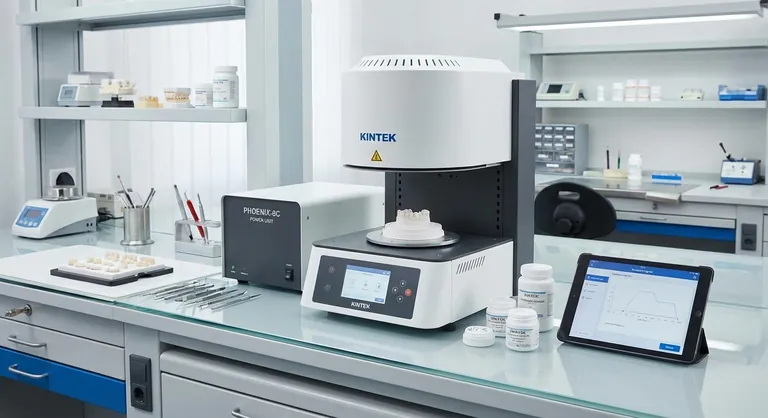
The Core Functions: What a Furnace Must Accomplish
Before examining specific features, it's essential to understand the three critical functions a furnace performs. These processes are the entire reason for the technology's existence.
Sintering: For Strength and Density
Sintering is the process of heating porcelain particles to a high temperature, just below their melting point. This causes the particles to bond and fuse, which increases the density and strength of the final restoration.
Glazing: For Aesthetics and Hygiene
Glazing involves applying a final, high-temperature firing cycle that creates a smooth, glass-like surface. This not only improves the restoration's appearance but also makes it stain-resistant and easy for the patient to clean.
Layering: For Natural Appearance
Complex restorations are built up in layers of porcelain, each with a different opacity and shade. The furnace must be able to fire each layer separately without distorting the previous ones, a critical step for achieving a natural, lifelike result.
Essential Features for Precision and Control
The quality of the final prosthetic is directly tied to the furnace's ability to execute firing cycles with absolute precision. The following features are non-negotiable for achieving consistent, high-quality results.
Digital Programmability and Program Storage
Modern furnaces are not manual. They rely on digital programs that dictate the precise heating rates, hold times, maximum temperatures, and cooling periods. The ability to store dozens or hundreds of these programs—often for specific ceramic brands—is crucial for workflow efficiency and reproducibility. USB connectivity allows for easy program transfer and backups.
High-Temperature Precision
The chemical and physical properties of dental ceramics are highly sensitive to temperature. A high-quality furnace must maintain temperature accuracy within +/- 1 degree Celsius. This precision prevents under-firing (weak restorations) or over-firing (slumping, poor fit, and unnatural glassiness).
Uniform Heat Distribution
An advanced muffle or chamber design is critical for ensuring that the entire restoration heats evenly. Uneven heating can create internal stresses, leading to warping or cracks. Look for furnaces with high-quality quartz-coiled muffles that eliminate "hot spots" and "cold spots."
Integrated Vacuum Technology
Firing porcelain under a vacuum is essential for removing air trapped between porcelain particles. This process prevents porosity (tiny bubbles) within the ceramic, which significantly increases the final strength and translucency of the restoration.
Understanding the Trade-offs and Practical Considerations
Choosing a furnace involves balancing competing priorities. There is no single "best" furnace, only the best one for a specific application.
Chamber Size vs. Lab Throughput
A larger chamber can fire more restorations at once, increasing throughput for a high-volume lab. However, a larger chamber also consumes more energy and may take longer to heat and cool. Smaller labs may benefit from a more compact design that is more energy-efficient and fits better in limited space.
Heating Rate vs. Material Integrity
A rapid heating rate (e.g., 100°C per minute) can speed up the workflow. However, some advanced ceramics can be stressed or cracked by overly aggressive heating. The furnace must offer programmable heating rates to match the specific requirements of the material being used.
Ease of Use vs. Advanced Customization
An intuitive touch-screen interface and optical status displays make a furnace easy to operate for routine tasks. However, advanced technicians working with experimental materials may require deeper access to customize every parameter of the firing cycle. The ideal furnace balances a simple user interface with the option for advanced control.
Safety and Operational Efficiency
A furnace is a powerful piece of equipment that operates at extreme temperatures, making safety and reliability paramount.
Critical Safety Mechanisms
Reliable furnaces include multiple safety redundancies. These include temperature and pressure sensors that monitor the chamber environment and an emergency shut-off to prevent overheating or other malfunctions that could damage the unit or pose a risk to the operator.
Build Quality and Durability
Look for signs of high-quality engineering, such as a precision stepper motor for the elevator lift. This ensures noise-free, vibration-free operation that won't jolt and potentially damage delicate pre-fired restorations. Overall build quality and brand reputation are strong indicators of the furnace's long-term durability.
Making the Right Choice for Your Goal
Your final decision should be guided by the specific needs of your dental practice or laboratory.
- If your primary focus is high-volume production: Prioritize a furnace with a larger chamber, a rapid and efficient cooling system, and robust program storage for quick cycle changes.
- If your primary focus is complex, aesthetic restorations: Emphasize industry-leading temperature precision, advanced vacuum control, and highly flexible programming for intricate layering work.
- If your primary focus is starting a new or small lab: Look for a reliable, compact furnace from a reputable brand that balances ease of use with the essential features of precision control and safety.
Ultimately, the right furnace is a direct investment in your ability to deliver predictable, high-quality outcomes for your patients.
Summary Table:
| Feature | Key Benefit |
|---|---|
| Digital Programmability | Ensures precise, repeatable firing cycles for consistent results |
| High-Temperature Precision | Maintains accuracy within +/- 1°C to prevent under/over-firing |
| Uniform Heat Distribution | Eliminates hot spots for even heating and reduced warping |
| Integrated Vacuum Technology | Removes air to prevent porosity, increasing strength and translucency |
| Safety Mechanisms | Includes emergency shut-off and sensors for reliable, safe operation |
Upgrade your dental lab with KINTEK's advanced high-temperature furnace solutions! Leveraging exceptional R&D and in-house manufacturing, we provide dental laboratories with precision tools like Muffle, Tube, and Vacuum & Atmosphere Furnaces, along with strong deep customization to meet your unique experimental needs. Achieve superior sintering, glazing, and layering for durable, lifelike restorations—contact us today to discuss how our furnaces can enhance your workflow and patient outcomes!
Visual Guide

Related Products
- Chairside Dental Porcelain Zirconia Sintering Furnace with Transformer for Ceramic Restorations
- Dental Porcelain Zirconia Sintering Ceramic Vacuum Press Furnace
- Vacuum Dental Porcelain Sintering Furnace for Dental Laboratories
- High Temperature Muffle Oven Furnace for Laboratory Debinding and Pre Sintering
- Spark Plasma Sintering SPS Furnace
People Also Ask
- What factors determine the quality of sintered zirconia restorations? Master Material, Equipment, and Technique
- How do conventional vs rapid sintering in dental furnaces affect zirconia? Optimize Efficiency Without Sacrificing Strength
- What industries use zirconia sintering furnaces? Beyond Dental and Jewelry Applications
- Why is a zirconia sintering furnace considered essential for dental laboratories and clinics? Unlock Precision and Durability
- What type of heating elements are preferred for zirconia sintering and why? Choose SiC or MoSi2 for Optimal Results





