
Overloading a dental sintering furnace directly causes uneven heating, which compromises the structural integrity, fit, and aesthetic quality of your final zirconia restorations. The core principle to avoid this is to ensure uniform radiant heat exposure to every surface of every unit in the chamber.
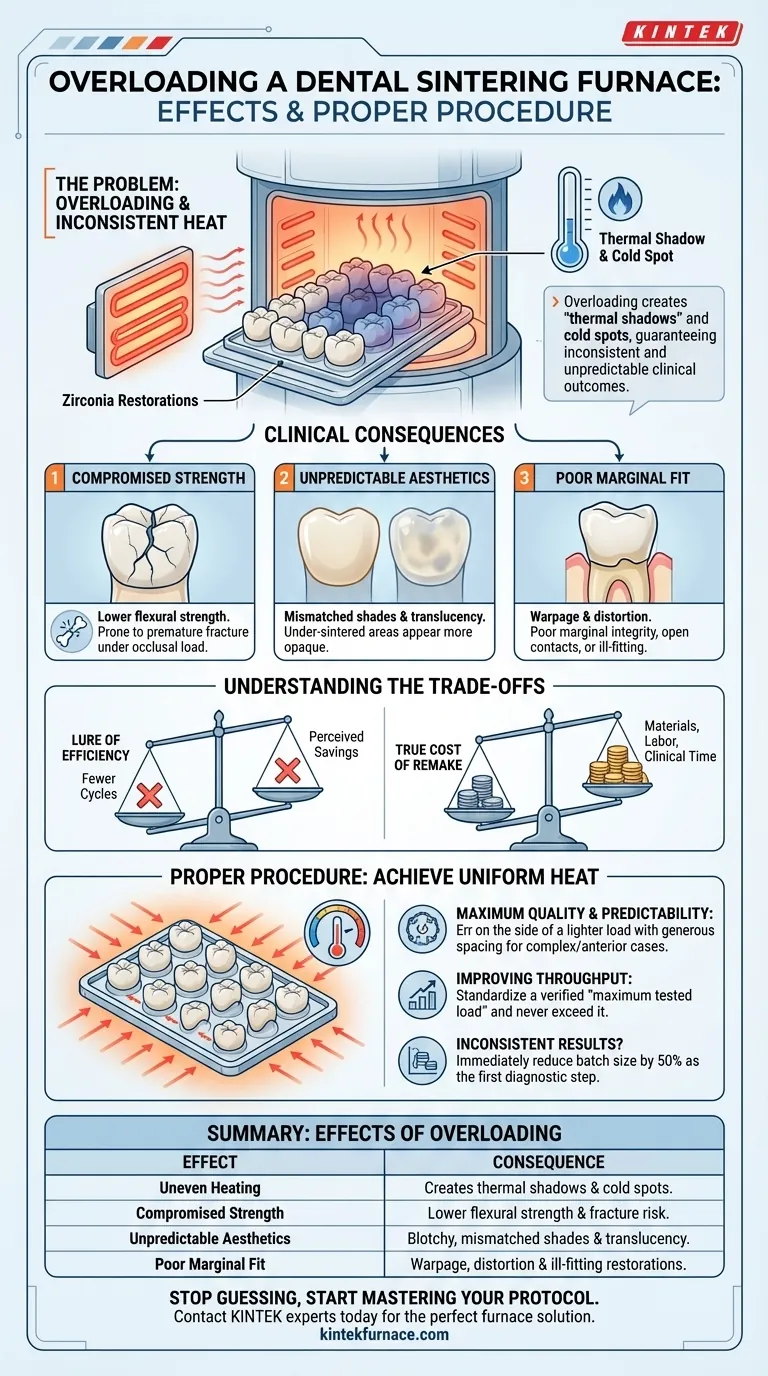
The central challenge is not simply fitting more units into the furnace, but rather managing the thermal dynamics of the chamber. Overloading creates "thermal shadows" and cold spots, guaranteeing inconsistent and unpredictable clinical outcomes.
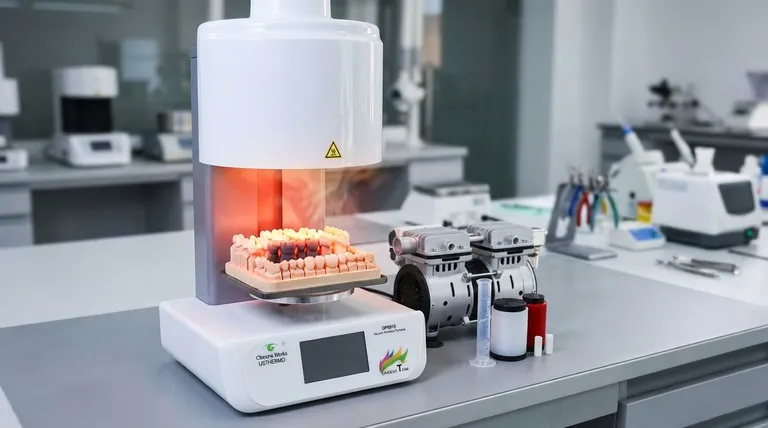
The Core Problem: Inconsistent Heat Distribution
To understand the effects of overloading, you must first understand how a sintering furnace works. It doesn't heat the air like a convection oven; it uses powerful heating elements to radiate thermal energy directly onto the restorations.
How Radiant Heat Works
A sintering furnace functions on the principle of line-of-sight heat transfer. The heating elements glow and emit infrared radiation, which travels in a straight line and is absorbed by the surface of the zirconia, causing it to heat up and densify.
The "Thermal Shadow" Effect
When you place too many restorations too close together, they physically block each other from the heating elements. The units in the center of a tightly packed cluster are "shadowed" by the outer units, receiving significantly less radiant energy.
Creating Cold Spots
This shadowing effect creates temperature gradients, or cold spots, within the sintering tray. While the furnace's thermocouple might read the target temperature, the core of an overloaded batch can be dozens of degrees cooler, preventing the restorations within from reaching full sintering density.
The Clinical Consequences of Overloading
The lack of uniform heating caused by overloading directly translates into tangible, negative clinical outcomes that lead to costly remakes and a loss of confidence in your workflow.
Compromised Flexural Strength
This is the most critical failure. Zirconia that does not reach its prescribed final sintering temperature will not achieve its full density. This results in a restoration with significantly lower flexural strength, making it prone to premature fracture under occlusal load.
Unpredictable Aesthetics
Sintering temperature has a direct and profound impact on the final shade and translucency. Under-sintered areas will appear more opaque and lighter in value, leading to blotchy, mismatched crowns that do not meet the shade prescription.
Inaccurate Marginal Fit
The sintering process involves precise, uniform shrinkage of the zirconia material. When one part of a restoration gets hotter than another, it shrinks at a different rate, leading to warpage and distortion. This results in poor marginal integrity, open contacts, or a restoration that simply will not seat.
Understanding the Trade-offs
It's tempting to maximize each furnace cycle to save time and electricity, but this perspective is often counterproductive.
The Lure of "Efficiency"
Packing a furnace seems efficient on the surface. You run fewer cycles, which appears to save on energy consumption and technician time.
The True Cost of a Remake
This perceived efficiency evaporates with a single failed case. The cost of materials, labor, and, most importantly, the clinical chair time required for a remake far exceeds any minor savings gained by overloading the furnace. A predictable, successful outcome is always more efficient.
Making the Right Choice for Your Goal
The proper procedure isn't a magic number, but a principle: prioritize adequate spacing to allow for uniform heat circulation around every single unit.
- If your primary focus is maximum quality and predictability: Always err on the side of a lighter load with generous spacing (at least 1-2 mm) between each unit, especially for complex or aesthetic anterior cases.
- If your primary focus is improving throughput: Instead of overloading, standardize a "maximum tested load" for your specific furnace that you have verified produces consistent results, and never exceed it.
- If you are currently experiencing inconsistent results: Immediately reduce your batch size by 50% as the first diagnostic step to determine if overloading is the root cause of your issues.
Mastering your sintering protocol is a foundational element of a successful digital workflow.
Summary Table:
| Effect of Overloading | Consequence |
|---|---|
| Uneven Heating | Creates thermal shadows and cold spots within the chamber. |
| Compromised Strength | Leads to lower flexural strength and risk of fracture. |
| Unpredictable Aesthetics | Causes blotchy, mismatched shades and translucency. |
| Poor Marginal Fit | Results in warpage, distortion, and ill-fitting restorations. |
Achieve predictable, high-quality sintering results every time.
Overloading your furnace is a common but costly mistake that leads to remakes and disappointed patients. The key to success is consistent, uniform heating, which requires a furnace designed for precision and reliability.
Backed by expert R&D and manufacturing, KINTEK offers Muffle, Tube, Rotary, Vacuum, and CVD systems, including lab high-temp furnaces, all customizable for unique needs. Our dental sintering furnaces are engineered to provide the uniform radiant heat essential for perfect zirconia densification, strength, and aesthetics.
Stop guessing and start mastering your sintering protocol. Contact our experts today to find the perfect furnace solution for your lab's workflow and ensure every restoration meets the highest standards.
Visual Guide
Related Products
- Dental Porcelain Zirconia Sintering Ceramic Vacuum Press Furnace
- Vacuum Dental Porcelain Sintering Furnace for Dental Laboratories
- Chairside Dental Porcelain Zirconia Sintering Furnace with Transformer for Ceramic Restorations
- High Temperature Muffle Oven Furnace for Laboratory Debinding and Pre Sintering
- Spark Plasma Sintering SPS Furnace
People Also Ask
- What factors determine the quality of sintered zirconia restorations? Master Material, Equipment, and Technique
- How do conventional vs rapid sintering in dental furnaces affect zirconia? Optimize Efficiency Without Sacrificing Strength
- What is the purpose of dental sintering furnaces? Transform Zirconia into Durable, High-Quality Dental Restorations
- What precautions should be taken when sintering zirconia in the Fast Slow Dental Sintering Furnace? Master Key Steps for Perfect Results
- What temperature range is used for sintering zirconia ceramics? Achieve Optimal Strength and Translucency















