
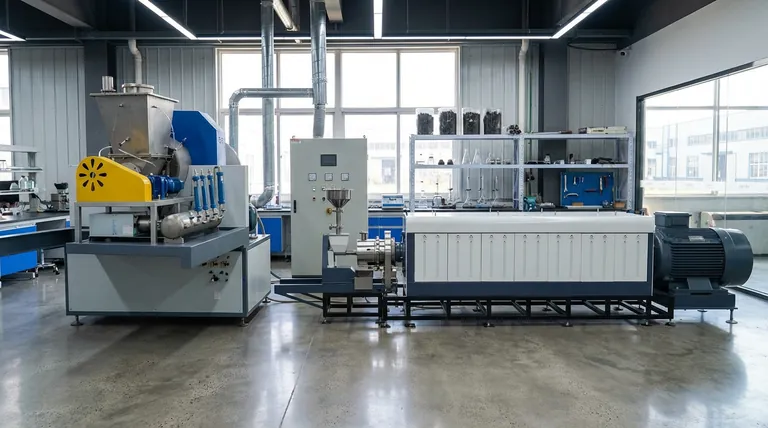
Industrial microwave heating equipment fundamentally changes the recovery process by utilizing electromagnetic waves to heat materials from the inside out. Unlike traditional furnaces that rely on slow external conduction, this technology acts directly on the internal structure to achieve complete resin removal in under 300 seconds, significantly reducing energy consumption and preserving fiber quality.
Core Takeaway The transition from external conductive heating to internal molecular heating represents a paradigm shift in efficiency. By bypassing the thermal lag of traditional furnaces, microwave systems offer a rapid, energy-efficient solution that recovers higher-quality carbon fibers with fewer surface impurities.
The Mechanics of Heating: Volumetric vs. Conductive
Internal Molecular Action
Industrial microwave systems do not rely on an external heat source to warm the air around the material. Instead, they use electromagnetic waves.
These waves act directly on the internal structure of the Carbon Fiber Reinforced Polymer (CFRP). This causes the material to generate heat from within, ensuring uniform heating at the molecular level.
The Limitations of External Conduction
Traditional pyrolysis furnaces operate on the principle of external conductive heating. Heat is applied to the outside of the material and must slowly travel inward.
This process is inherently limited by the thermal conductivity of the material. It creates a temperature gradient where the surface is hotter than the core, leading to uneven processing.
Operational Efficiency and Speed
Accelerating Heat Transfer
The primary operational advantage of microwave heating is a significant increase in the heat transfer rate.
Because the energy acts on the entire volume of the material simultaneously, the system bypasses the slow process of thermal conduction.
Rapid Resin Removal
This efficiency translates directly to processing speed. Industrial microwave equipment can achieve complete resin removal within 300 seconds.
This is a fraction of the time required by traditional methods, allowing for much higher throughput in recovery operations.
Reduced Energy Consumption
By heating the material directly rather than heating the surrounding environment (furnace chamber), the process minimizes wasted energy.
This targeted approach results in substantially lower overall energy consumption for the same volume of processed material.
Enhancing Material Quality
Minimizing Surface Contamination
A major challenge in CFRP recovery is the residue left on the fibers after the resin is removed.
Traditional furnaces often leave carbon deposits on the surface of the recovered fibers due to uneven heating or prolonged exposure to heat.
Cleaner Fiber Recovery
Microwave heating minimizes the formation of these carbon deposits.
The rapid, uniform heating ensures the resin decomposes cleanly, resulting in high-quality recovered fibers that are closer to their virgin state.
Understanding the Trade-offs: Traditional vs. Microwave
The Conductive Bottleneck
While traditional pyrolysis is a well-established technology, its reliance on conductive heating creates unavoidable inefficiencies.
Users must accept slower processing times to ensure the heat penetrates the material's core. Attempting to speed up a traditional furnace often results in overheating the surface while the center remains under-processed.
Precision vs. Brute Force
Microwave heating represents a precision approach, whereas traditional furnaces function as a "brute force" thermal method.
The "trade-off" for sticking with traditional methods is a necessary acceptance of higher energy bills and longer cycle times to achieve the same level of resin removal that microwaves accomplish in minutes.
Making the Right Choice for Your Goal
To select the right equipment for your CFRP recovery line, consider your primary constraints:
- If your primary focus is maximization of throughput: Prioritize industrial microwave systems to leverage the rapid, 300-second resin removal cycle.
- If your primary focus is fiber surface quality: Choose microwave heating to minimize carbon deposits and ensure cleaner, higher-grade recovered material.
- If your primary focus is operational sustainability: Adopting microwave technology will directly address goals regarding reduced energy consumption per unit processed.
Microwave heating moves CFRP recovery from a thermal processing challenge to a highly efficient, molecular-level solution.
Summary Table:
| Feature | Traditional Pyrolysis Furnace | Industrial Microwave Equipment |
|---|---|---|
| Heating Mechanism | External Conductive (Outside-in) | Internal Volumetric (Inside-out) |
| Processing Speed | Slow (High thermal lag) | Ultra-fast (<300 seconds) |
| Energy Efficiency | Low (Heats chamber air) | High (Direct material heating) |
| Fiber Quality | Potential carbon deposits | Clean, high-grade fiber |
| Temperature Uniformity | Uneven (Temperature gradients) | Highly uniform molecular heating |
Revolutionize Your Material Recovery with KINTEK
Maximize your laboratory or industrial throughput with cutting-edge heating solutions. KINTEK provides high-performance systems designed to overcome the limitations of traditional thermal processing.
Backed by expert R&D and manufacturing, KINTEK offers a comprehensive range of Muffle, Tube, Rotary, Vacuum, and CVD systems, along with specialized high-temp furnaces—all fully customizable to meet your unique CFRP recovery and material science needs.
Ready to reduce energy costs and improve fiber quality? Contact our technical experts today to find the perfect system for your application.
References
- Charitidis J. Panagiotis. Recycling of Carbon Fiber-Reinforced Composites-A Review. DOI: 10.48175/ijarsct-17474
This article is also based on technical information from Kintek Furnace Knowledge Base .
Related Products
People Also Ask
- What is the function of a multi-zone tube furnace in CVD synthesis? Master 2D In2Se3 Nanosheet Precision
- What environmental protection applications utilize multi zone tube furnaces? Unlock Precision in Waste Treatment and Green Tech
- What role do multi zone tube furnaces play in new energy research? Unlock Precise Thermal Control for Innovation
- What temperature-related capabilities make multi zone tube furnaces valuable for research? Unlock Precision Thermal Control
- Why are multi zone tube furnaces particularly useful for nanomaterial research? Unlock Precise Thermal Control for Advanced Synthesis
