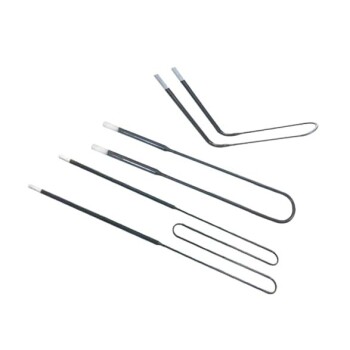
Electric furnaces with SiC elements provide the thermal precision required for low-temperature roasting of specialized clinkers. Specifically, they enable the stable growth of mineral phases like calcium sulfoaluminate and calcium ferroaluminate between 1150°C and 1200°C. This level of control results in high-quality specialized cement produced with significantly lower carbon emissions compared to traditional fossil-fuel kilns.
Core Takeaway: Silicon carbide (SiC) heating elements transform the sintering process by combining high-power density with extreme thermal stability, allowing producers to achieve precise mineralogical compositions that are nearly impossible to maintain in standard fuel-fired environments.
Precision Temperature Control for Mineral Synthesis
Facilitating SAI Clinker Roasting
Specialized sulfoaluminate-ferrite (SAI) clinkers require a specific roasting window, typically between 1150°C and 1200°C. Electric furnaces with SiC elements provide a stable environment up to 1250°C, ensuring the furnace remains well within its optimal operating range for these materials.
Phase Stability and Homogenization
The use of SiC elements creates a highly stable and uniform thermal field throughout the furnace chamber. This uniformity prevents localized hot spots, ensuring that mineral phases like calcium sulfoaluminate grow consistently and coexist without degradation.
Rapid Thermal Response
Silicon carbide possesses excellent thermal conductivity, which allows for rapid heating and cooling cycles. This responsiveness reduces total sintering time and enables operators to adjust temperatures quickly to meet strict metallurgical requirements.
Operational and Performance Benefits
High Power Density in Compact Spaces
SiC elements feature high power density, which allows them to deliver significant heat output without requiring a massive footprint. This makes them ideal for specialized production lines where space may be limited but high temperatures are essential.
Versatility in Furnacing Atmospheres
Unlike some metallic heating elements, SiC components perform reliably in both oxidizing and reducing atmospheres. This versatility is critical for cement researchers who may need to alter the chemical environment to influence the final properties of the clinker.
Clean and Quiet Operation
Electric furnaces eliminate the need for fuel storage and the management of noxious fuel exhaust. By removing the combustion process, the production environment stays cleaner and quieter, and there is no risk of fuel-based contaminants entering the cement mix.
Understanding the Trade-offs
Resistance Aging and Replacement
The electrical resistance of SiC elements increases over time as they age, a process known as "aging." To maintain balance, these elements are typically wired in parallel and often need to be replaced in pairs or complete sets to ensure uniform heating.
Contamination Risks
While SiC is chemically resistant to many corrosive gases, the elements themselves can be susceptible to certain contaminants and, in some rare cases, may cause minor contamination of the workload. Producers must monitor the furnace atmosphere to prevent chemical reactions that could shorten the element's lifespan.
Shorter Service Life at Extremes
While SiC is rated for high temperatures (up to 1600°C surface temperature), operating at the very top of its range can lead to a shorter lifespan. However, for specialized cement roasting at 1200°C, the elements are generally considered highly dependable and economical.
Making the Right Choice for Your Goal
- If your primary focus is mineral purity: Utilize the uniform thermal field of SiC elements to ensure a homogenized melt and consistent oxide fusion across the entire batch.
- If your primary focus is decarbonization: Transitioning to electric SiC heating eliminates direct CO2 emissions from fuel combustion, supporting low-carbon production targets.
- If your primary focus is process throughput: Leverage the high thermal conductivity of SiC to reduce sintering cycle times and increase the frequency of production runs.
Silicon carbide heating elements represent the technical gold standard for producers requiring the delicate balance of high heat and surgical temperature precision.
Summary Table:
| Key Feature | Benefit for Specialized Cement Production |
|---|---|
| Precision Control | Ensures stable growth of SAI clinkers between 1150°C and 1200°C. |
| Thermal Uniformity | Prevents localized hot spots for consistent mineral phase homogenization. |
| High Power Density | Delivers significant heat output within a compact laboratory footprint. |
| Atmosphere Flexibility | Performs reliably in both oxidizing and reducing chemical environments. |
| Decarbonization | Eliminates direct CO2 emissions by replacing fossil-fuel combustion. |
Elevate Your Mineral Synthesis with KINTEK Precision
Are you looking to achieve the surgical temperature precision required for high-quality specialized clinkers? KINTEK specializes in advanced laboratory equipment and consumables, offering a comprehensive range of high-temperature furnaces—including muffle, tube, rotary, vacuum, and atmosphere furnaces—all powered by high-performance SiC heating elements.
Whether you are focusing on low-carbon cement research or complex mineralogical stability, our furnaces are fully customizable to meet your unique sintering requirements.
Ready to optimize your production throughput and mineral purity? Contact KINTEK today for a tailored solution that powers your next breakthrough!
References
- Nemat R. Ruziev, Ш. С. Намазов. COMPREHENSIVE SOLUTION TO THE PROBLEM OF "CLEAN CLIMATE", ECOLOGY AND PRODUCTION OF SPECIAL TYPES OF CEMENT IN UZBEKISTAN. DOI: 10.34660/inf.2021.95.25.019
This article is also based on technical information from Kintek Furnace Knowledge Base .
Related Products
- Silicon Carbide SiC Thermal Heating Elements for Electric Furnace
- Molybdenum Disilicide MoSi2 Thermal Heating Elements for Electric Furnace
- 1400℃ Muffle Oven Furnace for Laboratory
- Electric Rotary Kiln Small Rotary Furnace for Activated Carbon Regeneration
- Multi Heating Zones CVD Tube Furnace Machine for Chemical Vapor Deposition Equipment
People Also Ask
- How do the different types of silicon carbide heating elements compare in terms of applications? Find the Best Fit for Your High-Temp Needs
- What are the temperature capabilities and mounting options for silicon carbide heating elements? Unlock High-Temp Flexibility and Durability
- How do silicon carbide heating elements enhance the heat treatment of alloys? Achieve Superior Temperature Control
- What is the recommended surface load for silicon carbide heating elements at different furnace temperatures? Maximize Lifespan & Performance
- What are the advantages of using silicon carbide heating elements in industrial furnaces? Boost Efficiency and Durability