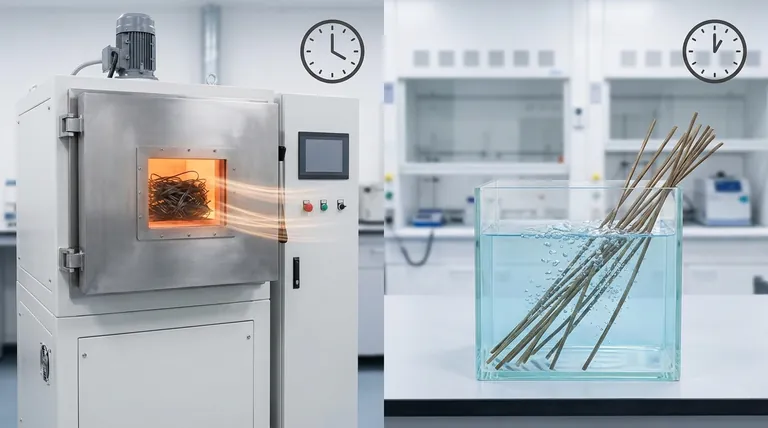
The primary advantage of using an acid oxidation bath is a massive reduction in processing time, compressing the stabilization phase from over 15 hours to just 10 minutes. This method replaces slow thermal cycling with a chemical immersion process using a 10% nitric acid solution, which rapidly introduces oxygen-containing groups to the fiber surface to ensure heat resistance.
Core Takeaway The transition from thermal furnaces to acid oxidation baths represents a shift from slow heating to rapid chemical modification. By substituting air oxidation with nitric acid immersion, manufacturers can achieve the necessary thermoset stability in minutes rather than hours, effectively removing the major bottleneck in lignin fiber production.
The Mechanics of Rapid Stabilization
Chemical Immersion vs. Air Oxidation
Traditional thermal stabilization relies on a tube furnace to provide a controlled air atmosphere. This method requires a slow heating process to facilitate the reaction between the fiber and the air.
In contrast, the acid oxidation bath utilizes a 10% nitric acid solution. By immersing the fibers directly into this liquid medium, the process bypasses the need for gradual atmospheric heating.
Acceleration of Surface Modification
The speed of the acid bath comes from its ability to chemically attack the fiber surface immediately.
The immersion introduces oxygen-containing functional groups onto the fiber surface in approximately 10 minutes. In the traditional furnace method, achieving a similar level of oxidative stabilization requires complex cycles lasting over 15 hours.
Impact on Structural Integrity
Preventing Fiber Fusion
The ultimate goal of stabilization is to convert the lignin from a thermoplastic state (which melts) to a thermoset structure (which holds its shape).
Without this step, fibers would melt, collapse, or adhere to one another during the subsequent high-temperature carbonization stage. The acid bath achieves this critical structural transition rapidly, ensuring the fibers remain distinct and intact.
Heat Resistance
The functional groups introduced by the nitric acid rapidly increase the heat resistance of the fibers.
This modification allows the fibers to withstand the intense heat of carbonization without losing their structural fidelity. This ensures that the final carbonized product maintains the desired fiber morphology.
Understanding the Operational Differences
The Production Cycle Bottleneck
The most significant limitation of the traditional thermal furnace is time. The requirement for a 15-hour cycle creates a substantial bottleneck in production throughput.
The acid bath removes this bottleneck. By reducing the time to 10 minutes, the production cycle is significantly shortened, allowing for faster throughput and potentially higher scalability.
Mechanism of Action
It is important to recognize the difference in how stability is achieved.
- Thermal Furnaces: Rely on slow cross-linking, dehydrogenation, and aromatization driven by heat and air.
- Acid Baths: Rely on aggressive chemical oxidation driven by liquid nitric acid.
Making the Right Choice for Your Goal
To optimize your lignin fiber production, consider your specific constraints:
- If your primary focus is Production Speed: Implement the acid oxidation bath to reduce stabilization time from hours to minutes and eliminate thermal bottlenecks.
- If your primary focus is Process Continuity: Ensure your workflow is designed to handle liquid chemical immersion (nitric acid) rather than dry air thermal cycling.
By leveraging the chemical efficiency of acid oxidation, you can achieve a stabilization process that is orders of magnitude faster than traditional thermal methods.
Summary Table:
| Feature | Traditional Thermal Furnace | Acid Oxidation Bath |
|---|---|---|
| Processing Time | 15+ Hours | ~10 Minutes |
| Medium | Air / Controlled Atmosphere | 10% Nitric Acid Solution |
| Mechanism | Slow Thermal Cross-linking | Rapid Chemical Surface Oxidation |
| Effect on Production | Major Bottleneck | High Throughput / Rapid Scalability |
| Structural Goal | Thermoplastic to Thermoset | Thermoplastic to Thermoset |
Revolutionize Your Material Processing with KINTEK
Is your production throughput stalled by slow stabilization cycles? At KINTEK, we understand that time is the most critical variable in lab-to-industrial scaling.
Backed by expert R&D and precision manufacturing, we offer a comprehensive range of Muffle, Tube, Rotary, Vacuum, and CVD systems, all fully customizable to meet your unique chemical or thermal processing requirements. Whether you are optimizing acid immersion workflows or advanced thermal stabilization, our high-temperature equipment provides the precision and durability needed for cutting-edge carbon fiber and material research.
Ready to eliminate your production bottlenecks? Contact KINTEK today to find your custom furnace solution
References
- Qi Hua, Scott Renneckar. Functionalized Lignin Derivatives as Melt‐Spinnable Precursors for Carbon Fiber Production without Stabilization. DOI: 10.1002/adfm.202509131
This article is also based on technical information from Kintek Furnace Knowledge Base .
Related Products
- Electric Rotary Kiln Small Rotary Furnace for Activated Carbon Regeneration
- High Temperature Muffle Oven Furnace for Laboratory Debinding and Pre Sintering
- Electric Rotary Kiln Small Rotary Furnace Biomass Pyrolysis Plant Rotating Furnace
- Stainless Steel Quick Release Vacuum Chain Three Section Clamp
- Controlled Inert Nitrogen Hydrogen Atmosphere Furnace
People Also Ask
- What are the main applications of a rotary kiln electric furnace? Achieve Uniform Heat Treatment for Powders
- What are the key components of a rotary kiln electric furnace? Unlock Efficient Thermal Processing
- What is the significance of the refractory lining in a rotary kiln electric furnace? Unlock Efficiency and Longevity
- What advantages do electric rotary kilns offer over fuel-based kilns? Boost Efficiency and Purity in Your Process
- What materials can be processed in an electric rotary kiln? Versatile Solutions for Advanced Materials