
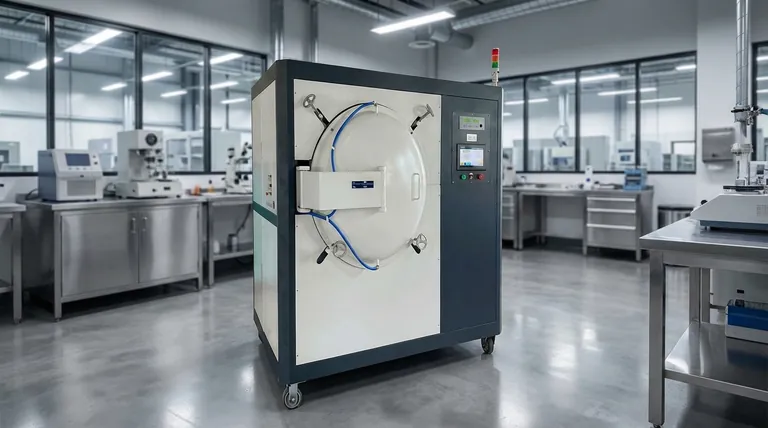
At its core, a vacuum furnace provides a level of environmental control that is simply unattainable in a traditional atmosphere-based system. Its primary advantages are the creation of a contamination-free environment that prevents oxidation, enables extremely precise temperature control and uniformity, and allows for computer-controlled processes that produce consistent, repeatable results for high-performance materials.
The fundamental advantage of a vacuum furnace isn't just one feature, but how it transforms heat treatment from a brute-force process into a precise science. By removing the reactive and unpredictable variable of atmospheric gas, you gain absolute control over the material's environment, leading to superior quality and reliability.
The Foundation: Unprecedented Purity and Control
The defining characteristic of a vacuum furnace is the removal of air and other gases. This simple act fundamentally changes the heat-treating process, moving it from an approximation to a highly controlled scientific procedure.
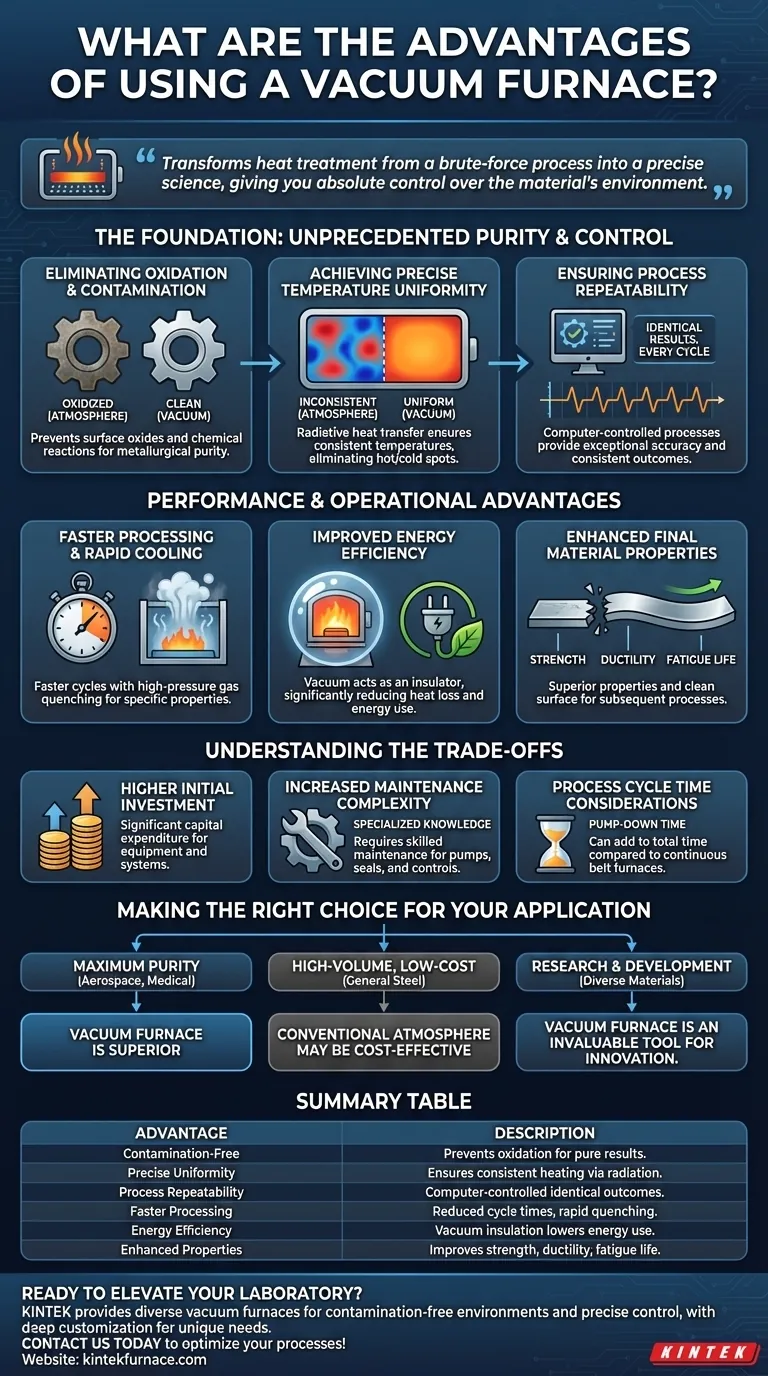
Eliminating Oxidation and Contamination
By operating at a negative pressure, a vacuum furnace removes virtually all oxygen and other reactive gases from the chamber.
This prevents the formation of oxides on the surface of a material, resulting in a clean, bright finish without the need for post-process cleaning. It also stops unwanted chemical reactions, ensuring the final product maintains its intended metallurgical purity.
Achieving Precise Temperature Uniformity
In a conventional furnace, air currents create hot and cold spots, leading to inconsistent heating. A vacuum, however, is an excellent insulator.
Heat transfer occurs primarily through radiation, which is far more uniform across the entire workload. This results in highly consistent temperatures, often within a few degrees, ensuring that every part of the component receives the exact same thermal treatment.
Ensuring Process Repeatability
With the atmosphere no longer a variable, the entire process can be managed by computer control with exceptional accuracy.
Heating rates, soak times, temperature setpoints, and cooling cycles can be programmed and executed identically every single time. This metallurgical repeatability is critical for industries like aerospace, medical, and electronics, where component failure is not an option.
Performance and Operational Advantages
The control offered by a vacuum environment directly translates into tangible benefits for performance, efficiency, and the quality of the final product.
Faster Processing and Rapid Cooling
Because there is no need to introduce and stabilize a specific gas atmosphere, the overall cycle time can be faster.
More importantly, many vacuum furnaces are equipped with high-pressure gas quenching systems. This allows for extremely rapid and controlled cooling (quenching) of the material, a critical step for developing specific hardness and strength characteristics.
Improved Energy Efficiency
The vacuum inside the furnace acts as a highly effective thermal insulator, drastically reducing heat loss to the outside environment.
This means less energy is wasted maintaining the target temperature, making vacuum furnaces more energy-efficient than many of their atmosphere-based counterparts during the heating and soaking stages.
Enhancing Final Material Properties
The combination of a pure environment, uniform heating, and controlled cooling leads to superior material properties.
Materials treated in a vacuum often exhibit enhanced strength, ductility, and fatigue life. The absence of surface contamination also improves the performance of subsequent processes like brazing or welding.
Understanding the Trade-offs
While powerful, vacuum furnaces are not the universal solution for all heat treatment needs. Objectivity requires acknowledging their specific challenges.
Higher Initial Investment
Vacuum furnaces, with their associated pumps, seals, and complex control systems, represent a significantly higher capital expenditure compared to most standard atmosphere furnaces.
Increased Maintenance Complexity
The systems required to create and maintain a high vacuum demand specialized knowledge for maintenance and repair. Seals, pumps, and instrumentation must be kept in perfect working order to ensure performance and prevent costly downtime.
Process Cycle Time Considerations
While the heating cycle can be efficient, the time required to pump the chamber down to the desired vacuum level can add to the total process time. For very high-volume, continuous operations, this pump-down time can make it a slower option than a continuous belt furnace.
Making the Right Choice for Your Application
Selecting the right furnace technology depends entirely on your process requirements, quality standards, and budget.
- If your primary focus is maximum material purity and performance (e.g., aerospace, medical devices, electronics): A vacuum furnace is the superior choice for its unparalleled control and contamination-free environment.
- If your primary focus is high-volume, low-cost treatment of standard alloys (e.g., general hardening of simple steel parts): A conventional atmosphere furnace may be a more cost-effective solution.
- If your primary focus is research, development, or processing diverse materials: The versatility and precise control of a vacuum furnace make it an invaluable tool for innovation.
Ultimately, choosing a vacuum furnace is a decision to prioritize absolute process control over all other factors.
Summary Table:
| Advantage | Description |
|---|---|
| Contamination-Free Environment | Prevents oxidation and chemical reactions for pure, clean results. |
| Precise Temperature Uniformity | Ensures consistent heating across materials via radiation. |
| Process Repeatability | Computer-controlled cycles for reliable, identical outcomes. |
| Faster Processing | Reduced cycle times with rapid gas quenching capabilities. |
| Energy Efficiency | Vacuum insulation minimizes heat loss, lowering energy use. |
| Enhanced Material Properties | Improves strength, ductility, and fatigue life of treated materials. |
Ready to elevate your laboratory's capabilities with advanced high-temperature solutions? Leveraging exceptional R&D and in-house manufacturing, KINTEK provides diverse laboratories with vacuum furnaces that deliver contamination-free environments, precise temperature control, and superior material outcomes. Our product line, including Muffle, Tube, Rotary Furnaces, Vacuum & Atmosphere Furnaces, and CVD/PECVD Systems, is complemented by strong deep customization to meet your unique experimental needs. Contact us today to discuss how we can optimize your heat treatment processes and drive innovation in your work!
Visual Guide
Related Products
- Vacuum Hot Press Furnace Machine Heated Vacuum Press Tube Furnace
- Vacuum Hot Press Furnace Machine Heated Vacuum Press
- 600T Vacuum Induction Hot Press Vacuum Heat Treat and Sintering Furnace
- 2200 ℃ Tungsten Vacuum Heat Treat and Sintering Furnace
- Vacuum Heat Treat Sintering Furnace with Pressure for Vacuum Sintering
People Also Ask
- Why use Vacuum Hot Press (VHP) for ZnS Ceramics? Achieve Superior IR Transparency and Mechanical Strength
- What safety features are incorporated in vacuum hot press furnaces? Ensure Operator and Equipment Protection
- What are the benefits of the vacuum environment system in a vacuum hot press furnace? Unlock High-Density Sintering
- What considerations guide the selection of heating elements and pressurization methods for a vacuum hot press furnace?
- What is the primary function of the vacuum environment in a vacuum hot press furnace during titanium alloy processing? Prevent Embrittlement for Superior Ductility



















