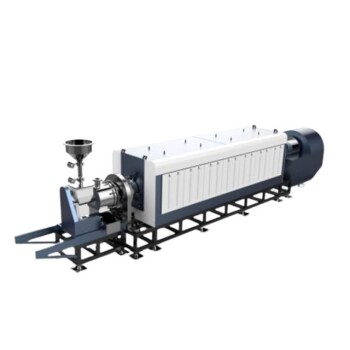
The integration of a tube furnace with a steel reactor provides a high-fidelity simulation of industrial coke ovens by combining unparalleled thermal uniformity with the structural durability required to capture and analyze volatile byproducts. This specific configuration allows researchers to replicate industrial-scale thermal profiles while maintaining a sealed environment for precise material balance analysis.
The primary advantage of this setup is the ability to achieve unmatched thermal uniformity and complete volatile recovery, ensuring that laboratory-scale data regarding gas composition and coal tar yield is both accurate and industrially relevant.
Replicating Industrial Environments
High-Pressure and Temperature Durability
Industrial coking occurs under extreme conditions that standard laboratory glassware cannot withstand. The steel reactor (retort) is specifically designed to endure high temperatures and internal pressures, mirroring the physical stresses of a large-scale coke oven.
This durability ensures the safety of the operation while allowing the reaction to proceed at the intensities required for accurate kinetic modeling.
Precision Thermal Uniformity
Tube furnaces utilize cylindrical heaters that provide 360-degree radiant heating, ensuring the reaction zone receives consistent energy from all sides. This eliminates cold spots that could lead to incomplete carbonization or unrepresentative byproduct yields.
For complex simulations, multi-zone tube furnaces can be used to create specific temperature gradients, mimicking the heat transfer characteristics found in industrial vertical or horizontal retorts.
Enhancing Analytical Accuracy
Complete Volatile Product Recovery
A critical requirement for coking research is the material balance analysis. The sealed nature of the steel reactor within the tube furnace allows for the total collection of pyrolysis gases and coal tars.
By capturing every milligram of volatile matter, engineers can perform rigorous gas composition testing and determine the exact chemical makeup of the resulting industrial-grade coke.
Atmosphere Control and Air Exclusion
To simulate true coking, the reaction must occur in the absence of oxygen to prevent combustion. These systems easily integrate inert gas purging, such as nitrogen or argon, to displace air and maintain a controlled environment.
This level of control is vital for studying how different catalysts or additives interact with coal during the pyrolysis phase without interference from atmospheric contaminants.
Understanding the Trade-offs
Material Limitations of Steel
While steel is durable, it is subject to thermal fatigue and oxidation over repeated high-temperature cycles. Depending on the alloy used, the reactor may eventually warp or develop scale, potentially contaminating sensitive samples if not regularly inspected.
Maintenance and Cleaning Requirements
Unlike open-air systems, the complete collection of tars and heavy oils means the internal plumbing and reactor walls require intensive cleaning between runs. Failure to remove residual carbon buildup can lead to flow restrictions or "coking up" of the reactor itself, which may skew the results of subsequent tests.
How to Apply This to Your Project
Making the Right Choice for Your Goal
To maximize the value of your industrial simulation, consider your primary research objective when configuring your tube furnace and reactor system.
- If your primary focus is material balance: Prioritize a reactor design that features integrated condenser units and high-precision gas flow meters to ensure every byproduct is accounted for.
- If your primary focus is thermal profiling: Utilize a multi-zone tube furnace with independent controllers to simulate the specific heat-up rates of industrial-scale oven walls.
- If your primary focus is high-throughput testing: Opt for a system with a simple, modular steel retort that can be quickly swapped and cleaned to minimize downtime between experiments.
By leveraging the structural integrity of steel and the thermal precision of the tube furnace, you can generate the high-quality data necessary to bridge the gap between laboratory discovery and industrial production.
Summary Table:
| Key Feature | Advantage for Coking Research | Industrial Relevance |
|---|---|---|
| 360° Radiant Heating | Eliminates cold spots in the reaction zone | Ensures accurate kinetic modeling |
| Steel Retort Durability | Withstands high internal pressures/temps | Replicates large-scale oven stresses |
| Sealed Environment | Captures 100% of gases and coal tars | Precise material balance analysis |
| Atmosphere Control | Integrated inert gas purging (N2/Ar) | Simulates oxygen-free pyrolysis |
| Multi-Zone Control | Customizable temperature gradients | Mimics heat transfer in vertical retorts |
Elevate Your Research with KINTEK Precision
Ready to bridge the gap between laboratory discovery and industrial production? KINTEK specializes in high-performance laboratory equipment and consumables designed for the most demanding thermal processes.
We offer a comprehensive range of high-temperature furnaces, including:
- Tube & Muffle Furnaces for precise material testing.
- Rotary, Vacuum, & CVD Furnaces for advanced chemical processing.
- Atmosphere & Induction Melting Furnaces tailored for metallurgical research.
Every KINTEK system is fully customizable to meet your unique simulation needs, ensuring you achieve the highest levels of thermal uniformity and structural integrity.
Contact our technical experts today to design a custom furnace solution that delivers accurate, industrially relevant data for your next project!
References
- А.В. Бондаренко, В.В. Левкина. СОВМЕСТНЫЙ ПИРОЛИЗ КАМЕННОУГОЛЬНОЙ ШИХТЫ И ОТХОДОВ БИОМАССЫ ДЛЯ ПРОИЗВОДСТВА МЕТАЛЛУРГИЧЕСКОГО КОКСА. DOI: 10.25699/sssb.2024.58.6.013
This article is also based on technical information from Kintek Furnace Knowledge Base .
Related Products
- Laboratory Quartz Tube Furnace RTP Heating Tubular Furnace
- Custom Made Versatile CVD Tube Furnace Chemical Vapor Deposition CVD Equipment Machine
- Slide PECVD Tube Furnace with Liquid Gasifier PECVD Machine
- Inclined Rotary Plasma Enhanced Chemical Deposition PECVD Tube Furnace Machine
- Inclined Rotary Plasma Enhanced Chemical Deposition PECVD Tube Furnace Machine
People Also Ask
- What physical conditions does a laboratory Tube Furnace provide for SOEC? Precision Heat for Solid Oxide Characterization
- What are the main features and functions of a laboratory tube furnace? Unlock Precise High-Temp Control for Your Lab
- Why is control of heating rate and gas flow in a lab tube furnace critical for EM wave absorption materials?
- Why is a laboratory tube furnace necessary for BiVO4/RGO synthesis? Achieve Precise Nano-Structure Control
- What conditions do tube furnaces provide for Au-Seeded TiO2 nanowires? Master Precision Thermal Synthesis