Peat char offers significant operational advantages over traditional charcoal when used for furnace preheating, primarily due to its distinct physical properties. By leveraging its unique porous structure, peat char can accelerate the preheating process to reduce time by approximately 50 minutes and lower overall fuel consumption by up to 22.1 percent.
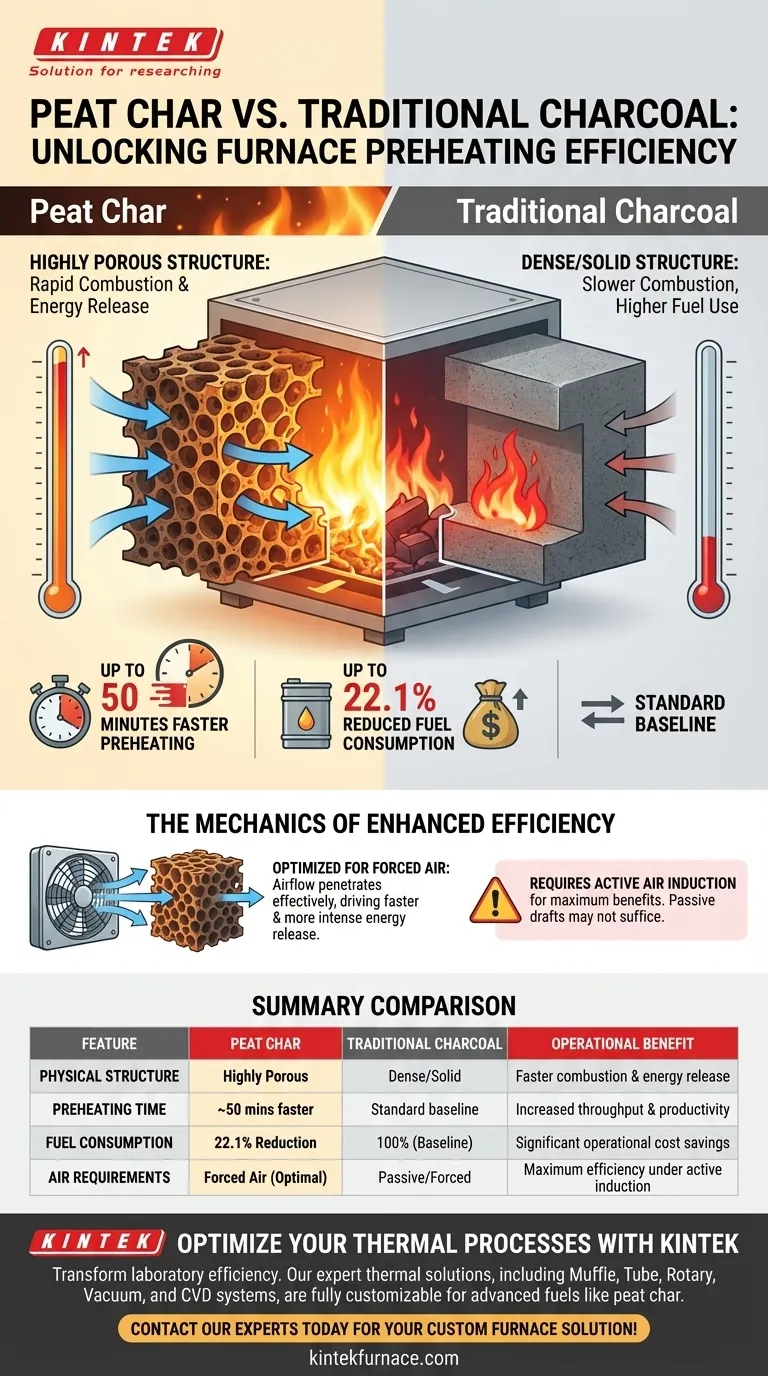
The superior efficiency of peat char stems from its high porosity, which allows for more rapid combustion and energy release, particularly when utilized under forced air conditions.
The Mechanics of Enhanced Efficiency
The Role of Porosity
The fundamental advantage of peat char lies in its unique porous structure. unlike denser fuels, this structure creates a larger surface area for combustion reactions to occur.
Optimized for Forced Air
This physical characteristic is particularly effective under forced air conditions. The airflow penetrates the porous material more effectively, driving a faster and more intense release of energy compared to traditional charcoal.
Quantifiable Operational Benefits
Accelerated Temperature Rise
In high-temperature furnace applications, time is a critical resource. The rapid combustion of peat char significantly accelerates the rise in temperature.
This acceleration translates to a reduction in preheating times of approximately 50 minutes, allowing operations to reach working temperatures much faster.
Reduced Fuel Consumption
Speed does not come at the cost of efficiency; in this case, they are correlated. Because the furnace reaches temperature more quickly, less total fuel is required for the preheating phase.
Data indicates that using peat char can decrease fuel consumption by up to 22.1 percent, offering a substantial reduction in operational costs.
Understanding the Operational Requirements
The Necessity of Forced Air
While peat char is highly efficient, the primary reference explicitly notes these benefits occur under forced air conditions.
This suggests that to fully realize the rapid temperature rise and fuel savings, the furnace setup must utilize active air induction. Systems relying solely on passive drafts may not exploit the porosity of peat char to the same degree.
Making the Right Choice for Your Goal
When evaluating fuel sources for furnace preheating, consider your specific operational constraints and priorities.
- If your primary focus is rapid turnaround: Switch to peat char to potentially shave nearly an hour off your preheating schedule.
- If your primary focus is cost reduction: Utilize peat char to lower your fuel overhead by roughly 20 percent per cycle.
- If your primary focus is equipment compatibility: Ensure your furnace utilizes forced air induction to maximize the benefits of the char's porous structure.
Leveraging the right fuel structure is the most direct path to optimizing thermal efficiency.
Summary Table:
| Feature | Peat Char | Traditional Charcoal | Operational Benefit |
|---|---|---|---|
| Physical Structure | Highly Porous | Dense/Solid | Faster combustion & energy release |
| Preheating Time | ~50 mins faster | Standard baseline | Increased throughput & productivity |
| Fuel Consumption | 22.1% Reduction | 100% (Baseline) | Significant operational cost savings |
| Air Requirements | Forced Air (Optimal) | Passive/Forced | Maximum efficiency under active induction |
Optimize Your Thermal Processes with KINTEK
Ready to transform your laboratory's efficiency? Whether you are looking to shave an hour off your heating schedule or drastically reduce fuel overhead, choosing the right equipment is vital.
KINTEK provides industry-leading thermal solutions backed by expert R&D and manufacturing. Our extensive range of Muffle, Tube, Rotary, Vacuum, and CVD systems are fully customizable to handle advanced fuels like peat char, ensuring you maximize every percent of energy efficiency.
Contact our experts today to find your custom furnace solution!
Visual Guide
References
- Paul M. Jack. Feeling the Peat: Investigating peat charcoal as an iron smelting fuel for the Scottish Iron Age. DOI: 10.54841/hm.682
This article is also based on technical information from Kintek Furnace Knowledge Base .
Related Products
- Electric Rotary Kiln Small Rotary Furnace Biomass Pyrolysis Plant Rotating Furnace
- Slide PECVD Tube Furnace with Liquid Gasifier PECVD Machine
- Electric Rotary Kiln Small Rotary Furnace for Activated Carbon Regeneration
- High Temperature Muffle Oven Furnace for Laboratory Debinding and Pre Sintering
- Multi Heating Zones CVD Tube Furnace Machine for Chemical Vapor Deposition Equipment
People Also Ask
- What are the main applications of a rotary kiln electric furnace? Achieve Uniform Heat Treatment for Powders
- What are the key components of a rotary kiln electric furnace? Unlock Efficient Thermal Processing
- What is the significance of the refractory lining in a rotary kiln electric furnace? Unlock Efficiency and Longevity
- What is the benefit of adjustable speed control in rotary kilns? Optimize Efficiency and Quality
- What are the main advantages of using rotary kilns for bulk solids processing? Achieve High-Volume, Uniform Thermal Processing