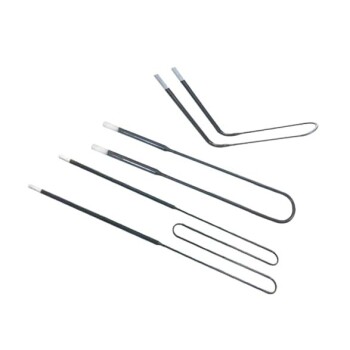
The key to reliable, high-temperature lab furnace performance is matching the heating element material to both your target temperature and the exact furnace atmosphere. Selection begins by identifying the maximum process temperature you need, then immediately checking that the element can survive—and not contaminate—your specific gas or vacuum environment. Ignoring either factor leads to early element failure, poor temperature control, and contaminated samples.
Selecting a furnace heating element is not just about peak temperature—it’s about chemical survival. Every material has a temperature ceiling and a strict set of atmospheres in which it remains stable; cross those boundaries and you trade element life for process risk.
The Two Critical Selection Factors
Choosing a heating element is a simultaneous evaluation of thermal limits and chemical compatibility. You cannot treat them as separate decisions.
Peak Operating Temperature Dictates Material Class
Each element family has a hard thermal ceiling. Metallic alloys like nichrome top out near 1200°C, while graphite can push well past 2500°C. Your process temperature immediately narrows the candidate list.
Furnace Atmosphere Determines Chemical Stability
An element that thrives in air may self-destruct under vacuum or in a reducing gas. Oxidation, carburization, nitride formation, and evaporation all change drastically with atmosphere. The same temperature in different environments can make a material either excellent or completely unsuitable.
Guide to Element Materials by Temperature and Atmosphere
Below is a practical breakdown based on the primary material families used in high‑temperature laboratory furnaces. Temperatures are maximum values under the stated conditions.
Nichrome (Ni‑Cr): The Workhorse up to ~1200°C
Nichrome operates reliably to approximately 1200°C in oxidizing, inert, or reducing atmospheres. It is the economical, low‑maintenance choice for moderate‑temperature work whenever gas composition varies.
Platinum: High‑Purity Oxidizing up to ~1400°C
Platinum elements reach approximately 1400°C in oxidizing atmospheres. They offer exceptional chemical inertness, making them ideal for clean processing where sample purity is paramount.
Silicon Carbide (SiC): Robust in Air, Sensitive to Reducing Atmospheres
Silicon Carbide can operate up to ~1450°C in oxidizing atmospheres. However, its performance drops significantly in reducing or inert conditions, where the practical limit is closer to 1250°C. Always verify atmosphere when using SiC near its upper thermal range.
Molybdenum Disilicide (MoSi₂): 1600°C in Air, but Avoid Reducing Conditions
MoSi₂ excels in oxidizing environments, achieving a maximum of ~1600°C. In inert gas it is usable to lower temperatures, but in reducing atmospheres or vacuum its limit falls to roughly 1100°C. Reserve MoSi₂ for air-rich processes.
Lanthanum Chromite (LaCrO₃): Ultra‑High Temperature Oxidizing up to 1750°C
LaCrO₃ is the premier choice for oxidizing atmospheres up to ~1750°C. It combines a high ceiling with stable electrical properties, but it is strictly an air‑environment element.
Refractory Metals (Mo, W, Ta): Vacuum/Inert Up to 2000°C and Beyond
Refractory metals collectively serve vacuum, inert, and reducing environments. Their individual limits are:
- Molybdenum (Mo): up to 1700°C
- Tungsten (W): up to 2800°C
- Tantalum (Ta): up to 2500°C
A critical rule applies to all three: above ~1500°C, avoid atmospheres containing carbon or nitrogen. Even trace amounts can form brittle carbides or nitrides that drastically shorten element life.
Graphite: The Extreme Temperature Champion
Graphite can reach ~2800°C in inert or reducing atmospheres. Under vacuum, evaporation becomes significant above approximately 1500°C, so for sustained high‑vacuum operation above that threshold, switch to an inert gas. Processes above 2000°C demand high‑purity helium (or equivalent gettered gas) to prevent oxidative attack.
Understanding the Trade‑offs and Pitfalls
Element selection is never a single‑variable decision. The most common failures come from overlooking atmosphere‑temperature interactions.
Oxidation Ruins Metals in Air
Molybdenum, tungsten, and tantalum cannot be used in oxidizing environments—molybdenum oxidizes rapidly above 600–700°C. If your process uses air, confine your choices to nichrome, platinum, SiC, MoSi₂, or LaCrO₃.
Carburization and Nitriding Degrade Refractory Metals
Even in nominally inert atmospheres, residual carbon (from binder or furnace furniture) or nitrogen can attack refractory metals above 1500°C. The resulting carbides and nitrides cause embrittlement and failure. Material purity and atmospheric control are not negotiable.
Atmosphere‑Dependent Performance of SiC and MoSi₂
SiC is outstanding in air up to 1450°C, but a reducing or inert environment caps it near 1250°C. MoSi₂’s 1600°C performance in air plummets to around 1100°C under vacuum or reducing conditions. Operating these elements in the wrong atmosphere at high temperature leads to rapid degradation.
Graphite Contamination and Vacuum Limits
Graphite can sublime significantly in high vacuum above 1500°C, coating insulation and altering electrical paths. Additionally, graphite can introduce carbon contamination into sensitive workloads. When sample purity is vital and the temperature is extreme, weigh these trade‑offs carefully.
Making the Right Choice for Your Lab Furnace
Match the element to your process goals and environment, then stay within the established boundaries for both temperature and atmosphere.
- If your primary focus is maximum temperature in air: Choose MoSi₂ (up to 1600°C) or LaCrO₃ (up to 1750°C).
- If your primary focus is ultra‑high temperature under vacuum or inert gas: Use tungsten (up to 2800°C) or graphite (up to 2800°C in inert) with strict atmospheric purity controls.
- If your primary focus is clean processing where sample purity is critical: Prefer platinum in oxidizing conditions, or refractory metals under clean vacuum/inert atmospheres, always avoiding carbide/nitride‑forming contaminants.
- If your primary focus is cost‑effective operation across multiple atmospheres up to 1200°C: Nichrome delivers reliability and simplicity without complex gas management.
- If your primary focus is high‑temperature work in reducing atmospheres: Limit SiC to below 1250°C and MoSi₂ to below 1100°C; instead consider refractory metals or graphite with appropriate gas safeguards.
Treat heating element selection as a chemical survival problem, not just a thermal one, and you’ll build a furnace that delivers stable, repeatable results for years.
Summary Table:
| Material | Max Temp | Compatible Atmospheres | Key Considerations |
|---|---|---|---|
| Nichrome (Ni-Cr) | ~1200°C | Oxidizing, Inert, Reducing | Economical, low-maintenance workhorse |
| Platinum | ~1400°C | Oxidizing | Ideal for ultra-clean processing |
| Silicon Carbide (SiC) | 1450°C (Air) / 1250°C (Red.) | Oxidizing | Performance drops significantly in reducing gases |
| Molybdenum Disilicide (MoSi₂) | 1600°C (Air) / 1100°C (Vac.) | Oxidizing | Excellent in air; degrades in vacuum/reducing conditions |
| Lanthanum Chromite (LaCrO₃) | ~1750°C | Oxidizing (Air only) | High-temperature stability in air environments |
| Refractory Metals (Mo, W, Ta) | Up to 1700°C–2800°C | Vacuum, Inert, Reducing | Rapidly oxidizes in air; avoid C/N above 1500°C |
| Graphite | ~2800°C | Inert, Reducing | Sublimes in vacuum >1500°C; risk of carbon contamination |
Optimize Your Thermal Processes with KINTEK
Need help selecting the perfect heating elements or custom furnace configuration for your critical lab applications? KINTEK specializes in premium laboratory equipment and consumables, offering a complete range of high-temperature furnaces—including muffle, tube, rotary, vacuum, CVD, atmosphere, dental, and induction melting furnaces. All of our solutions are fully customizable to meet your unique operating temperatures and atmosphere requirements.
Contact KINTEK today to discuss your thermal processing needs with our technical experts!
Related Products
- 1400℃ Muffle Oven Furnace for Laboratory
- 1400℃ High Temperature Laboratory Tube Furnace with Alumina Tube
- 1700℃ High Temperature Laboratory Tube Furnace with Alumina Tube
- 1800℃ High Temperature Muffle Oven Furnace for Laboratory
- 1700℃ High Temperature Muffle Oven Furnace for Laboratory
People Also Ask
- How does a high-temperature laboratory muffle furnace affect material properties? Transform Anodic Oxide Films Fast
- What is the primary function of a high-temperature laboratory muffle furnace in chemical synthesis? Achieve Precision.
- What is the function of a muffle furnace in MOF-derived zirconia conversion? Optimize Phase & Pore Engineering
- How does a laboratory high-temperature muffle furnace facilitate the homogenization of borosilicate glass samples? Expert Insights
- What is the purpose of using a laboratory high-temperature muffle furnace for drying Fe-Ni-Co catalysts? Boost Purity